BIBLIO is the largest independent book marketplace in the world, with over 100 million books.

Skip to content

The Return of the Native

The Return of the Native

The Return of the Native
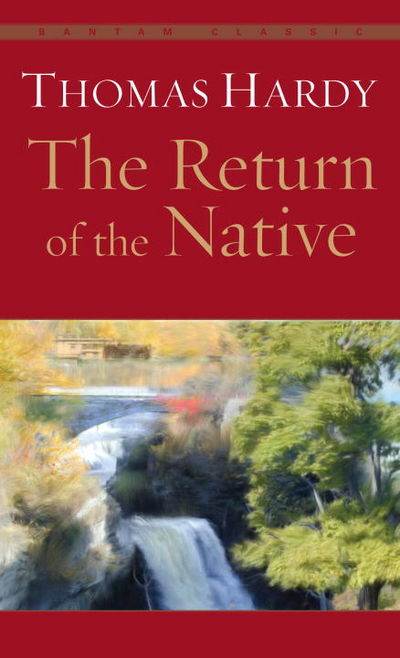
Stock photo: cover may vary

The Return of the Native Mass market paperback - 1982

by Hardy, Thomas

Add to wish list
  • Used
  • Paperback
Used - Good. No dust jacket as issued

Description

Bantam Classics, 1982. Mass-market paperback. Good. No dust jacket as issued. Mass market (rack) paperback. Glued binding. 384 p. Bantam Classic. Audience: Young adult.
Ask the seller a question Add to wish list
A$4.11
A$8.73 Delivery within USA
Standard delivery: 7 to 14 days
More delivery options
Ships from Red Rover Do Over (Wisconsin, United States)

Details

  • Title The Return of the Native
  • Author Hardy, Thomas
  • Binding Paperback
  • Edition Reprint
  • Condition Used - Good. No dust jacket as issued
  • Pages 512
  • Volumes 1
  • Language ENG
  • Publisher Bantam Classics, New York, New York, U.S.A.
  • Publication date 1982
  • Features Bibliography
  • Bookseller's Inventory # Alibris.0022157
  • ISBN 9780553212693 / 0553212699
  • Weight 0.53 lbs (0.24 kg)
  • Dimensions 6.23 x 5 x 0.83 in (15.82 x 12.70 x 2.11 cm)
  • Reading level 1040
  • Themes
    • Chronological Period: 19th Century
    • Cultural Region: British
    • Topical: Home School
  • Category Literature - Classics / Criticism
  • Library of Congress subjects Historical fiction, England - Social life and customs - 19th
  • Dewey Decimal Code FIC
  • Quantity available 1

About Red Rover Do Over Wisconsin, United States

Biblio member since 2007

bookseller with new and out of print, rare books ..

Terms of Sale:

Sellers agree to ship within 2 business days of your purchase. Domestic Standard shipments are expected to arrive within 4 to 14 business days after shipping (they may take as long as 21 business days for media).

Browse books from Red Rover Do Over

Summary

The native of the title is Clym Yeobright, who returns to the area from the bright society of Paris and, as any reader of Hardy knows, all is not smooth. He is quickly taken by and marries the one woman he should not--Eustacia Vye. The suffering that follows is mitigated somewhat by the ending.

Reader reviews for The Return of the Native

From the publisher

This fine novel sets in opposition two of Thomas Hardy's most unforgettable creations: his heroine, the sensuous, free-spirited Eustacia Vye, and the solemn, majestic stretch of upland in Dorsetshire he called Egdon Heath. The famous opening reveals the haunting power of that dark, forbidding moor where proud Eustacia fervently awaits a clandestine meeting with her lover, Damon Wildeve. But Eustacia's dreams of escape are not to be realized--neither Wildeve nor the returning native Clym Yeobright can bring her salvation.

Injured by forces beyond their control, Hardy's characters struggle vainly in the net of destiny. In the end, only the face of the lonely heath remains untouched by fate in this masterpiece of tragic passion, a tale that perfectly epitomizes the author's own unique and melancholy genius.

From the jacket flap

This fine novel sets in opposition two of Thomas Hardy's most unforgettable creations: his heroine, the sensuous, free-spirited Eustacia Vye, and the solemn, majestic stretch of upland in Dorsetshire he called Egdon Heath. The famous opening reveals the haunting power of that dark, forbidding moon where proud Eustacia fervently awaits a clandestine meeting with her lover, Damon Wildeve. But Eustacia's dreams of escape are not to be realized--neither Wildeve nor the retuming native Clym Yeobright can bring her salvation. Injured by forces beyond their control, Hardy's characters struggle vainly in the net of destiny. In the end, only the face of the lonely heath remains untouched by fate in this masterpiece of tragic passion, a tale that perfectly epitomizes the author's own unique and melancholy genius.

Excerpt

A SATURDAY afternoon in November was approaching the time of twilight, and the vast tract of unenclosed wild known as Egdon Heath embrowned itself moment by moment. Overhead the hollow stretch of whitish cloud shutting out the sky was as a tent which had the whole heath for its floor.

The heaven being spread with this pallid screen and the earth with the darkest vegetation, their meeting-line at the horizon was clearly marked. In such contrast the heath wore the appearance of an instalment of night which had taken up its place before its astronomical hour was come: darkness had to a great extent arrived hereon, while day stood distinct in the sky. Looking upwards, a furze-cutter would have been inclined to continue work; looking down, he would have decided to finish his faggot and go home. The distant rims of the world and of the firmament seemed to be a division in time no less than a division in matter. The face of the heath by its mere complexion added half an hour to evening; it could in like manner retard the dawn, sadden noon, anticipate the frowning of storms scarcely generated, and intensify the opacity of a moonless midnight to a cause of shaking dread.

In fact, precisely at this transitional point of its nightly roll into darkness the great and particular glory of the Egdon waste began, and nobody could be said to understand the heath who had not been there at such a time. It could best be felt when it could not clearly be seen, its complete effect and explanation lying in this and the succeeding hours before the next dawn: then, and only then, did it tell its true tale. The spot was, indeed, a near relation of night, and when night showed itself an apparent tendency to gravitate together could be perceived in its shades and the scene. The sombre stretch of rounds and hollows seemed to rise and meet the evening gloom in pure sympathy, the heath exhaling darkness as rapidly as the heavens precipitated it. And so the obscurity in the air and the obscurity in the land closed together in a black fraternization towards which each advanced half-way.

The place became full of a watchful intentness now; for when other things sank brooding to sleep the heath appeared slowly to awake and listen. Every night its Titanic form seemed to await something; but it had waited thus, unmoved, during so many centuries, through the crises of so many things, that it could only be imagined to await one last crisis—the final overthrow.

Media reviews

"This is the quality Hardy shares with the great writers...this setting behind the small action the terrific action of unfathomed nature."—D. H. Lawrence

About the author

Thomas Hardy, whose writing immortalized the Wessex countryside and dramatized his sense of the inevitable tragedy of life, was born at Upper Bockhampton, near Stinsford in Dorset in 1840, the eldest child of a prosperous stonemason. As a youth he trained as an architect and in 1862 obtained a post in London. During his time he began seriously to write poetry, which remained his first literary love and his last. In 1867-68, his first novel was refused publication, but Under the Greenwood Tree (1872), his first Wessex novel, did well enough to convince him to continue writing. In 1874, Far from the Maddening Crowd, published serially and anonymously in the Cornhill Magazine, became a great success. Hardy married Emma Gifford in 1878, and in 1885 they settled at Max Gate in Dorchester, where he lived the rest of his life. There he had wrote The Return of the Native (1878), The Mayor of Casterbridge (1886), Tess of the d'Urbervilles (1891), and Jude the Obscure (1895).

With Tess, Hardy clashed with the expectations of his audience; a storm of abuse broke over the "infidelity" and "obscenity" of this great novel he had subtitled "A Pure Woman Faithfully Presented." Jude the Obscure aroused even greater indignation and was denounced as pornography. Hardy's disgust at the reaction to Jude led him to announce in 1869 that he would never write fiction ever again. He published Wessex Poems in 1898, Poems of the Past and Present in 1901, and from 1903 to 1908, The Dynast, a huge drama in which Hardy's conception of the Immanent Will, implicit in the tragic novels, is most clearly stated.

In 1912 Hardy's wife, Emma died. The marriage was childless and had been a troubled one, but in the years after her death, Hardy memorialized her in several poems. At seventy-four he married his longtime secretary, Florence Dugdale, herself a writer of children's books and articles, with whom he live happily until his death in 1928. His heart was buried in the Wessex Countryside; his ashes were placed next to Charles Dickens's in the Poet's Corner of Westminster Abbey.

tracking-