
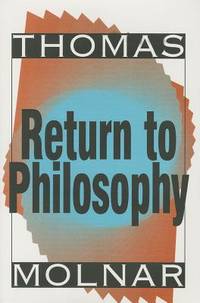
Stock photo: cover may vary
Return to Philosophy Hardback - 1996
by Molnar, Thomas
- Used
- Hardback
- first
A$429.90
A$21.65
Delivery within USA
Standard delivery: 12 to 14 days
More delivery options
Standard delivery: 12 to 14 days
Dropship order
Ships from Ergodebooks (Texas, United States)
Details
- Title Return to Philosophy
- Author Molnar, Thomas
- Binding Hardback
- Edition 1
- Condition Used: Good
- Pages 120
- Volumes 1
- Language ENG
- Publisher Routledge, Somerset, New Jersey, U.S.A.
- Publication date 1996-01-30
- Features Bibliography, Dust Cover, Index, Table of Contents
- Bookseller's Inventory # SONG1560002514
- ISBN 9781560002512 / 1560002514
- Weight 0.85 lbs (0.39 kg)
- Dimensions 9.2 x 6.2 x 0.6 in (23.37 x 15.75 x 1.52 cm)
- Size 6.50x0.50x9.50
-
Themes
- Chronological Period: Modern
- Category Philosophy
- Library of Congress Catalogue Number 96000408
- Dewey Decimal Code 100
- Quantity available 1
About Ergodebooks Texas, United States
Biblio member since 2005
Our goal is to provide best customer service and good condition books for the lowest possible price. We are always honest about condition of book. We list book only by ISBN # and hence exact book is guaranteed.
We have 30 day return policy.
Reader reviews for Return to Philosophy
Write a review for this book
Important Terms and Guidelines
- Please focus on the book’s content and context. Also, add any personal comments as to how you enjoyed the book. Substantiate your likes and dislikes. You may make comparisons to other books.
- Reviews must be at least 140 characters in length.
- Please do not reveal critical plot elements.
- This is not a help line. Contact customer support if you need help.
Your review must not include:
- Obscenities, discriminatory language, or other insulting language not suitable for public domain
- Advertisements, “spam” content, or references to other products, offers or websites.
- Email addresses, URLs, phone numbers, physical addresses or other contact information.
- Overly critical comments about other reviews or reviewers
- Time-sensitive material (i.e. promotional tours, seminars, lectures, etc.)
- Availability, price, or alternative ordering/shipping information
From the publisher
From the rear cover
From its earliest beginnings and through much of its history, the philosophical enterprise has rooted its intellectual procedures in common sense. Ordinary discourse is what the pre-Socratic thinkers did at the dawn of speculation. The same approach was characteristic of the medieval mystics, Pascal in the seventeenth century, and Gaston Bachelard in the twentieth century. However with the ascendency of the physical sciences, mathematics, and depth psychology as influences in contemporary thought, philosophical language and forms of expression became increasingly distant from ordinary language. This created estrangement and confusion in the learner's mind. In Return to Philosophy Thomas Molnar diagnoses the verbal derailment of philosophy shows how it might be reconnected to the realities of human life. Return to Philosophy is a unique endeavor. Molnar's book unmasks the modern derailment and shows that many leading philosophers do not so much philosophize, but merely elaborate verbal-technical instruments in what may be little more than trivial language games. This volume will be of interest to philosophers, cultural historians, and sociologists.

