BIBLIO is the largest independent book marketplace in the world, with over 100 million books.

Skip to content

Risk of General Artificial Intelligence

Risk of General Artificial Intelligence

Risk of General Artificial Intelligence
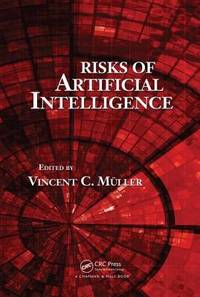
Stock photo: cover may vary

Risk of General Artificial Intelligence Hardback -

by MULLER VINCENT C.

Add to wish list
  • New
  • Hardback
New

Description

Taylor & Francis Group , pp. 320 . Hardback. New.
Ask the seller a question Add to wish list
A$330.44
A$5.79 Delivery within USA
Standard delivery: 9 to 14 days
More delivery options
Ships from Cold Books (New York, United States)

Details

  • Title Risk of General Artificial Intelligence
  • Author MULLER VINCENT C.
  • Binding Hardback
  • Condition New
  • Pages 291
  • Language ENG
  • Publisher Taylor & Francis Group
  • Publication date pp. 320
  • Features Illustrated, Index
  • Bookseller's Inventory # 6372493879
  • ISBN 9781498734820
  • Quantity available 4

About Cold Books New York, United States

Biblio member since 2012

Terms of Sale: 30 day return guarantee, with full refund including shipping costs for up to 30 days after delivery if an item arrives misdescribed or damaged.

Browse books from Cold Books

Reader reviews for Risk of General Artificial Intelligence

From the publisher

If the intelligence of artificial systems were to surpass that of humans, humanity would face significant risks. The time has come to consider these issues, and this consideration must include progress in artificial intelligence (AI) as much as insights from AI theory.

Featuring contributions from leading experts and thinkers in artificial intelligence, Risks of Artificial Intelligence is the first volume of collected chapters dedicated to examining the risks of AI. The book evaluates predictions of the future of AI, proposes ways to ensure that AI systems will be beneficial to humans, and then critically evaluates such proposals.
The book covers the latest research on the risks and future impacts of AI. It starts with an introduction to the problem of risk and the future of artificial intelligence, followed by a discussion (Armstrong/Sokala/higeartaigh) on how predictions of its future have fared to date.

Omohundro makes the point that even an innocuous artificial agent can easily turn into a serious threat for humans. T. Goertzel explains how to succeed in the design of artificial agents. But will these be a threat for humanity, or a useful tool? Ways to assure beneficial outcomes through 'machine ethics' and 'utility functions' are discussed by Brundage and Yampolskiy.

B. Goertzel and Potapov/Rodionov propose 'learning' and 'empathy' as paths towards safer AI while Kornai explains how the impact of AI may be bounded. Sandberg explains the implications of human-like AI via the technique of brain emulation. Dewey discusses strategies to deal with the 'fast takeoff' of artificial intelligence and, finally, Bishop explains why there is no need to worry because computers will remain in a state of 'artificial stupidity'.

Sharing insights from leading thinkers in artificial intelligence, this book provides you with an expert-level perspective of what is on the horizon for AI, whether it will be a threat for humanity, and how we might counteract this threat.

Media reviews

Citations

  • Choice, 08/01/2016, Page 0

About the author

Vincent C. Mller's research focuses on the nature and future of computational systems, particularly on the prospects and dangers of artificial intelligence. He is the president of the European Association for Cognitive Systems and was the coordinator of the European Network for Cognitive Systems, Robotics and Interaction, which has nearly 1000 members and is funded by the European Commission through two FP7 projects worth 3.9 million over 2009-2014 (www.eucognition.org). He organizes a conference series, Theory and Philosophy of AI (www.pt-ai.org), and is the principal investigator of a European Commission-funded research project Digital DIY. He is currently working as professor of philosophy, Division of Humanities & Social Sciences, Anatolia College/ACT, Pylaia-Thessaloniki, Greece.

tracking-