
Stock photo: cover may vary
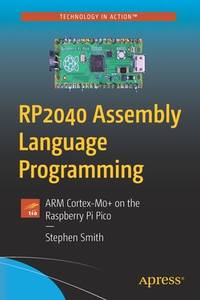
RP2040 Assembly Language Programming: ARM Cortex-M0+ on the Raspberry Pi Pico Paperback -
by Smith, Stephen
- Used
- Good
- Paperback
A$93.27
Free Delivery within USA
Standard delivery: 7 to 14 days
More delivery options
Standard delivery: 7 to 14 days
Dropship order
Ships from Bonita (California, United States)
Details
- Title RP2040 Assembly Language Programming: ARM Cortex-M0+ on the Raspberry Pi Pico
- Author Smith, Stephen
- Binding Paperback
- Condition Used - Good
- Pages 320
- Volumes 1
- Language ENG
- Publisher Apress
- Illustrated Yes
- Bookseller's Inventory # 148427752X.G
- ISBN 9781484277522 / 148427752X
- Weight 1.07 lbs (0.49 kg)
- Dimensions 9.25 x 6.1 x 0.72 in (23.50 x 15.49 x 1.83 cm)
- Category Computers - General Information
- Quantity available 1
About Bonita California, United States
Reader reviews for RP2040 Assembly Language Programming: ARM Cortex-M0+ on the Raspberry Pi Pico
Write a review for this book
Important Terms and Guidelines
- Please focus on the book’s content and context. Also, add any personal comments as to how you enjoyed the book. Substantiate your likes and dislikes. You may make comparisons to other books.
- Reviews must be at least 140 characters in length.
- Please do not reveal critical plot elements.
- This is not a help line. Contact customer support if you need help.
Your review must not include:
- Obscenities, discriminatory language, or other insulting language not suitable for public domain
- Advertisements, “spam” content, or references to other products, offers or websites.
- Email addresses, URLs, phone numbers, physical addresses or other contact information.
- Overly critical comments about other reviews or reviewers
- Time-sensitive material (i.e. promotional tours, seminars, lectures, etc.)
- Availability, price, or alternative ordering/shipping information
From the publisher
From the rear cover
Learn to program the Raspberry Pi Pico's dual ARM Cortex M0+ CPUs in Assembly Language. The Pico contains a customer System on a Chip (SoC) called the RP2040, making it the Foundation's first entry into the low-cost microcontroller market. The RP2040 contains a wealth of coprocessors for performing arithmetic as well as performing specialized I/O functionality. This book will show you how these CPUs work from a low level, easy-to-learn perspective.
There are eight new Programmable I/O (PIO) coprocessors that have their own specialized Assembly Language supporting a wide variety of interface protocols. You'll explore these protocols and write programs or functions in Assembly Language and interface to all the various bundled hardware interfaces. Then go beyond working on your own board and projects to contribute to the official RP2040 SDK. Finally, you'll take your DIY hardware projects to the next level of performance and functionalitywith more advanced programming skills. You will:
There are eight new Programmable I/O (PIO) coprocessors that have their own specialized Assembly Language supporting a wide variety of interface protocols. You'll explore these protocols and write programs or functions in Assembly Language and interface to all the various bundled hardware interfaces. Then go beyond working on your own board and projects to contribute to the official RP2040 SDK. Finally, you'll take your DIY hardware projects to the next level of performance and functionalitywith more advanced programming skills. You will:
- Read and understand the Assembly Language code that is part of the Pico's SDK
- Integrate Assembly Language and C code together into one program
- Interface to available options for DIY electronics and IoT projects

