
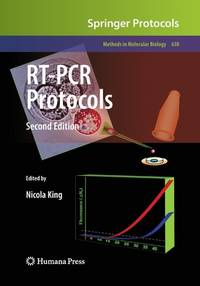
Stock photo: cover may vary
RT-PCR Protocols: Second Edition (Methods in Molecular Biology (630)) Papeback -
by Nicola King (Editor)
- New
A$265.63
A$5.87
Delivery within USA
Standard delivery: 9 to 14 days
More delivery options
Standard delivery: 9 to 14 days
Ships from Cold Books (New York, United States)
Details
- Title RT-PCR Protocols: Second Edition (Methods in Molecular Biology (630))
- Author Nicola King (Editor)
- Binding Papeback
- Condition New
- Pages 341
- Volumes 1
- Language ENG
- Publisher Humana Press
- Publication date pp. 352
- Illustrated Yes
- Features Illustrated
- Bookseller's Inventory # 6379977665
- ISBN 9781493956821 / 1493956825
- Weight 1.36 lbs (0.62 kg)
- Dimensions 10 x 7 x 0.74 in (25.40 x 17.78 x 1.88 cm)
- Category Medical / Nursing
- Dewey Decimal Code 572.43
- Quantity available 4
About Cold Books New York, United States
Reader reviews for RT-PCR Protocols: Second Edition (Methods in Molecular Biology (630))
Write a review for this book
Important Terms and Guidelines
- Please focus on the book’s content and context. Also, add any personal comments as to how you enjoyed the book. Substantiate your likes and dislikes. You may make comparisons to other books.
- Reviews must be at least 140 characters in length.
- Please do not reveal critical plot elements.
- This is not a help line. Contact customer support if you need help.
Your review must not include:
- Obscenities, discriminatory language, or other insulting language not suitable for public domain
- Advertisements, “spam” content, or references to other products, offers or websites.
- Email addresses, URLs, phone numbers, physical addresses or other contact information.
- Overly critical comments about other reviews or reviewers
- Time-sensitive material (i.e. promotional tours, seminars, lectures, etc.)
- Availability, price, or alternative ordering/shipping information
From the publisher
From the rear cover
Once a tedious, highly skilled operation, reverse-transcription polymerase chain reaction (RT-PCR) has become a routine and invaluable technique used in most laboratories. In RT-PCR Protocols, Second Edition, expert researchers fully update the technologies presented in the popular previous edition, such as competitive RT-PCR, nested RT-PCR, RT-PCR from single cells, and RT-PCR for cloning. In addition, newer technologies are also explored, including multiplex RT-PCR, RT-LATE-PCR, and the greatly advanced field of real-time quantitative RT-PCR, while recent advances in creating the optimum RT-PCR reaction, e.g. RNA extraction, primer design, and reverse transcription, end the book with their indispensable input. Written in the highly successful Methods in Molecular Biology(TM) series format, chapters include brief introductions to their respective topics, lists of the necessary materials and reagents, step-by-step, readily reproducible protocols, and notes sections, highlighting tips on troubleshooting and avoiding known pitfalls.
User friendly and up-to-date, RT-PCR Protocols, Second Edition acts as a handy companion to scientists from numerous diverse backgrounds who wish to explore further the marvels of gene expression.

