
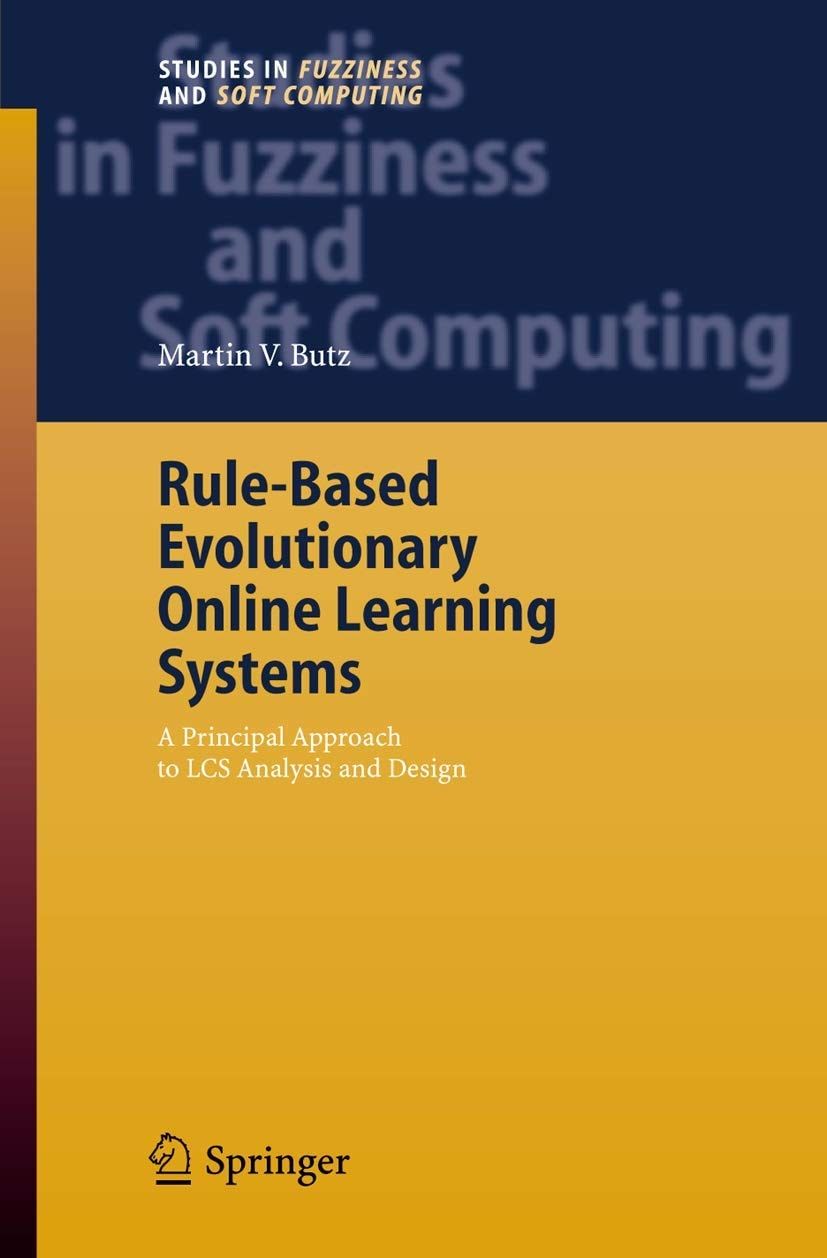
Rule-Based Evolutionary Online Learning Systems: A Principled Approach to LCS Analysis and Design (Studies in Fuzziness and Soft Computing, 191). Hardback - 2005 - 2006th Edition
by Butz, Martin V
- Used
- Hardback
A$209.94
A$33.32
Delivery to USA
Standard delivery: 7 to 21 days
More delivery options
Standard delivery: 7 to 21 days
Ships from Lange & Springer Antiquariat (Germany)
Details
- Title Rule-Based Evolutionary Online Learning Systems: A Principled Approach to LCS Analysis and Design (Studies in Fuzziness and Soft Computing, 191).
- Author Butz, Martin V
- Binding Hardback
- Edition number 2006th
- Edition 2006
- Pages 280 pages
- Volumes 1
- Language ENG
- Publisher Springer, in Stock: we Ship at Once fr. IL USA;
- Publication date 2005
- Bookseller's Inventory # 6778VB
- ISBN 9783540253792 / 3540253793
- Weight 1.29 lbs (0.59 kg)
- Dimensions 9.21 x 6.14 x 0.69 in (23.39 x 15.60 x 1.75 cm)
- Category Mathematics
- Library of Congress Catalogue Number 2005932567
- Dewey Decimal Code 006.31
About Lange & Springer Antiquariat Germany
Specialising in: Astrology, Chemistry, Engineering, Humanities, Mathematics, Medicine, Natural Science, Old and rare scientific books
Biblio member since 2025
Lange & Springer Antiquariat (est. 1816) is a long-established scientific antiquarian bookstore based in Berlin. We specialize in rare and scholarly books spanning the sciences, medicine, mathematics, engineering, and the humanities — from historically significant early works to modern academic literature. Our curated selection includes antiquarian treasures as well as contemporary academic titles for researchers, collectors, and institutions worldwide.
Reader reviews for Rule-Based Evolutionary Online Learning Systems: A Principled Approach to LCS Analysis and Design (Studies in Fuzziness and Soft Computing, 191).
Write a review for this book
Important Terms and Guidelines
- Please focus on the book’s content and context. Also, add any personal comments as to how you enjoyed the book. Substantiate your likes and dislikes. You may make comparisons to other books.
- Reviews must be at least 140 characters in length.
- Please do not reveal critical plot elements.
- This is not a help line. Contact customer support if you need help.
Your review must not include:
- Obscenities, discriminatory language, or other insulting language not suitable for public domain
- Advertisements, “spam” content, or references to other products, offers or websites.
- Email addresses, URLs, phone numbers, physical addresses or other contact information.
- Overly critical comments about other reviews or reviewers
- Time-sensitive material (i.e. promotional tours, seminars, lectures, etc.)
- Availability, price, or alternative ordering/shipping information
From the publisher
From the rear cover
This book offers a comprehensive introduction to learning classifier systems (LCS) - or more generally, rule-based evolutionary online learning systems. LCSs learn interactively - much like a neural network - but with an increased adaptivity and flexibility. This book provides the necessary background knowledge on problem types, genetic algorithms, and reinforcement learning as well as a principled, modular analysis approach to understand, analyze, and design LCSs. The analysis is exemplarily carried through on the XCS classifier system - the currently most prominent system in LCS research. Several enhancements are introduced to XCS and evaluated. An application suite is provided including classification, reinforcement learning and data-mining problems. Reconsidering John Holland's original vision, the book finally discusses the current potentials of LCSs for successful applications in cognitive science and related areas.

