
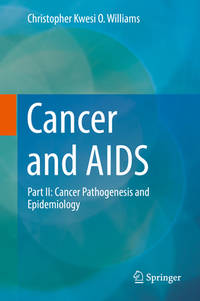
Stock photo: cover may vary
Cancer and AIDS: Part II: Cancer Pathogenesis and Epidemiology Papeback -
by Christopher Kwesi Williams
- New
A$281.42
A$5.87
Delivery within USA
Standard delivery: 9 to 14 days
More delivery options
Standard delivery: 9 to 14 days
Ships from Cold Books (New York, United States)
Details
- Title Cancer and AIDS: Part II: Cancer Pathogenesis and Epidemiology
- Author Christopher Kwesi Williams
- Binding Papeback
- Condition New
- Pages 180
- Volumes 1
- Language ENG
- Publisher Springer
- Publication date
- Bookseller's Inventory # 6384028524
- ISBN 9783319992341 / 3319992341
- Weight 1.17 lbs (0.53 kg)
- Dimensions 9.25 x 6.1 x 0.5 in (23.50 x 15.49 x 1.27 cm)
- Category Medical / Nursing
- Dewey Decimal Code 330.9
- Quantity available 4
About Cold Books New York, United States
Reader reviews for Cancer and AIDS: Part II: Cancer Pathogenesis and Epidemiology
Write a review for this book
Important Terms and Guidelines
- Please focus on the book’s content and context. Also, add any personal comments as to how you enjoyed the book. Substantiate your likes and dislikes. You may make comparisons to other books.
- Reviews must be at least 140 characters in length.
- Please do not reveal critical plot elements.
- This is not a help line. Contact customer support if you need help.
Your review must not include:
- Obscenities, discriminatory language, or other insulting language not suitable for public domain
- Advertisements, “spam” content, or references to other products, offers or websites.
- Email addresses, URLs, phone numbers, physical addresses or other contact information.
- Overly critical comments about other reviews or reviewers
- Time-sensitive material (i.e. promotional tours, seminars, lectures, etc.)
- Availability, price, or alternative ordering/shipping information
From the publisher
From the rear cover
This series of books is about the nature of cancer and retroviral diseases, including AIDS, their presentation and the challenges associated with their control, especially in the low- and middle-income countries. Anxiety about these diseases is a global phenomenon, and so also is the confusion about their origins. Studies of Egyptian mummies in paleopathology have documented the ancient occurrence of cancer, but not for AIDS and allied disorders, for which a role of modern lifestyle is more likely. These diseases share a background of worldwide variability of opulence and poverty, rather than heredity, in their manifestation and control.
This book covers the role of the global economy and its disparities, resulting in the variability of human development factors and their role in shaping the pathogenesis and epidemiology of cancer and HIV/AIDS as well as other retroviral diseases. It also covers the local, regional and international responses, or lack thereof, to these challenges.
Much of the information on oncology concentrates on the nature of the disease in the in developed countries, where emphasis tends to be on adult cancers, and less so on those of childhood and adolescence, an important population group in countries of limited resources. Furthermore, much of the available cancer control information reflects expensive and often-unaffordable curative practices of well-endowed nations, rather than public health approaches, which may be more relevant and appropriate for much of the rest of the world.
This book is the work of an extensively traveled oncologist and human retrovirology enthusiast with an international educational and professional background in resource poor and developed countries, who therefore, is able to compare and contrast health related observations and challenges in diverse settings.
Practicing and academic physicians in the emerging economies of Eastern Europe, Asia, South America and Africa, who are facing the challenge of cancer and AIDS as their populations transition from traditional to more affluent lifestyles, will find this series of books particularly informative. Oncologists, retrovirologists and others in developed countries, who are concerned about the global impact of cancer and AIDS, and are promoting related global health interventions, should read this collection, the topic of which is also relevant to officials of international agencies and resource-limited national public health policy units.

