
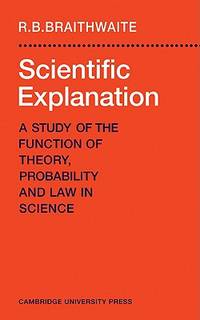
Stock photo: cover may vary
Scientific Explanation: A Study of the Function of Theory, Probability and Law in Science Paperback - 1968
by Braithwaite, Richard Bevan
- Used
- Good
- Paperback
A$14.23
A$7.25
Delivery within USA
Standard delivery: 3 to 10 days
More delivery options
Standard delivery: 3 to 10 days
Details
- Title Scientific Explanation: A Study of the Function of Theory, Probability and Law in Science
- Author Braithwaite, Richard Bevan
- Binding Paperback
- Edition First Paperback
- Condition Used - Good
- Pages 392
- Volumes 1
- Language ENG
- Publisher Cambridge University Press, London
- Publication date 1968-05-01
- Illustrated Yes
- Features Bibliography, Illustrated
- Bookseller's Inventory # 2103220065
- ISBN 9780521094429 / 0521094429
- Weight 0.93 lbs (0.42 kg)
- Dimensions 8 x 5 x 0.87 in (20.32 x 12.70 x 2.21 cm)
- Category Philosophy
- Library of Congress subjects Science - Methodology
- Library of Congress Catalogue Number 68102638
- Dewey Decimal Code 501
- Quantity available 1
About SequiturBooks Maryland, United States
Specialising in: African Studies, Classical Studies, Early Printings, History, History Of Ideas, Philosophy, Science, Social Science
Biblio member since 2008


Sequitur Books is an independent academic bookstore. We pride ourselves on a thought provoking selection, with extensive collections in Art, philosophy, American and World history, social science, African studies, Near Eastern studies, and physical science. Our motto, "For every person, a good book!"
Customers may return ordered books for any reason within 14 days of receipt. We will pay the return shipping costs if the return is a result of our error. Shipping fees and handling fees may be charged to the customer if the return is the result of customer error. Open box charges may be applied for new books that are opened by customers (i.e. the shrink wrap is removed or there is obvious signs of wear.)
Reader reviews for Scientific Explanation: A Study of the Function of Theory, Probability and Law in Science
Write a review for this book
Important Terms and Guidelines
- Please focus on the book’s content and context. Also, add any personal comments as to how you enjoyed the book. Substantiate your likes and dislikes. You may make comparisons to other books.
- Reviews must be at least 140 characters in length.
- Please do not reveal critical plot elements.
- This is not a help line. Contact customer support if you need help.
Your review must not include:
- Obscenities, discriminatory language, or other insulting language not suitable for public domain
- Advertisements, “spam” content, or references to other products, offers or websites.
- Email addresses, URLs, phone numbers, physical addresses or other contact information.
- Overly critical comments about other reviews or reviewers
- Time-sensitive material (i.e. promotional tours, seminars, lectures, etc.)
- Availability, price, or alternative ordering/shipping information

