
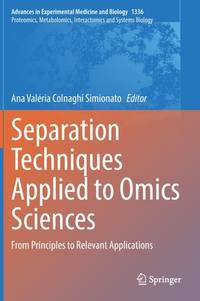
Stock photo: cover may vary
Separation Techniques Applied to Omics Sciences: From Principles to Relevant Applications (Advances in Experimental Medicine and Biology, 1336) Hardback - 2021
- New
- Hardback
A$439.21
A$5.85
Delivery within USA
Standard delivery: 9 to 14 days
More delivery options
Standard delivery: 9 to 14 days
Ships from Cold Books (New York, United States)
Details
- Title Separation Techniques Applied to Omics Sciences: From Principles to Relevant Applications (Advances in Experimental Medicine and Biology, 1336)
- Binding Hardback
- Condition New
- Publication date 1st ed. 2021 edition NO-PA1
- Features Illustrated
- Bookseller's Inventory # 6390045090
- ISBN 9783030772512
- Quantity available 4
About Cold Books New York, United States
Reader reviews for Separation Techniques Applied to Omics Sciences: From Principles to Relevant Applications (Advances in Experimental Medicine and Biology, 1336)
Write a review for this book
Important Terms and Guidelines
- Please focus on the book’s content and context. Also, add any personal comments as to how you enjoyed the book. Substantiate your likes and dislikes. You may make comparisons to other books.
- Reviews must be at least 140 characters in length.
- Please do not reveal critical plot elements.
- This is not a help line. Contact customer support if you need help.
Your review must not include:
- Obscenities, discriminatory language, or other insulting language not suitable for public domain
- Advertisements, “spam” content, or references to other products, offers or websites.
- Email addresses, URLs, phone numbers, physical addresses or other contact information.
- Overly critical comments about other reviews or reviewers
- Time-sensitive material (i.e. promotional tours, seminars, lectures, etc.)
- Availability, price, or alternative ordering/shipping information
From the publisher
From the rear cover
This book covers liquid chromatography, gas chromatography and capillary electrophoresis, the three main separation techniques lately available, applied to key omic sciences, such as genomics, proteomics, metabolomics and foodomics. The fundamentals of each technique are not covered herein. Instead, the recent advances in such techniques are presented focusing on the application to omics analyses and unique aspects in each case. This volume intends to offer wide ranging options available to researchers on omics sciences, and how to integrate them in order to achieve the comprehension of a biological system as a whole.
Omic sciences have been of ultimate importance to comprehend the complex biochemical reactions and related events that occurs upon a biological system. The classical central dogma of molecular biology, which states that genetic information flows unidirectionally from DNA to RNA and then to proteins, has been gradually replaced by the systems biology approach. This book presents a multidisciplinary approach that explains the biological system as a whole, where the entire organism is influenced by a variety of internal events as well as by the environment, showing that each level of the biological information flux may influence the previous or the subsequent one.
