
Stock photo: cover may vary
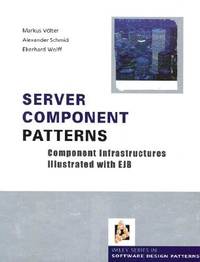
Server Component Patterns: Component Infrastructures Illustrated with EJB (Wiley Software Patterns Series) Hardback - 2002 - 1st Edition
by V
- New
- Hardback
- first
A detailed exploration of the basic patterns underlying today's component infrastructures, the latest addition to this bestselling series opens by providing an "Alexandrian-style" pattern language covering the patterns underlying EJB, COM+ and CCM. It addresses not only the underlying building blocks, but also how they interact and why they are used.
A$91.43
Free Delivery within USA
Standard delivery: 5 to 10 days
More delivery options
Standard delivery: 5 to 10 days
Dropship order
Ships from Ergodebooks (Texas, United States)
Details
- Title Server Component Patterns: Component Infrastructures Illustrated with EJB (Wiley Software Patterns Series)
- Author V
- Binding Hardback
- Edition number 1st
- Edition 1
- Condition New
- Pages 488
- Language ENG
- Publisher Wiley, Hoboken, NJ, U.S.A
- Publication date 2002-11-01
- Features Glossary, Illustrated, Index, Table of Contents
- Bookseller's Inventory # DADAX0470843195
- ISBN 9780470843192
- Weight 0.16 lbs (0.07 kg)
- Size 7.60x1.24x9.37
- Quantity available 1
About Ergodebooks Texas, United States
Biblio member since 2005
Our goal is to provide best customer service and good condition books for the lowest possible price. We are always honest about condition of book. We list book only by ISBN # and hence exact book is guaranteed.
We have 30 day return policy.
Reader reviews for Server Component Patterns: Component Infrastructures Illustrated with EJB (Wiley Software Patterns Series)
Write a review for this book
Important Terms and Guidelines
- Please focus on the book’s content and context. Also, add any personal comments as to how you enjoyed the book. Substantiate your likes and dislikes. You may make comparisons to other books.
- Reviews must be at least 140 characters in length.
- Please do not reveal critical plot elements.
- This is not a help line. Contact customer support if you need help.
Your review must not include:
- Obscenities, discriminatory language, or other insulting language not suitable for public domain
- Advertisements, “spam” content, or references to other products, offers or websites.
- Email addresses, URLs, phone numbers, physical addresses or other contact information.
- Overly critical comments about other reviews or reviewers
- Time-sensitive material (i.e. promotional tours, seminars, lectures, etc.)
- Availability, price, or alternative ordering/shipping information
From the publisher
First line
This part of the Book contains a pattern language that describes an architecture for a server-side component infrastructure.
From the rear cover
Component technologies like Enterprise JavaBeans (EJB), COM+ and CORBA Components (CCM) have become mainstream in many application domains. Developers and architects who use this technology in their everyday work need to know more about component infrastructures than the API's of the respective technology. And this is the book they need.
The first part of the book introduces a pattern language that describes how server-side component infrastructures work internally. It does not only adress the basic building blocks and their interactions. It also provides details about the reasons and rationales for this kind of system architecture. For each pattern, the book provides short examples of how it is implemented in EJB, CCM and COM+. These examples thus also serve as a good comparison of those three mainstream component infrastructures.
The second part of the book uses EJB technology to provide even more detailed examples for the patterns, including UML diagrams and extensive source code. Also serving as a comprehensive overview of EJB, it introduces it from the architectural viewpoint and for the developer highlights the consequences of working with that architecture.
Part three offers another approach to the material: a conversation between two people that describes how a concrete application has been built using component technology, focusing on the benefits of this approach.
After reading this book you will:
* understand the principles and patterns of server-side component infrastructures
* be able to design your own proprietary component infrastructures for specific projects
* have learnt about the commonalities and differences between EJB, CCM and COM+
* gain a comprehensive overview of EJB technology
* see how server-side component infrastructures can be used to great benefit in a real application
The "comic" illustrations accompanying the patterns have been created by Stefan Schulz who, when not drawing, works as an independent technology consultant.
The first part of the book introduces a pattern language that describes how server-side component infrastructures work internally. It does not only adress the basic building blocks and their interactions. It also provides details about the reasons and rationales for this kind of system architecture. For each pattern, the book provides short examples of how it is implemented in EJB, CCM and COM+. These examples thus also serve as a good comparison of those three mainstream component infrastructures.
The second part of the book uses EJB technology to provide even more detailed examples for the patterns, including UML diagrams and extensive source code. Also serving as a comprehensive overview of EJB, it introduces it from the architectural viewpoint and for the developer highlights the consequences of working with that architecture.
Part three offers another approach to the material: a conversation between two people that describes how a concrete application has been built using component technology, focusing on the benefits of this approach.
After reading this book you will:
* understand the principles and patterns of server-side component infrastructures
* be able to design your own proprietary component infrastructures for specific projects
* have learnt about the commonalities and differences between EJB, CCM and COM+
* gain a comprehensive overview of EJB technology
* see how server-side component infrastructures can be used to great benefit in a real application
The "comic" illustrations accompanying the patterns have been created by Stefan Schulz who, when not drawing, works as an independent technology consultant.

