
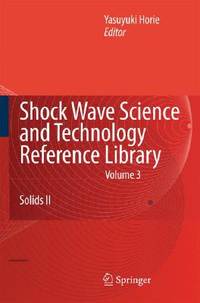
Stock photo: cover may vary
Shock Wave Science And Technology Reference Library, Volume 3: Solids Ii Paperback - 2009 - 1st Edition
by Horie Y
- New
- Paperback
A$404.26
A$21.20
Delivery to USA
Standard delivery: 20 to 30 days
More delivery options
Standard delivery: 20 to 30 days
Ships from BookVistas (Delhi, India)
Details
- Title Shock Wave Science And Technology Reference Library, Volume 3: Solids Ii
- Author Horie Y
- Binding Paperback
- Edition number 1st
- Edition 1
- Condition New
- Pages 280
- Volumes 1
- Language ENG
- Publisher Springer
- Publication date 2009
- Illustrated Yes
- Bookseller's Inventory # Adhya-9783540770787
- ISBN 9783540770787 / 354077078X
- Weight 1.36 lbs (0.62 kg)
- Dimensions 9.25 x 6.1 x 0.6 in (23.50 x 15.49 x 1.52 cm)
- Category Technology & Industrial Arts
- Dewey Decimal Code 620.112
- Quantity available 200
About BookVistas Delhi, India
Specialising in: Art, Archaeology & Architecture, Computers, History, Culture & Politics, Languages, Literature & Linguistics, Management, Music, Dance & Theatre, Religion & Philosophy, Science, Technology & Medicine
Biblio member since 2011
We are leading publishers, booksellers, distributors, importers, and exporters. We carry a large selection of books on varied subjects. Do place your valued order or let us know your requirement via email.
30 day return guarantee, with full refund including shipping costs for up to 30 days after delivery if an item arrives misdescribed or damaged.
�
Books are shipped by Registered Air Mail or DHL/FedEx/Aramex. Additional shipping charges may be required for multi-volume sets.
Reader reviews for Shock Wave Science And Technology Reference Library, Volume 3: Solids Ii
Write a review for this book
Important Terms and Guidelines
- Please focus on the book’s content and context. Also, add any personal comments as to how you enjoyed the book. Substantiate your likes and dislikes. You may make comparisons to other books.
- Reviews must be at least 140 characters in length.
- Please do not reveal critical plot elements.
- This is not a help line. Contact customer support if you need help.
Your review must not include:
- Obscenities, discriminatory language, or other insulting language not suitable for public domain
- Advertisements, “spam” content, or references to other products, offers or websites.
- Email addresses, URLs, phone numbers, physical addresses or other contact information.
- Overly critical comments about other reviews or reviewers
- Time-sensitive material (i.e. promotional tours, seminars, lectures, etc.)
- Availability, price, or alternative ordering/shipping information
From the publisher
From the rear cover
This book is the second of several volumes on solids in the Shock Wave Science and Technology Reference Library. These volumes are primarily concerned with high-pressure shock waves in solid media, including detonation and high-velocity impact and penetration events.
Of the four extensive chapters in this volume, the first two describe the reactive behavior of condensed phase explosives,
- Condensed-Phase Explosives: Shock Initiation and Detonation Phenomena (SA Sheffield and R Engelke)
- First Principles Molecular Simulations of Energetic Materials at High-Pressures (F Zhang, S Alavi, and TK Woo),
and the remaining two discuss the inert, mechanical response of solid materials.
- Combined Compression and Shear Plane Waves (ZP Tang and JB Aidun), and
- Dynamic Fragmentation of Solids (D Grady).
All chapters are each self-contained, and can be read independently of each other. They offer a timely reference, for beginners as well as professional scientists and engineers, on the foundations of detonation phenomena, high strain rate response behavior, and on the burgeoning developments as well as challenging unsolved problems.

