
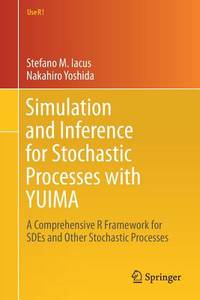
Stock photo: cover may vary
Simulation and Inference for Stochastic Processes with YUIMA: A Comprehensive R Framework for SDEs and Other Stochastic Processes (Use R!) Paperback - 2018
by Iacus, Stefano M
- Used
- Paperback
- first
A$143.13
Free Delivery within USA
Standard delivery: 5 to 10 days
More delivery options
Standard delivery: 5 to 10 days
Dropship order
Ships from Ergodebooks (Texas, United States)
Details
- Title Simulation and Inference for Stochastic Processes with YUIMA: A Comprehensive R Framework for SDEs and Other Stochastic Processes (Use R!)
- Author Iacus, Stefano M
- Binding Paperback
- Edition 1st ed. 2018
- Condition Used: Good
- Pages 268
- Volumes 1
- Language ENG
- Publisher Springer
- Publication date 2018-06-12
- Illustrated Yes
- Features Illustrated
- Bookseller's Inventory # SONG3319555677
- ISBN 9783319555676 / 3319555677
- Weight 0.88 lbs (0.40 kg)
- Dimensions 9.21 x 6.14 x 0.6 in (23.39 x 15.60 x 1.52 cm)
- Size 6.10x0.64x9.25
- Category Computers - Other Applications
- Dewey Decimal Code 005.55
- Quantity available 1
About Ergodebooks Texas, United States
Biblio member since 2005
Our goal is to provide best customer service and good condition books for the lowest possible price. We are always honest about condition of book. We list book only by ISBN # and hence exact book is guaranteed.
We have 30 day return policy.
Reader reviews for Simulation and Inference for Stochastic Processes with YUIMA: A Comprehensive R Framework for SDEs and Other Stochastic Processes (Use R!)
Write a review for this book
Important Terms and Guidelines
- Please focus on the book’s content and context. Also, add any personal comments as to how you enjoyed the book. Substantiate your likes and dislikes. You may make comparisons to other books.
- Reviews must be at least 140 characters in length.
- Please do not reveal critical plot elements.
- This is not a help line. Contact customer support if you need help.
Your review must not include:
- Obscenities, discriminatory language, or other insulting language not suitable for public domain
- Advertisements, “spam” content, or references to other products, offers or websites.
- Email addresses, URLs, phone numbers, physical addresses or other contact information.
- Overly critical comments about other reviews or reviewers
- Time-sensitive material (i.e. promotional tours, seminars, lectures, etc.)
- Availability, price, or alternative ordering/shipping information
From the publisher
From the rear cover
The YUIMA package is the first comprehensive R framework based on S4 classes and methods which allows for the simulation of stochastic differential equations driven by Wiener process, Lvy processes or fractional Brownian motion, as well as CARMA processes. The package performs various central statistical analyses such as quasi maximum likelihood estimation, adaptive Bayes estimation, structural change point analysis, hypotheses testing, asynchronous covariance estimation, lead-lag estimation, LASSO model selection, and so on. YUIMA also supports stochastic numerical analysis by fast computation of the expected value of functionals of stochastic processes through automatic asymptotic expansion by means of the Malliavin calculus. All models can be multidimensional, multiparametric or non parametric.The book explains briefly the underlying theory for simulation and inference of several classes of stochastic processes and then presents both simulation experiments and applications to realdata. Although these processes have been originally proposed in physics and more recently in finance, they are becoming popular also in biology due to the fact the time course experimental data are now available. The YUIMA package, already available on CRAN, can be freely downloaded and this companion book will make the user able to start his or her analysis from the first page.
- Contains both theory and code with step-by-step examples and figures
- Uses YUIMA package to implement the latest techniques available in the literature of inference for stochastic processes
- Shows how to create the description of very abstract models in the same way they are described in theoretical papers but with an extremely easy interface
Stefano M. Iacus, PhD, is full professor of statistics the Department of Economics, Management and Quantitative Methods at the University of Milan. He has been a member of the RCore Team (1999-2014) for the development of the R statistical environment and now member of the R Foundation. His research interests include inference for stochastic processes, simulation, computational statistics, causal inference, text mining, and sentiment analysis.
Nakahiro Yoshida, PhD, is a professor at the Graduate School of Mathematical Sciences, University of Tokyo. He is working in theoretical statistics, probability theory, computational statistics, and financial data analysis. He was awarded the Japan Statistical Society Award in 2009 and the Analysis Prize from the Mathematical Society of Japan in 2006.

