BIBLIO is the largest independent book marketplace in the world, with over 100 million books.

Skip to content

Small Data is Beautiful

Small Data is Beautiful

Small Data is Beautiful
Stock photo: cover may vary

Small Data is Beautiful Paperback - 2023

by Rachel Fensham

Add to wish list
  • New
New

Description

new.
Ask the seller a question Add to wish list
A$75.87
A$5.66 Delivery within USA
Standard delivery: 2 to 14 days
More delivery options
Ships from GreatBookPrices (Maryland, United States)

Details

  • Title Small Data is Beautiful
  • Author Rachel Fensham
  • Binding Paperback
  • Condition New
  • Pages 334
  • Volumes 1
  • Language ENG
  • Publisher Grattan Street Press, University of Melbourne
  • Publication date 2023-11-03
  • Bookseller's Inventory # 47243811-n
  • ISBN 9780645481327 / 0645481327
  • Weight 2.03 lbs (0.92 kg)
  • Dimensions 10 x 8 x 0.87 in (25.40 x 20.32 x 2.21 cm)
  • Category Art & Art Instruction
  • Quantity available 5

About GreatBookPrices Maryland, United States

Biblio member since 2024

Since 1991, we have worked every day to serve our customers with state-of-the-art technology and world class service. We are dedicated to providing customers around the world with the widest selection of books, DVDs, and CDs at the absolute lowest price.

Terms of Sale: 30 day return guarantee, with full refund including original shipping costs for up to 30 days after delivery if an item arrives misdescribed or damaged.

Browse books from GreatBookPrices

Reader reviews for Small Data is Beautiful

From the publisher

Small Data is Beautiful investigates the conceptual, artistic, and computational qualities of small data. This original collection presents a challenge to discussions centred on big data - algorithms, surveillance and the datafication of human lives - by exploring the seditious and revelatory potential of radically rethinking data in creative research and practice. Taking inspiration from the 'small is beautiful' mantra of the 1970s, a counter-cultural pursuit of planetary survival, the book interrogates the scale of the digital age through narratives, intimacies, representations, and ecologies. It offers a rich interdisciplinary dialogue from perspectives including cultural history, sociology, visual art, performance studies, archaeology, musicology, literary studies, and data science.

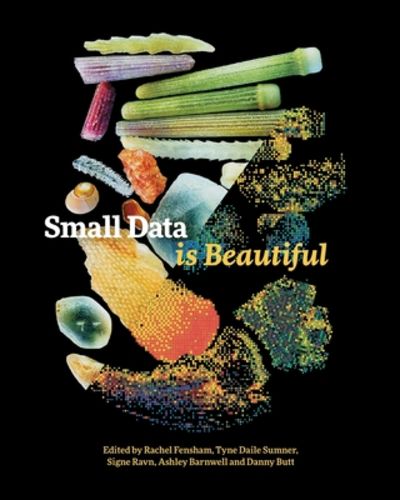
On the cover of this collection is an image that is both ordinary and remarkable, depending on where you place your focus. To the naked eye and from a distance, these striking jewel-like objects appear as a mass of plain, brown sand: homogeneous, simple and flat. Under a microscope, the different parts come alive, each piece taking on a distinct colour, formation and intriguing aesthetic. Microscopic grains of sand tell individual stories about the ecosystems and ecologies from which they came, originating from diverse corals, sea urchins and structural components such as algae and sponges. Finer than pebbles but coarser than silt, sand also articulates narratives of transformation and change, from volcanic eruption and mountainous erosion to shifting seabeds across millions of years of planetary evolution.

With this image in mind, we train our attention on small data and its power to fascinate, slow and attune us to matters we might otherwise skate over. Capturing the 'so what' of the magnified gaze, Small Data is Beautiful contends that attention to the minor scale can inform major social issues. It anchors us at the heart of political questions about what registers or qualifies, what is included or excluded or what becomes (of) an outlier. The small's way of ushering in change may have a different texture - starting as a seed, an itch, an earworm, something that soon spirals. It requires us to generate nimble methods to notice, scrutinise and sometimes seize chances to transform how we live with and by data. Such happenings are best captured in the kaleidoscope of small data that turns across the chapters in this volume, but here we offer three prisms for thinking about what small data can do: Politics, Ethics, and Aesthetics. Deliberately general, though not exhaustive, they focalise the power of the particular.

The book is structured around four themes: Narratives, Intimacies, Representations and Ecologies. Each theme intersects with concepts of smallness in distinct ways, providing a roadmap for reconceptualising data in an age of turmoil, resistance and ecological change.

tracking-