
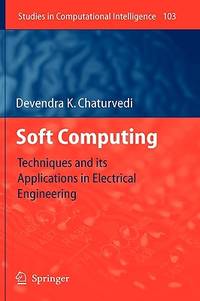
Stock photo: cover may vary
SOFT COMPUTING TECHNIQUES AND ITS APPLICATIONS IN ELECTRICAL ENGINEERING (HB 2008) Hardback - 2008
by Devendra K. Chaturvedi
- New
A$238.24
A$21.26
Delivery to USA
Standard delivery: 20 to 30 days
More delivery options
Standard delivery: 20 to 30 days
Ships from BookVistas (Delhi, India)
Details
- Title SOFT COMPUTING TECHNIQUES AND ITS APPLICATIONS IN ELECTRICAL ENGINEERING (HB 2008)
- Author Devendra K. Chaturvedi
- Binding Hardback
- Edition U. S. EDITION
- Condition New
- Pages 612
- Volumes 1
- Language ENG
- Publisher Springer, Berlin, Germany
- Publication date 2008-08-20
- Features Bibliography, Glossary
- Bookseller's Inventory # BWP-9783540774808
- ISBN 9783540774808 / 3540774807
- Weight 2.34 lbs (1.06 kg)
- Dimensions 9.33 x 6.32 x 1.5 in (23.70 x 16.05 x 3.81 cm)
- Category Mathematics
- Library of Congress Catalogue Number 2008920252
- Dewey Decimal Code 006.33
- Quantity available 500
About BookVistas Delhi, India
Specialising in: Art, Archaeology & Architecture, Computers, History, Culture & Politics, Languages, Literature & Linguistics, Management, Music, Dance & Theatre, Religion & Philosophy, Science, Technology & Medicine
Biblio member since 2011
We are leading publishers, booksellers, distributors, importers, and exporters. We carry a large selection of books on varied subjects. Do place your valued order or let us know your requirement via email.
30 day return guarantee, with full refund including shipping costs for up to 30 days after delivery if an item arrives misdescribed or damaged.
�
Books are shipped by Registered Air Mail or DHL/FedEx/Aramex. Additional shipping charges may be required for multi-volume sets.
Reader reviews for SOFT COMPUTING TECHNIQUES AND ITS APPLICATIONS IN ELECTRICAL ENGINEERING (HB 2008)
Write a review for this book
Important Terms and Guidelines
- Please focus on the book’s content and context. Also, add any personal comments as to how you enjoyed the book. Substantiate your likes and dislikes. You may make comparisons to other books.
- Reviews must be at least 140 characters in length.
- Please do not reveal critical plot elements.
- This is not a help line. Contact customer support if you need help.
Your review must not include:
- Obscenities, discriminatory language, or other insulting language not suitable for public domain
- Advertisements, “spam” content, or references to other products, offers or websites.
- Email addresses, URLs, phone numbers, physical addresses or other contact information.
- Overly critical comments about other reviews or reviewers
- Time-sensitive material (i.e. promotional tours, seminars, lectures, etc.)
- Availability, price, or alternative ordering/shipping information
From the publisher
From the rear cover
Taking inspiration from the brain structure (neurons), linguistic rather than precise way of description by humans (not so cold, very warm), genetics and the behaviour of birds and ants in the nature, new techniques for the solution of various problems have been developed over the past three decades or so. All these techniques are broadly classified as artificial intelligence or computational intelligence.
Artificial intelligence encompasses methods like artificial neural networks and fuzzy logic. Computational intelligence includes optimization methods such as genetic algorithm, evolutionary algorithm, arts colony, particle swarm optimization, etc. and their variations. Feasibility of the application of these techniques in various control and optimization problems has been investigated extensively and these techniques have been applied to physical systems in a number of cases.
With the computational power now available, importance of this relatively new branch of knowledge, that is heavily dependent on soft computing, will grow significantly in the future. The appearance of a book like this one helps spread awareness about the new techniques based on soft computing and is thus a welcome addition.
In this book a cross-section of these techniques is introduced and their applications illustrated by examples from physical systems based on the author's own research. It will provide a good introduction to a reader interested in this subject.
Om P. Malik, Professor Emeritus, University of Calgary

