
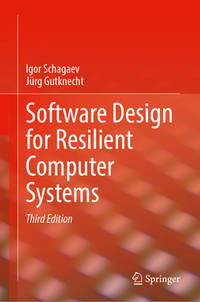
Stock photo: cover may vary
Software Design for Resilient Computer Systems Hardback - 2024
- New
- Hardback
A$368.38
A$5.79
Delivery within USA
Standard delivery: 9 to 14 days
More delivery options
Standard delivery: 9 to 14 days
Ships from Cold Books (New York, United States)
Details
- Title Software Design for Resilient Computer Systems
- Binding Hardback
- Condition New
- Publisher Springer
- Publication date Third Edition 2024 NO-PA16AP
- Features Illustrated
- Bookseller's Inventory # 6399324691
- ISBN 9783031551383
- Quantity available 4
About Cold Books New York, United States
Reader reviews for Software Design for Resilient Computer Systems
Write a review for this book
Important Terms and Guidelines
- Please focus on the book’s content and context. Also, add any personal comments as to how you enjoyed the book. Substantiate your likes and dislikes. You may make comparisons to other books.
- Reviews must be at least 140 characters in length.
- Please do not reveal critical plot elements.
- This is not a help line. Contact customer support if you need help.
Your review must not include:
- Obscenities, discriminatory language, or other insulting language not suitable for public domain
- Advertisements, “spam” content, or references to other products, offers or websites.
- Email addresses, URLs, phone numbers, physical addresses or other contact information.
- Overly critical comments about other reviews or reviewers
- Time-sensitive material (i.e. promotional tours, seminars, lectures, etc.)
- Availability, price, or alternative ordering/shipping information
From the publisher
From the rear cover
This book addresses the question of how system software should be designed to account for faults, and which fault tolerance features should provide for highest reliability. With this third edition of Software Design for Resilient Computer Systems, the book is thoroughly updated to contain the newest advice regarding software resilience. With a new introductory chapter, the new edition is ideal for researchers and industry professionals.
In the book, the authors first show how system software interacts with the hardware to tolerate faults. They analyze and further develop the theory of fault tolerance to understand the diverse ways to increase the reliability of a system, with special attention on the role of system software in this process. They introduce the theory of redundancy and its use for construction of a subsystem through generalised algorithm of fault tolerance (GAFT) and apply it to distributed systems. The book's approach is applied to various hardware subsystems: different structures of RAM and processor cores and demonstrates exceptional performance reliability and energy efficiency. This third edition devotes substantial attention to system software for modern computers, including run time systems, supporting algorithms of recovery and their analysis, language aspects and ways to improve reconfigurable and parallel computing.

