
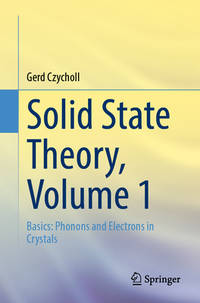
Stock photo: cover may vary
SOLID STATE THEORY, VOLUME 1: BASICS: PHONONS AND ELECTRONS IN CRYSTALS Paperback -
by CZYCHOLL, GERD
- New
A$196.31
A$5.82
Delivery within USA
Standard delivery: 5 to 10 days
More delivery options
Standard delivery: 5 to 10 days
Details
- Title SOLID STATE THEORY, VOLUME 1: BASICS: PHONONS AND ELECTRONS IN CRYSTALS
- Author CZYCHOLL, GERD
- Binding Paperback
- Edition USA Edition
- Condition New
- Pages 400
- Volumes 1
- Language ENG
- Publisher Springer
- Bookseller's Inventory # Ad 9783662661345
- ISBN 9783662661345 / 3662661349
- Weight 1.63 lbs (0.74 kg)
- Category Science
- Quantity available 3
About XLANCEBOOKS L.L.C. Wyoming, United States
Reader reviews for SOLID STATE THEORY, VOLUME 1: BASICS: PHONONS AND ELECTRONS IN CRYSTALS
Write a review for this book
Important Terms and Guidelines
- Please focus on the book’s content and context. Also, add any personal comments as to how you enjoyed the book. Substantiate your likes and dislikes. You may make comparisons to other books.
- Reviews must be at least 140 characters in length.
- Please do not reveal critical plot elements.
- This is not a help line. Contact customer support if you need help.
Your review must not include:
- Obscenities, discriminatory language, or other insulting language not suitable for public domain
- Advertisements, “spam” content, or references to other products, offers or websites.
- Email addresses, URLs, phone numbers, physical addresses or other contact information.
- Overly critical comments about other reviews or reviewers
- Time-sensitive material (i.e. promotional tours, seminars, lectures, etc.)
- Availability, price, or alternative ordering/shipping information
From the publisher
From the rear cover
The textbooks "Solid State Theory" give an introduction to the methods, contents and results of modern solid state physics in two volumes. This first volume has the basic courses in theoretical physics as prerequisites, i.e. knowledge of classical mechanics, electrodynamics and, in particular, quantum mechanics and statistical physics is assumed. The formalism of second quantization (occupation number representation), which is needed for the treatment of many-body effects, is introduced and used in the book. The content of the first volume deals with the classical areas of solid state physics (phonons and electrons in the periodic potential, Bloch theorem, Hartree-Fock approximation, density functional theory, electron-phonon interaction). The first volume is already suitable for Bachelor students who want to go beyond the basic courses in theoretical physics and get already familiar with an application area of theoretical physics, e.g. for an elective subject "Theoretical (Solid State) Physics" or as a basis for a Bachelor thesis. Every solid-state physicist working experimentally should also be familiar with the theoretical methods covered in the first volume. The content of the first volume can therefore also be the basis for a module "Solid State Physics" in the Master program in Physics or, together with the content of the 2nd volume, for a module "Theoretical Solid State Physics" or "Advanced Theoretical Physics". The following second volume covers application areas such as superconductivity and magnetism to areas that are current research topics (e.g. quantum Hall effect, high-temperature superconductivity, low-dimensional structures).
The author
Gerd Czycholl, born 1951 in Cologne, studied physics in Cologne, diploma in 1974, doctorate in 1977 at the University of Cologne, then postdoc (research assistant) at the University of Dortmund and 1983-84 at Stanford University, habilitation in 1985 at the University of Dortmund, then temporaryprofessorships in Dortmund and 1987-1990 at RWTH Aachen. Since 1991 Professor of Theoretical Physics at the University of Bremen.

