
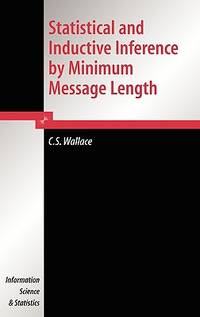
Stock photo: cover may vary
Statistical and Inductive Inference by Minimum Message Length (Information Science and Statistics) Hardback - 2005
by Wallace, C.S
- New
- Hardback
A$167.96
A$8.75
Delivery within USA
Standard delivery: 2 to 21 days
More delivery options
Standard delivery: 2 to 21 days
Ships from GridFreed LLC (California, United States)
Details
- Title Statistical and Inductive Inference by Minimum Message Length (Information Science and Statistics)
- Author Wallace, C.S
- Binding Hardback
- Edition U. S. EDITION
- Condition New
- Pages 432
- Volumes 1
- Language ENG
- Publisher Springer, Secaucus, New Jersey, U.S.A.
- Publication date 2005-05-26
- Illustrated Yes
- Features Bibliography, Illustrated, Index
- Bookseller's Inventory # Q-038723795X
- ISBN 9780387237954 / 038723795X
- Weight 1.65 lbs (0.75 kg)
- Dimensions 9.56 x 6.16 x 0.99 in (24.28 x 15.65 x 2.51 cm)
- Category Mathematics
- Library of Congress subjects Induction (Mathematics), Minimum message length (Information theory)
- Library of Congress Catalogue Number 2004059195
- Dewey Decimal Code 519.5
- Quantity available 1
About GridFreed LLC California, United States
Biblio member since 2021
We sell primarily non-fiction, many new books, some collectible first editions and signed books. We operate 100% online and have been in business since 2005.
Reader reviews for Statistical and Inductive Inference by Minimum Message Length (Information Science and Statistics)
Write a review for this book
Important Terms and Guidelines
- Please focus on the book’s content and context. Also, add any personal comments as to how you enjoyed the book. Substantiate your likes and dislikes. You may make comparisons to other books.
- Reviews must be at least 140 characters in length.
- Please do not reveal critical plot elements.
- This is not a help line. Contact customer support if you need help.
Your review must not include:
- Obscenities, discriminatory language, or other insulting language not suitable for public domain
- Advertisements, “spam” content, or references to other products, offers or websites.
- Email addresses, URLs, phone numbers, physical addresses or other contact information.
- Overly critical comments about other reviews or reviewers
- Time-sensitive material (i.e. promotional tours, seminars, lectures, etc.)
- Availability, price, or alternative ordering/shipping information
From the publisher
First line
The best explanation of the facts is the shortest.
From the rear cover
The Minimum Message Length (MML) Principle is an information-theoretic approach to induction, hypothesis testing, model selection, and statistical inference. MML, which provides a formal specification for the implementation of Occam's Razor, asserts that the 'best' explanation of observed data is the shortest. Further, an explanation is acceptable
(i.e. the induction is justified) only if the explanation is shorter than the original data.
This book gives a sound introduction to the Minimum Message Length Principle and its applications, provides the theoretical arguments for the adoption of the principle, and shows the development of certain approximations that assist its practical application. MML appears also to provide both a normative and a descriptive basis for inductive reasoning generally, and scientific induction in particular. The book describes this basis and aims to show its relevance to the Philosophy of Science.
Statistical and Inductive Inference by Minimum Message Length will be of special interest to graduate students and researchers in Machine Learning and Data Mining, scientists and analysts in various disciplines wishing to make use of computer techniques for hypothesis discovery, statisticians and econometricians interested in the underlying theory of their discipline, and persons interested in the Philosophy of Science. The book could also be used in a graduate-level course in Machine Learning and Estimation and Model-selection, Econometrics and Data Mining.
C.S. Wallace was appointed Foundation Chair of Computer Science at Monash University in 1968, at the age of 35, where he worked until his death in 2004. He received an ACM Fellowship in 1995, and was appointed Professor Emeritus in 1996. Professor Wallace made numerous significant contributions to diverse areas of Computer Science, such as Computer Architecture, Simulation and Machine Learning. His final research focusedprimarily on the Minimum Message Length Principle.

