BIBLIO is the largest independent book marketplace in the world, with over 100 million books.

Skip to content

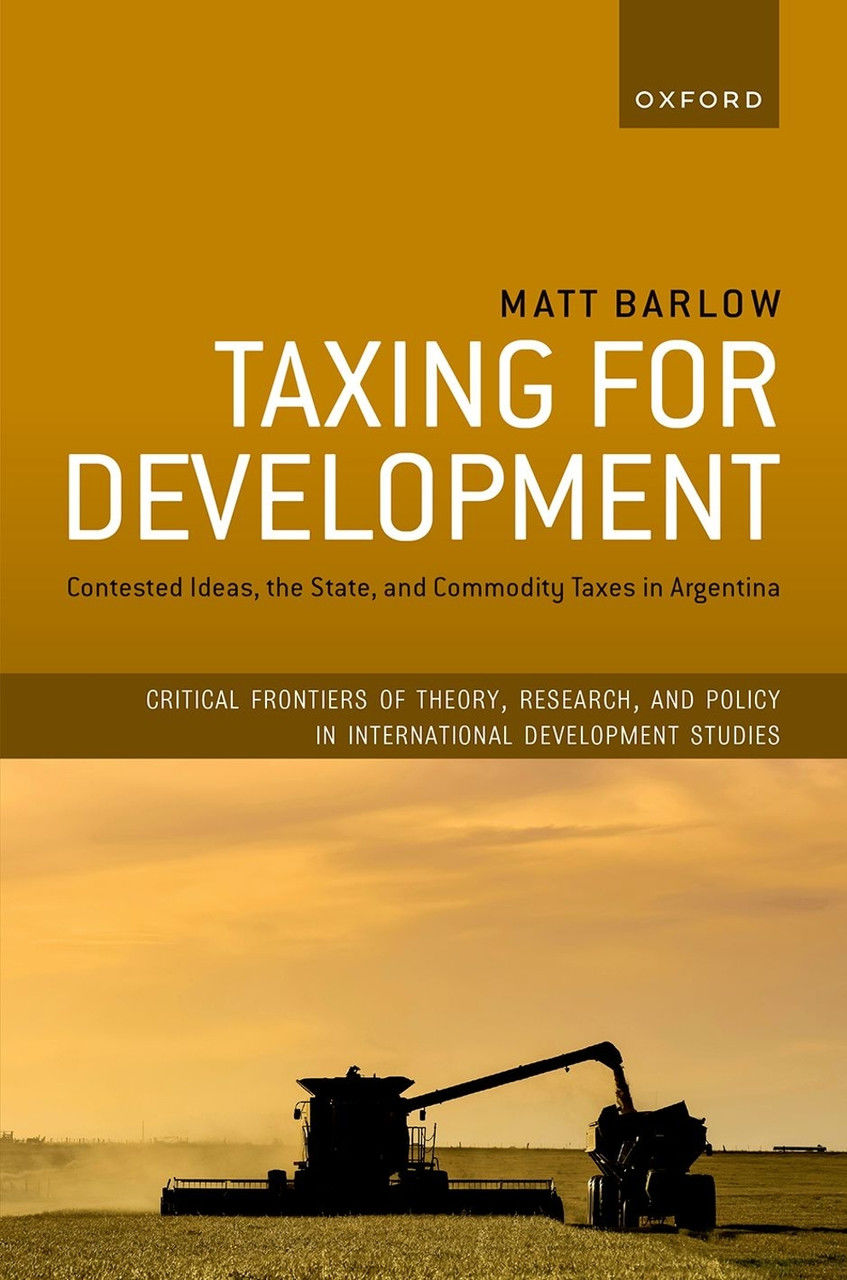
Taxing for Development: Contested Ideas, the State, and Commodity Taxes in Argentina

Taxing for Development: Contested Ideas, the State, and Commodity Taxes in Argentina

Taxing for Development: Contested Ideas, the State, and Commodity Taxes in Argentina Hardback - 2025

by Matt Barlow

Add to wish list
  • New
  • Hardback
New

Description

Hardback. New. Taxing for Development shows that tax is a profoundly political problem, associated with debates about the role of the state, the market, and business-state relationships.
Ask the seller a question Add to wish list
A$194.31
A$19.24 Delivery to USA
Standard delivery: 14 to 21 days
More delivery options
Ships from The Saint Bookstore (Merseyside, United Kingdom)

Details

  • Title Taxing for Development: Contested Ideas, the State, and Commodity Taxes in Argentina
  • Author Matt Barlow
  • Binding Hardback
  • Condition New
  • Pages 272
  • Volumes 1
  • Language ENG
  • Publisher Oxford University Press (UK)
  • Publication date 2025-09-30
  • Features Dust Cover
  • Bookseller's Inventory # A9780198923190
  • ISBN 9780198923190 / 0198923198
  • Weight 1.23 lbs (0.56 kg)
  • Dimensions 9.21 x 6.14 x 0.63 in (23.39 x 15.60 x 1.60 cm)
  • Category Politics / Current Events
  • Quantity available 10

About The Saint Bookstore Merseyside, United Kingdom

Biblio member since 2018

The Saint Bookstore specialises in hard to find titles & also offers delivery worldwide for reasonable rates.

Terms of Sale: Refunds or Returns: A full refund of the price paid will be given if returned within 30 days in undamaged condition. If the product is faulty, we may send a replacement.

Browse books from The Saint Bookstore

Reader reviews for Taxing for Development: Contested Ideas, the State, and Commodity Taxes in Argentina

From the publisher

The importance of tax collection for sustainable development cannot be overstated: it forms a central pillar of the UN's Agenda 2030 and offers a concrete pathway to finance development in an increasingly politicised and diminishing foreign aid landscape. However, the strengthening of tax systems in the Global South has proved to be both complex and contentious. Scholars that have approached this tax-for-development puzzle have tended to privilege interest- and institutional-based arguments to explain low levels of tax collection and problems with implementing tax reforms.

This book takes a different approach and argues that ideas about tax matter as much as interests and institutions for understanding social attitudes and responses to attempts by the state to raise revenues for development. Sometimes contested ideas about the boundaries of the state in relation to tax and development come to shape the fault lines of politics and determine the success and failure of programmes to raise revenue for development. Using the case of Argentina, the book examines, empirically, the attempts by progressive-Peronist governments of Nstor and Cristina Kirchner to finance state expenditure and social welfare via taxes on commodity (mainly soybean) exports after 2001. It traces how an idea of these taxes generated widespread conflict outside of the sector where they were levied, which entirely polarised Argentine society. Taxing for Development shows that tax is a profoundly political problem, associated with debates about the role of the state, the market, and business-state relationships. In doing so it shows how historically and socially constructed ideas of tax can become embedded in and influence debates which have normally been approached through perspectives of material interests.

This is an open access title available under the terms of a [CC BY-NC-ND 4.0 International] licence. It is free to read at Oxford Scholarship Online and offered as a free PDF download from OUP and selected open access locations.

About the author

Matt Barlow, Lecturer in International Political Economy, University of Glasgow

Matt Barlow is a Lecturer in International Political Economy at the University of Glasgow and a Research Fellow at IBEI. Previously, he was a postdoctoral research fellow in the Department of International Development at King's College London. Before this he was an Associate Lecturer in the Department of Politics at the University of York where he was awarded his PhD. During this time, he also worked as a research associate in the Interdisciplinary Global Development Centre at the University of York. He has twice been a visiting researcher at the Universidad Torcuato di Tella in Buenos Aires, Argentina.

tracking-