
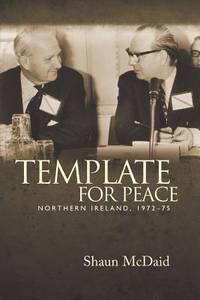
Stock photo: cover may vary
Template for Peace Papeback -
by Shaun McDaid
- New
A$42.03
A$5.77
Delivery within USA
Standard delivery: 9 to 14 days
More delivery options
Standard delivery: 9 to 14 days
Ships from Cold Books (New York, United States)
Details
- Title Template for Peace
- Author Shaun McDaid
- Binding Papeback
- Condition New
- Pages 224
- Volumes 1
- Language ENG
- Publisher Manchester University Press
- Publication date pp.
- Features Bibliography, Index
- Bookseller's Inventory # 6372696878
- ISBN 9780719099762 / 0719099765
- Weight 0.7 lbs (0.32 kg)
- Dimensions 9.21 x 6.14 x 0.47 in (23.39 x 15.60 x 1.19 cm)
-
Themes
- Cultural Region: British
- Category Politics / Current Events
- Library of Congress subjects Great Britain - Foreign relations - Northern, Northern Ireland - Foreign relations - Great
- Library of Congress Catalogue Number 2015509910
- Dewey Decimal Code 941.608
- Quantity available 1
About Cold Books New York, United States
Reader reviews for Template for Peace
Write a review for this book
Important Terms and Guidelines
- Please focus on the book’s content and context. Also, add any personal comments as to how you enjoyed the book. Substantiate your likes and dislikes. You may make comparisons to other books.
- Reviews must be at least 140 characters in length.
- Please do not reveal critical plot elements.
- This is not a help line. Contact customer support if you need help.
Your review must not include:
- Obscenities, discriminatory language, or other insulting language not suitable for public domain
- Advertisements, “spam” content, or references to other products, offers or websites.
- Email addresses, URLs, phone numbers, physical addresses or other contact information.
- Overly critical comments about other reviews or reviewers
- Time-sensitive material (i.e. promotional tours, seminars, lectures, etc.)
- Availability, price, or alternative ordering/shipping information
From the publisher
From the rear cover
This book examines the creation and collapse of the first power-sharing administration in Northern Ireland, and British government policy during the period 1972-75. It also analyses the relationship between the British and Irish states during the 1972-75 period.
Drawing on recently released archival sources, this book sheds new light on the events of this turbulent period, and questions many core assumptions about the political dynamics of the time. In particular, it challenges existing interpretations of the relationship between the Irish government and the representatives of constitutional nationalism in Northern Ireland and security co-operation between the British and Irish states. It revises the widely held view that the Irish government sought to use the Sunningdale Agreement's proposed Council of Ireland as a means of securing future Irish unity. It also examines the socio-economic problems which Northern Ireland faced at this time, and the attempts of the region's politicians to solve them, demonstrating the remarkable similarities between nationalist and unionist parties with regard to non-constitutional matters. It also challenges the view that the power-sharing experiment can be seen as a 'lost peace process', due to the levels of violence between 1972 and 1975. However, it demonstrates that the Sunningdale package, and the policies established during this period, provided the basic template for the current settlement in the region. It will thus be essential reading for students and scholars of modern British and Irish politics and the Northern Ireland conflict, and those interested in the politics of conflict resolution.
