BIBLIO is the largest independent book marketplace in the world, with over 100 million books.

Skip to content

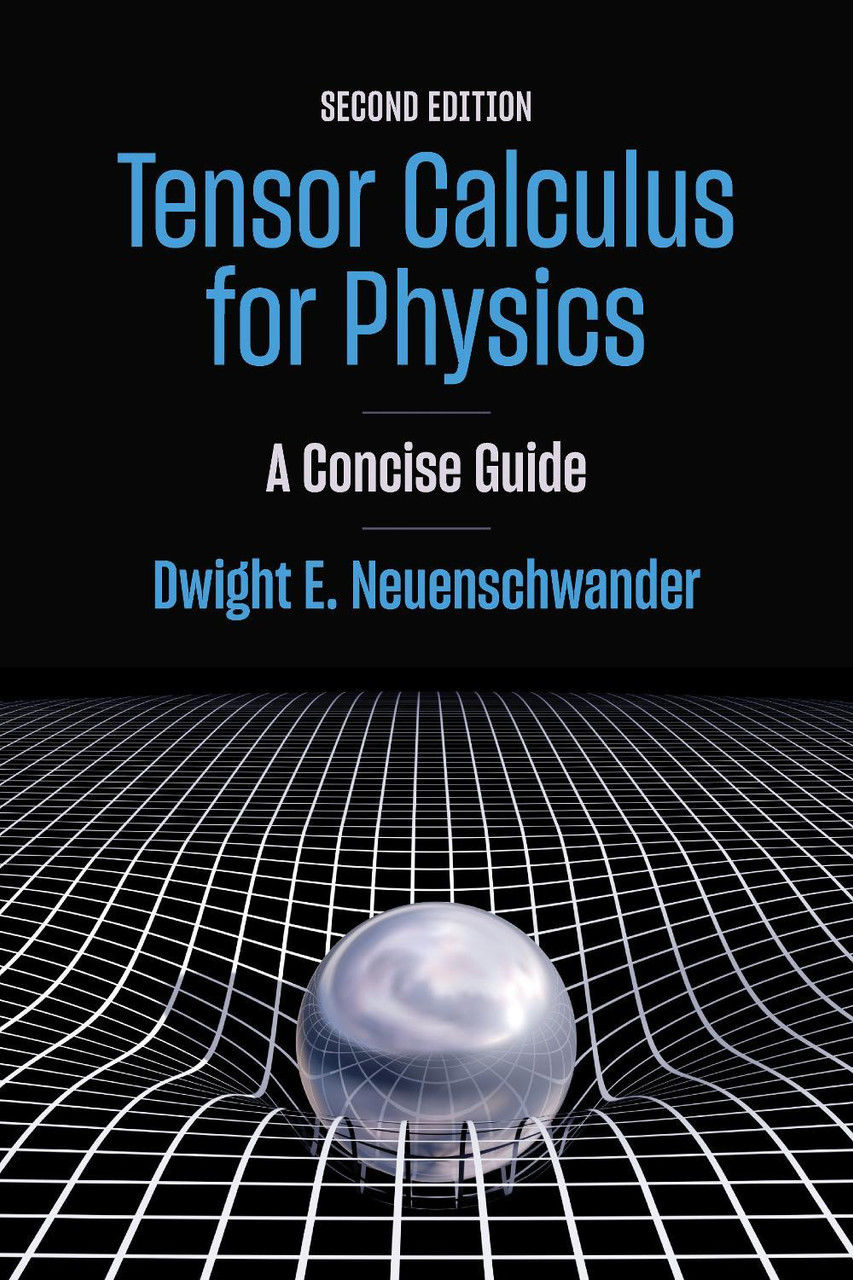
Tensor Calculus for Physics: A Concise Guide

Tensor Calculus for Physics: A Concise Guide

Tensor Calculus for Physics: A Concise Guide Paperback / softback - 2026

by Dwight E. Neuenschwander

Add to wish list
  • New
  • Paperback
New

Description

Paperback / softback. New.

An essential guide to understanding tensors through physics.

Understanding tensors is essential for physics students who encounter phenomena where direction matters. A jet stream rushing overhead can trigger vertical convection that leads to thunderstorms. An unbalanced car wheel spinning around a horizontal axis produces a wobble in the vertical plane. Astronauts orbiting Earth observe an electrostatic field as a magnetic one. In all these cases, tensors offer a language that captures directional relationships with precision. In the second edition of Tensor Calculus for Physics, Dwight E. Neuenschwander provides an accessible guide that shows how tensor logic arises naturally from physical problems.

Tensors' true elegance lies in how they transform: when coordinates change from one system to another, tensors follow the same rules, allowing physical laws to retain their form across perspectives. Students are often introduced to tensors piecemeal through the inertia tensor in classical mechanics or the polarization tensor in electricity and magnetism. While useful, this fragmented approach does not prepare the student for tensor features such as affine connections, dual basis vectors, and covariant derivatives they will encounter in advanced studies such as general relativity, continuum mechanics, or non-Euclidean geometry. This concise guide builds from the ground up, providing a clear, step-by-step progression that embeds tensors in contexts where their power becomes self-evident.

This extensively revised second edition incorporates more illustrative examples and carefully designed homework problems to strengthen understanding. Now accompanied by a solutions manual, this edition is an ideal resource for courses in general relativity, covariant electrodynamics, continuum mechanics, fluid dynamics, materials science, and any discipline where tensors illuminate the structure of physical reality.

Ask the seller a question Add to wish list
A$145.85
A$19.40 Delivery to USA
Standard delivery: 14 to 21 days
More delivery options
Ships from The Saint Bookstore (Merseyside, United Kingdom)

Details

About The Saint Bookstore Merseyside, United Kingdom

Biblio member since 2018

The Saint Bookstore specialises in hard to find titles & also offers delivery worldwide for reasonable rates.

Terms of Sale: Refunds or Returns: A full refund of the price paid will be given if returned within 30 days in undamaged condition. If the product is faulty, we may send a replacement.

Browse books from The Saint Bookstore

Reader reviews for Tensor Calculus for Physics: A Concise Guide

From the publisher

An essential guide to understanding tensors through physics.

Understanding tensors is essential for physics students who encounter phenomena where direction matters. A jet stream rushing overhead can trigger vertical convection that leads to thunderstorms. An unbalanced car wheel spinning around a horizontal axis produces a wobble in the vertical plane. Astronauts orbiting Earth observe an electrostatic field as a magnetic one. In all these cases, tensors offer a language that captures directional relationships with precision. In the second edition of Tensor Calculus for Physics, Dwight E. Neuenschwander provides an accessible guide that shows how tensor logic arises naturally from physical problems.

Tensors' true elegance lies in how they transform: when coordinates change from one system to another, tensors follow the same rules, allowing physical laws to retain their form across perspectives. Students are often introduced to tensors piecemeal through the inertia tensor in classical mechanics or the polarization tensor in electricity and magnetism. While useful, this fragmented approach does not prepare the student for tensor features such as affine connections, dual basis vectors, and covariant derivatives they will encounter in advanced studies such as general relativity, continuum mechanics, or non-Euclidean geometry. This concise guide builds from the ground up, providing a clear, step-by-step progression that embeds tensors in contexts where their power becomes self-evident.

This extensively revised second edition incorporates more illustrative examples and carefully designed homework problems to strengthen understanding. Now accompanied by a solutions manual, this edition is an ideal resource for courses in general relativity, covariant electrodynamics, continuum mechanics, fluid dynamics, materials science, and any discipline where tensors illuminate the structure of physical reality.

About the author

Dwight E. Neuenschwander is an emeritus professor of physics at Southern Nazarene University. He is the author of Emmy Noether's Wonderful Theorem and How to Involve Undergraduates in Research: A Field Guide for Faculty.

tracking-