
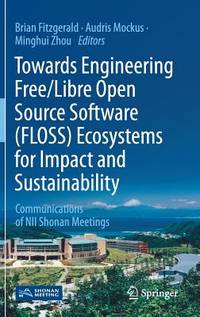
Stock photo: cover may vary
Towards Engineering Free/Libre Open Source Software (FLOSS) Ecosystems for Impact and Sustainability: Communications of NII Shonan Meetings Hardback - 2019
by Fitzgerald, Brian
- Used
- Hardback
- first
A$289.33
Free Delivery within USA
Standard delivery: 5 to 10 days
More delivery options
Standard delivery: 5 to 10 days
Dropship order
Ships from Ergodebooks (Texas, United States)
Details
- Title Towards Engineering Free/Libre Open Source Software (FLOSS) Ecosystems for Impact and Sustainability: Communications of NII Shonan Meetings
- Author Fitzgerald, Brian
- Binding Hardback
- Edition 1st ed. 2019
- Condition Used: Good
- Pages 156
- Volumes 1
- Language ENG
- Publisher Springer
- Publication date 2019-07-16
- Illustrated Yes
- Features Illustrated
- Bookseller's Inventory # SONG9811370982
- ISBN 9789811370984 / 9811370982
- Weight 0.92 lbs (0.42 kg)
- Dimensions 9.21 x 6.14 x 0.44 in (23.39 x 15.60 x 1.12 cm)
- Size 6.14x0.44x9.21
- Category Computers - Languages / Programming
- Dewey Decimal Code 006.76
- Quantity available 1
About Ergodebooks Texas, United States
Biblio member since 2005
Our goal is to provide best customer service and good condition books for the lowest possible price. We are always honest about condition of book. We list book only by ISBN # and hence exact book is guaranteed.
We have 30 day return policy.
Reader reviews for Towards Engineering Free/Libre Open Source Software (FLOSS) Ecosystems for Impact and Sustainability: Communications of NII Shonan Meetings
Write a review for this book
Important Terms and Guidelines
- Please focus on the book’s content and context. Also, add any personal comments as to how you enjoyed the book. Substantiate your likes and dislikes. You may make comparisons to other books.
- Reviews must be at least 140 characters in length.
- Please do not reveal critical plot elements.
- This is not a help line. Contact customer support if you need help.
Your review must not include:
- Obscenities, discriminatory language, or other insulting language not suitable for public domain
- Advertisements, “spam” content, or references to other products, offers or websites.
- Email addresses, URLs, phone numbers, physical addresses or other contact information.
- Overly critical comments about other reviews or reviewers
- Time-sensitive material (i.e. promotional tours, seminars, lectures, etc.)
- Availability, price, or alternative ordering/shipping information
From the publisher
From the rear cover
Free/libre open source software (FLOSS) ecosystems such as Linux have had a tremendous impact on computing and society and have captured the attention of businesses, researchers, and policy makers. Research on FLOSS has been ongoing for almost two decades. From an economic perspective, the most common topics involve motivation and organization. As commercial participation in FLOSS has become common, the question of how to combine FLOSS practice with commercial practice has been the subject of research, particularly with a view to understanding how to ensure sustainability of the ecosystem.
This book is based on a Shonan meeting on FLOSS ecosystem sustainability held in June 2017. The meeting brought together a blend of established and young researchers who were actively studying the FLOSS phenomenon. These researchers were drawn from a variety of disciplines including software engineering, human computer interaction, information systems, computer-supported cooperative work, data mining, cognitive science, psychology, operations research, and management. Industry practitioners who were active in the FLOSS space also participated. This book presents the results of discussion on fundamental questions related to the impact and sustainability of FLOSS ecosystems, including:
- How does an ecosystem form? How do different stakeholders work together to form a community that develops and maintains valuable and freely available software, and how does an ecosystem with millions of repositories and developers operate given the lack of centralized planning?
- How does an ecosystem evolve in response to the environment as technology and needs evolve over time?
- How do newcomers learn the protocols and practices of an ecosystem? How would they sustain the ecosystem? What is the relationship between people and ecosystem sustainability?
