
Click to view full size.
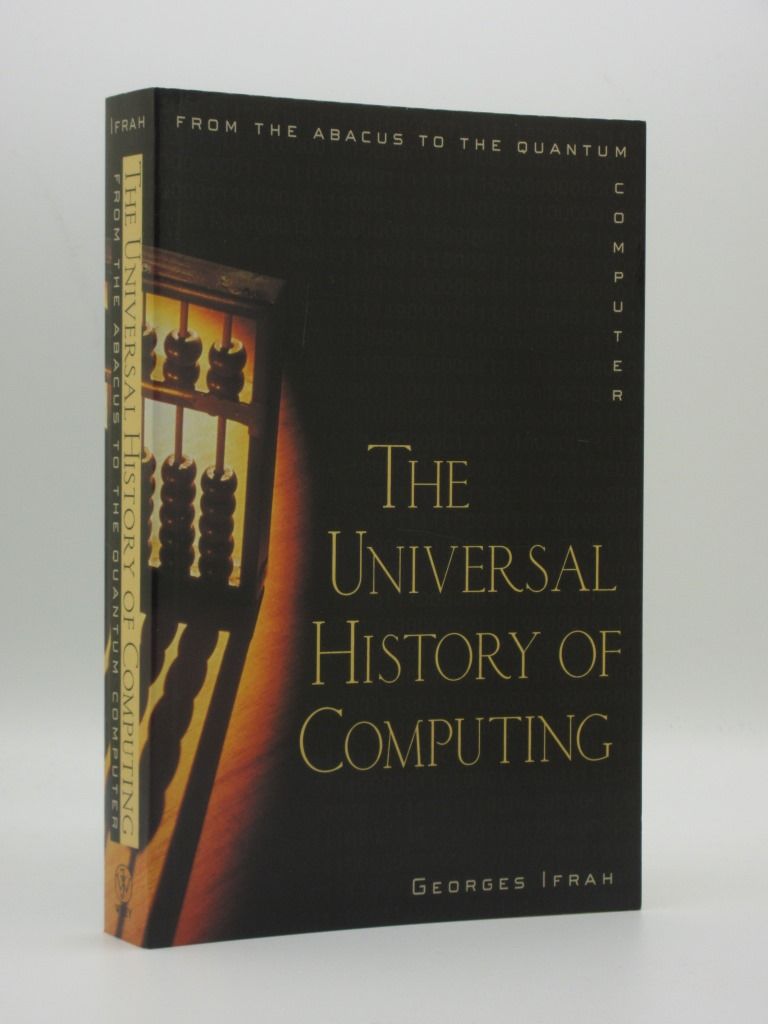
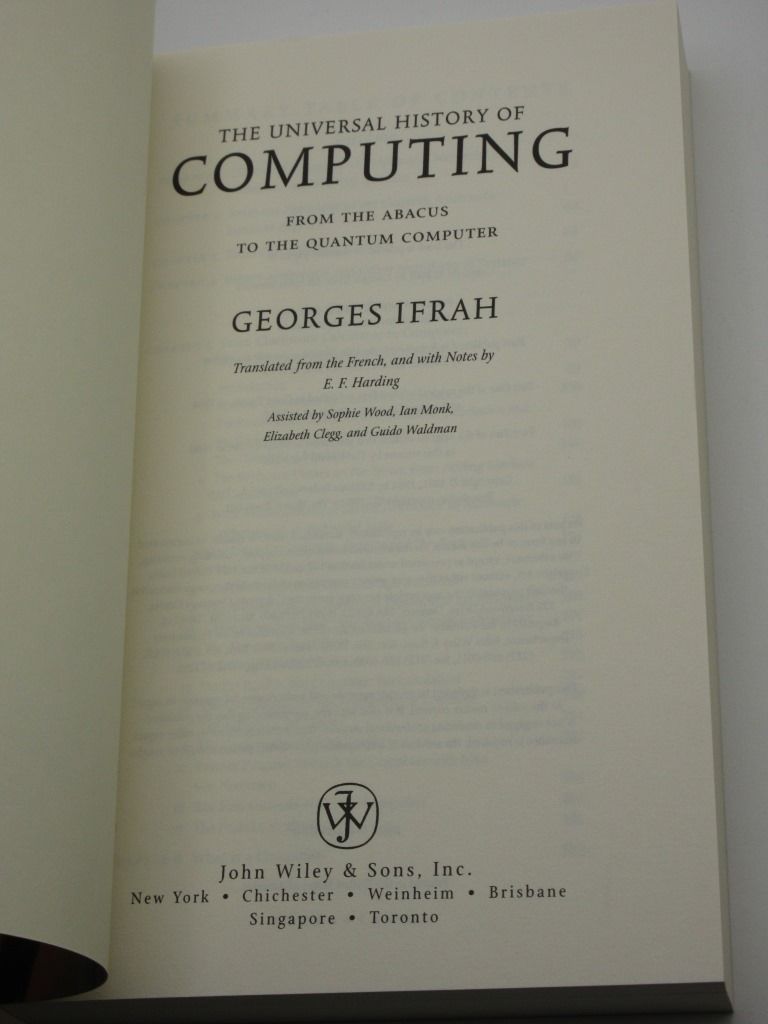
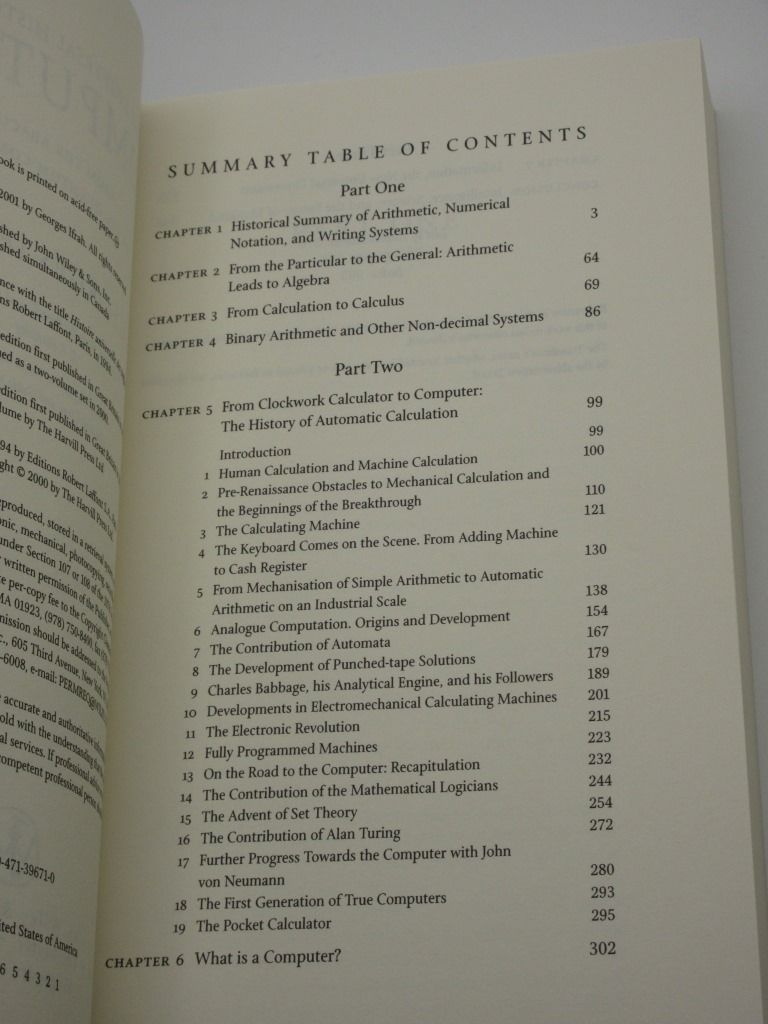
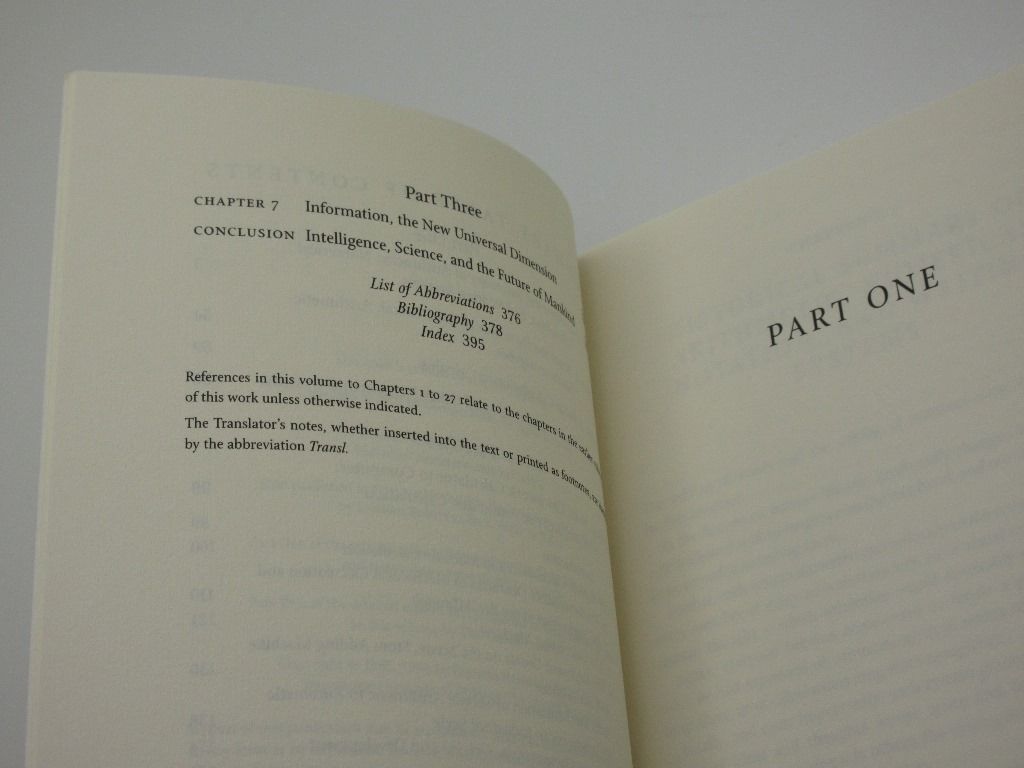
The Universal History of Computing from the Abacus to the Quantum Computer Paperback. printed pages: 410 - 2001 - 1st Edition
by Georges Ifrah / E.F. Harding (Trans.)
- Used
- near fine
- Paperback
- first
A$40.73
A$34.91
Delivery to USA
Standard delivery: 5 to 15 days
More delivery options
Standard delivery: 5 to 15 days
Details
- Title The Universal History of Computing from the Abacus to the Quantum Computer
- Author Georges Ifrah / E.F. Harding (Trans.)
- Binding Paperback
- Edition number 1st
- Edition 1st Edition Thus
- Condition Used - Near Fine
- Pages 416
- Volumes 1
- Language ENG
- Publisher John Wiley and Sons Inc, New York
- Publication date 2001
- Illustrated Yes
- Features Bibliography, Illustrated, Index, Table of Contents
- Bookseller's Inventory # 1189E090
- ISBN 9780471441472 / 0471441473
- Weight 1.35 lbs (0.61 kg)
- Dimensions 8.75 x 6.03 x 1.01 in (22.23 x 15.32 x 2.57 cm)
- Size 5.75 x 8.75 inches (14 x 22 cm)
- Category Computers - General Information
- Library of Congress subjects Computers - History, Electronic data processing - History
- Dewey Decimal Code 004.09
- Quantity available 1
About Tarrington Books Herefordshire, United Kingdom
Specialising in: Antiquarian, Crime, Mystery & Espionage, Fine Bindings, History, Military, Signed First Editions, Theology, Vintage Paperbacks
Biblio member since 2015
A family run bookshop located in the heart of rural Herefordshire. Large selection of children's literature, crime fiction, military, history, travel, vintage paperbacks, quality antiquarian volumes & fine bindings. We offer free UK postage on all items and pride ourselves on our safe packaging and rapid dispatch of orders. Browsers welcome by appointment.
30 day return guarantee, with full refund including original shipping costs for up to 30 days after delivery if an item arrives misdescribed or damaged.
Reader reviews for The Universal History of Computing from the Abacus to the Quantum Computer
Write a review for this book
Important Terms and Guidelines
- Please focus on the book’s content and context. Also, add any personal comments as to how you enjoyed the book. Substantiate your likes and dislikes. You may make comparisons to other books.
- Reviews must be at least 140 characters in length.
- Please do not reveal critical plot elements.
- This is not a help line. Contact customer support if you need help.
Your review must not include:
- Obscenities, discriminatory language, or other insulting language not suitable for public domain
- Advertisements, “spam” content, or references to other products, offers or websites.
- Email addresses, URLs, phone numbers, physical addresses or other contact information.
- Overly critical comments about other reviews or reviewers
- Time-sensitive material (i.e. promotional tours, seminars, lectures, etc.)
- Availability, price, or alternative ordering/shipping information
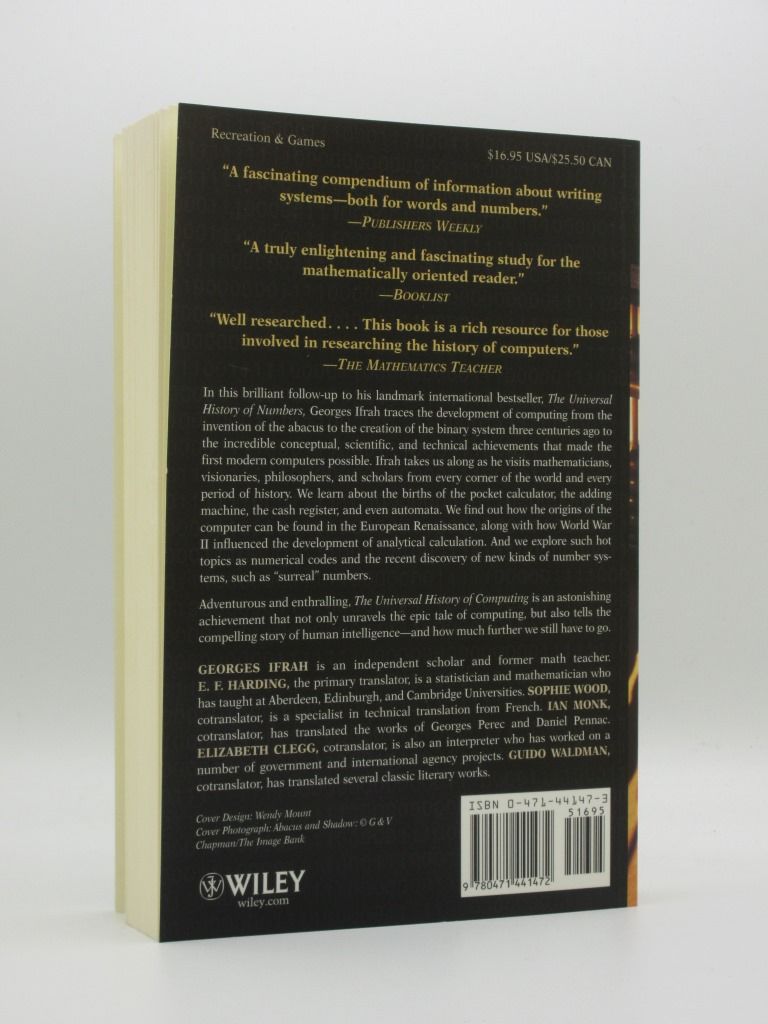
From the rear cover
"A fascinating compendium of information about writing systems-both for words and numbers."
-Publishers Weekly
-Publishers Weekly
"A truly enlightening and fascinating study for the mathematically oriented reader."
-Booklist
"Well researched. . . . This book is a rich resource for those involved in researching the history of computers."
-The Mathematics Teacher
In this brilliant follow-up to his landmark international bestseller, The Universal History of Numbers, Georges Ifrah traces the development of computing from the invention of the abacus to the creation of the binary system three centuries ago to the incredible conceptual, scientific, and technical achievements that made the first modern computers possible. Ifrah takes us along as he visits mathematicians, visionaries, philosophers, and scholars from every corner of the world and every period of history. We learn about the births of the pocket calculator, the adding machine, the cash register, and even automata. We find out how the origins of the computer can be found in the European Renaissance, along with how World War II influenced the development of analytical calculation. And we explore such hot topics as numerical codes and the recent discovery of new kinds of number systems, such as "surreal" numbers.
Adventurous and enthralling, The Universal History of Computing is an astonishing achievement that not only unravels the epic tale of computing, but also tells the compelling story of human intelligence-and how much further we still have to go.

