
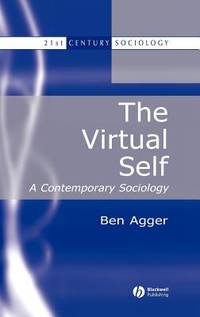
Stock photo: cover may vary
The Virtual Self Hardback - 2003 - 1st Edition
by Agger, Ben,
- Used
A$185.66
A$5.86
Delivery within USA
Standard delivery: 2 to 14 days
More delivery options
Standard delivery: 2 to 14 days
Ships from GreatBookPrices (Maryland, United States)
Details
- Title The Virtual Self
- Author Agger, Ben,
- Binding Hardback
- Edition number 1st
- Edition 1
- Condition New
- Pages 216
- Volumes 1
- Language ENG
- Publisher Wiley-Blackwell
- Publication date 2003-12-05
- Features Bibliography, Glossary, Index, Table of Contents
- Bookseller's Inventory # 1786992
- ISBN 9780631216483 / 0631216480
- Weight 1.89 lbs (0.86 kg)
- Dimensions 9.3 x 6.1 x 0.85 in (23.62 x 15.49 x 2.16 cm)
- Category Computers - General Information
- Library of Congress subjects Information society
- Library of Congress Catalogue Number 2003009903
- Dewey Decimal Code 303.483
- Quantity available 5
About GreatBookPrices Maryland, United States
Biblio member since 2024
Since 1991, we have worked every day to serve our customers with state-of-the-art technology and world class service. We are dedicated to providing customers around the world with the widest selection of books, DVDs, and CDs at the absolute lowest price.
Summary
The Virtual Self is an engaging and exciting text that addresses issues relating to our rapidly changing society, social structure, and communication needs. In doing so, it addresses major issues in sociology that inform virtually all of a student's course work.Introduces students to concepts of the self and society in an age of rapid technology and high speed communication. Examines the relationship between everyday life and social structure in key domains of communication, personality, work/family, leisure and entertainment, and economics. Written in a lively, engaging style for readers without a sociological background.
Reader reviews for The Virtual Self
Write a review for this book
Important Terms and Guidelines
- Please focus on the book’s content and context. Also, add any personal comments as to how you enjoyed the book. Substantiate your likes and dislikes. You may make comparisons to other books.
- Reviews must be at least 140 characters in length.
- Please do not reveal critical plot elements.
- This is not a help line. Contact customer support if you need help.
Your review must not include:
- Obscenities, discriminatory language, or other insulting language not suitable for public domain
- Advertisements, “spam” content, or references to other products, offers or websites.
- Email addresses, URLs, phone numbers, physical addresses or other contact information.
- Overly critical comments about other reviews or reviewers
- Time-sensitive material (i.e. promotional tours, seminars, lectures, etc.)
- Availability, price, or alternative ordering/shipping information
From the publisher
First line
Does the Internet require that we revise sociology's and social theory's categories?
From the rear cover
The Virtual Self is a concise, critical introduction to social life in an age of rapid technology and high speed communication. It addresses a fundamental question of our time: is contemporary society significantly different from the society that formed the theories and basic concepts of the founders of sociology?
The Virtual Self addresses major issues in sociology that inform virtually all of a student's course work. Of central concern is the relationship between everyday life and social structure in key domains of communication, personality, work/family, leisure and entertainment, and economics. At the same time, the book advances an argument about our stage of civilization, joining dialogue with critical thinkers and theorists who bemoan the loss of community and civic discourse. These perspectives from critical theory and postmodernism are introduced in readable, digestible ways as discussions are linked to standard sociological concerns such as the relationship between self and society.
Written in a lively, accessible style, The Virtual Self presumes no sociological background and cites ample literature for further reference. Students and scholars will find it an engaging and exciting text.
Media reviews
Citations
- Choice, 07/01/2004, Page 2128

