
Stock photo: cover may vary
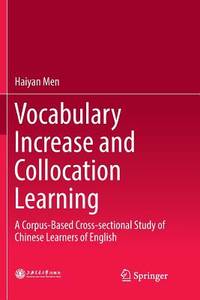
Vocabulary Increase and Collocation Learning: A Corpus-Based Cross-sectional Study of Chinese Learners of English (Perspectives on Rethinking and Reforming Education) Paperback - 2019
by Men, Haiyan
- Used
- Good
- Paperback
A$166.13
Free Delivery within USA
Standard delivery: 7 to 14 days
More delivery options
Standard delivery: 7 to 14 days
Dropship order
Ships from Bonita (California, United States)
Details
- Title Vocabulary Increase and Collocation Learning: A Corpus-Based Cross-sectional Study of Chinese Learners of English (Perspectives on Rethinking and Reforming Education)
- Author Men, Haiyan
- Binding Paperback
- Condition Used - Good
- Pages 206
- Volumes 1
- Language ENG
- Publisher Springer
- Publication date 2019-02-09
- Illustrated Yes
- Features Illustrated
- Bookseller's Inventory # 9811355002.G
- ISBN 9789811355004 / 9811355002
- Weight 0.7 lbs (0.32 kg)
- Dimensions 9.21 x 6.14 x 0.47 in (23.39 x 15.60 x 1.19 cm)
- Category Education / Teaching
- Dewey Decimal Code 371.3
- Quantity available 1
About Bonita California, United States
Reader reviews for Vocabulary Increase and Collocation Learning: A Corpus-Based Cross-sectional Study of Chinese Learners of English (Perspectives on Rethinking and Reforming Education)
Write a review for this book
Important Terms and Guidelines
- Please focus on the book’s content and context. Also, add any personal comments as to how you enjoyed the book. Substantiate your likes and dislikes. You may make comparisons to other books.
- Reviews must be at least 140 characters in length.
- Please do not reveal critical plot elements.
- This is not a help line. Contact customer support if you need help.
Your review must not include:
- Obscenities, discriminatory language, or other insulting language not suitable for public domain
- Advertisements, “spam” content, or references to other products, offers or websites.
- Email addresses, URLs, phone numbers, physical addresses or other contact information.
- Overly critical comments about other reviews or reviewers
- Time-sensitive material (i.e. promotional tours, seminars, lectures, etc.)
- Availability, price, or alternative ordering/shipping information
From the publisher
From the rear cover
This book highlights research that expands on our knowledge of second- language collocation acquisition. It presents original findings based on the largest collocation database to date, encompassing over 8,000 collocations: verb + noun, adjective + noun, and noun + noun. These collocations, collected from a one-million-learner corpus, were not confined to English as a foreign language (EFL) learners at a particular proficiency level, but also included learners at three levels. As such, the book provides a panoramic view regarding L2 collocation acquisition, not only in terms of learners' acquisition of different types of collocations, but in terms of the developmental patterns in L2 collocation learning. One major discovery is that there is a collocation lag as learners' proficiency levels rise, which is associated with vocabulary increase, in particular semantic domains--a remarkable insight for second-language acquisition researchers, English teachers and EFL learners alike. The findings reported shed new light on how collocations are acquired by EFL learners, offering guidance on how they can best be taught. In closing, the book discusses pedagogical aspects that arise from considering how learners can be helped with collocation learning.

