BIBLIO is the largest independent book marketplace in the world, with over 100 million books.

Skip to content

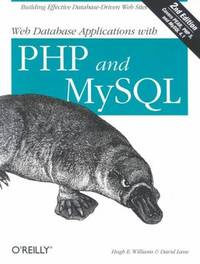
Web Database Applications with PHP and MySQL : Building Effective Database-Driven Web Sites

Web Database Applications with PHP and MySQL : Building Effective Database-Driven Web Sites

Web Database Applications with PHP and MySQL : Building Effective Database-Driven Web Sites Paperback - 2004

by Hugh E. Williams; David Lane

Add to wish list
  • Used
  • very good
  • Paperback
Used - Very good

Description

O'Reilly Media, Incorporated, 2004. Paperback. Very Good. May have limited writing in cover pages. Pages are unmarked. ~ ThriftBooks: Read More, Spend Less.Dust jacket quality is not guaranteed.
Ask the seller a question Add to wish list
A$10.22
Free Delivery within USA
Standard delivery: 4 to 8 days
More delivery options
Ships from ThriftBooks (Washington, United States)

Details

About ThriftBooks Washington, United States

Biblio member since 2018

From the largest selection of used titles, we put quality, affordable books into the hands of readers

Terms of Sale: 30 day return guarantee, with full refund including original shipping costs for up to 30 days after delivery if an item arrives misdescribed or damaged.

Browse books from ThriftBooks

Reader reviews for Web Database Applications with PHP and MySQL : Building Effective Database-Driven Web Sites

From the publisher

There are many reasons for serving up dynamic content from a web site: to offer an online shopping site, create customized information pages for users, or just manage a large volume of content through a database. Anyone with a modest knowledge of HTML and web site management can learn to create dynamic content through the PHP programming language and the MySQL database. This book gives you the background and tools to do the job safely and reliably. Web Database Applications with PHP and MySQL, Second Edition thoroughly reflects the needs of real-world applications. It goes into detail on such practical issues as validating input (do you know what a proper credit card number looks like?), logging in users, and using templates to give your dynamic web pages a standard look. But this book goes even further. It shows how JavaScript and PHP can be used in tandem to make a user's experience faster and more pleasant. It shows the correct way to handle errors in user input so that a site looks professional. It introduces the vast collection of powerful tools available in the PEAR repository and shows how to use some of the most popular tools. Even while it serves as an introduction to new programmers, the book does not omit critical tasks that web sites require. For instance, every site that allows updates must handle the possibility of multiple users accessing data at the same time. This book explains how to solve the problem in detail with locking. Through a sophisticated sample application--Hugh and Dave's Wine Store--all the important techniques of dynamic content are introduced. Good design is emphasized, such as dividing logic from presentation. The book introduces PHP 5 and MySQL 4.1 features, while providing techniques that can be used on older versions of the software that are still in widespread use. This new edition has been redesigned around the rich offerings of PEAR. Several of these, including the Template package and the database-independent query API, are fully integrated into examples and thoroughly described in the text. Topics include:
  • Installation and configuration of Apache, MySQL, and PHP on Unix(R), Windows(R), and Mac OS(R) X systems
  • Introductions to PHP, SQL, and MySQL administration
  • Session management, including the use of a custom database for improved efficiency
  • User input validation, security, and authentication
  • The PEAR repository, plus details on the use of PEAR DB and Template classes
  • Production of PDF reports

Media reviews

Citations

  • Library Journal, 12/01/2004, Page 152

About the author

Hugh E. Williams is a software design engineer at Microsoft's Windows Live Search in Redmond, WA. Previously, he was the Associate Professor in Information Retrieval at RMIT University in Melbourne, Australia. He's published over 70 research papers and holds around 10 patents, mostly in the search engine area. When not at work Hugh likes to hang out with his family, exercise, watch Richmond play footy, and learn about baseball. Hugh has a PhD from RMIT University. His home page is http: //hughwilliams.com.

Since the mid 1990s David Lane has worked as a software engineer and IT manager with the Multimedia Database Systems group at RMIT University in Melbourne, Australia. In that group he has helped to develop and commercialize the Structured Information Manager, a large-scale SGML/XML document repository and a high performance Web server. David has also worked with Australia's largest telecommunications company, Telstra, in areas as diverse as Satellite Communications, Human Factors Research, and Electronic Document Interchange (EDI). David has a Bachelor's degree in Applied Science (majoring in mathematics and computer science) from Swinburne University.

tracking-