BIBLIO is the largest independent book marketplace in the world, with over 100 million books.

Skip to content

Why Does E=mc2? : And Why Should We Care?

Why Does E=mc2? : And Why Should We Care?

Why Does E=mc2? : And Why Should We Care?
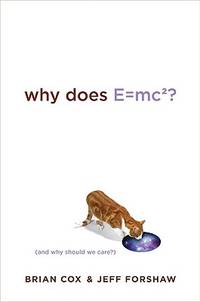
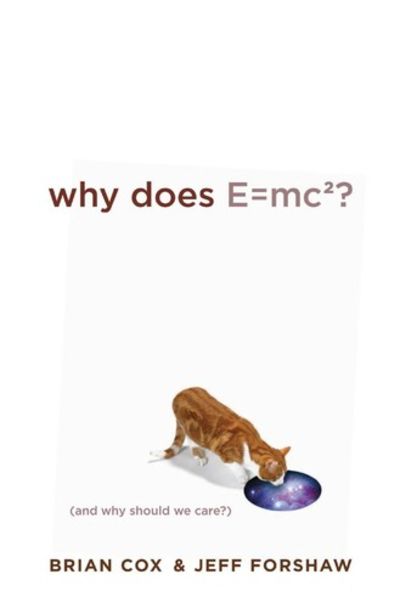
Stock photo: cover may vary

Why Does E=mc2? : And Why Should We Care? Hardback - 2009

by Forshaw, Jeff, Cox, Brian

Add to wish list
  • Used
Used - Very good

Description

Hachette Books. Used - Very Good. Pages intact with possible writing/highlighting. Binding strong with minor wear. Dust jackets/supplements may not be included. Stock photo provided. Product includes identifying sticker. Better World Books: Buy Books. Do Good.
Ask the seller a question Add to wish list
A$16.65
Free Delivery within USA
Standard delivery: 4 to 14 days
More delivery options
Ships from Better World Books (Nevada, United States)

Details

  • Title Why Does E=mc2? : And Why Should We Care?
  • Author Forshaw, Jeff, Cox, Brian
  • Binding Hardback
  • Edition First Edition
  • Condition Used - Very good
  • Pages 249
  • Volumes 1
  • Language ENG
  • Publisher Hachette Books, NY
  • Publication date 2009-07
  • Illustrated Yes
  • Bookseller's Inventory # 3986358-20
  • ISBN 9780306817588 / 0306817586
  • Weight 0.83 lbs (0.38 kg)
  • Dimensions 8.66 x 6.34 x 0.99 in (22.00 x 16.10 x 2.51 cm)
  • Category Science
  • Library of Congress subjects Space and time - Mathematics, Special relativity (Physics) - Mathematics
  • Library of Congress Catalogue Number 2009009291
  • Dewey Decimal Code 530.11
  • Quantity available 1

About Better World Books Nevada, United States

Biblio member since 2010

Better World Books is a for-profit, socially conscious business and a global online bookseller that collects and sells new and used books online, matching each purchase with a book donation. Each sale generates funds for literacy and education initiatives in the U.S., the U.K., and around the world. Since its launch in 2003, Better World Books has raised over $35 million for libraries and literacy, donated over 38 million books, and reused or recycled more than 475 million books.

Terms of Sale: Better World Books ("BWB") values your satisfaction and offers you returns within thirty (30) days after the estimated delivery date on most items. All returned items must be in the original condition; used items should include the SKU sticker located on the spine or back of the product. If you have an incomplete, incorrect, or damaged shipment, please contact our Customer Care team via Biblio's contact seller options before proceeding with the return. Please keep in mind that because we deal mostly in used books, any extra components, such as CDs, DVDs, figurines, or access codes are not included.

Browse books from Better World Books

Reader reviews for Why Does E=mc2? : And Why Should We Care?

From the publisher

The most accessible, entertaining, and enlightening explanation of the best-known physics equation in the world, as rendered by two of today's leading scientists.

Professor Brian Cox and Professor Jeff Forshaw go on a journey to the frontier of 21st century science to consider the real meaning behind the iconic sequence of symbols that make up Einstein's most famous equation, E=mc2. Breaking down the symbols themselves, they pose a series of questions: What is energy? What is mass? What has the speed of light got to do with energy and mass? In answering these questions, they take us to the site of one of the largest scientific experiments ever conducted. Lying beneath the city of Geneva, straddling the Franco-Swiss boarder, is a 27 km particle accelerator, known as the Large Hadron Collider. Using this gigantic machine--which can recreate conditions in the early Universe fractions of a second after the Big Bang--Cox and Forshaw will describe the current theory behind the origin of mass.

Alongside questions of energy and mass, they will consider the third, and perhaps, most intriguing element of the equation: 'c' - or the speed of light. Why is it that the speed of light is the exchange rate? Answering this question is at the heart of the investigation as the authors demonstrate how, in order to truly understand why E=mc2, we first must understand why we must move forward in time and not backwards and how objects in our 3-dimensional world actually move in 4-dimensional space-time. In other words, how the very fabric of our world is constructed. A collaboration between two of the youngest professors in the UK, Why Does E=mc2? promises to be one of the most exciting and accessible explanations of the theory of relativity in recent years.

About the author

Brian Cox is a professor of particle physicist and Royal Society University Research Fellow at the University of Manchester. He divides his time between Manchester in the UK and the CERN laboratory in Geneva, where he heads an international project to upgrade the giant ATLAS and CMS detectors at the Large Hadron Collider. He has received many awards for his work promoting science, including being elected an International Fellow of the Explorers Club in 2002, an organization whose members include Neil Armstrong and Chuck Yeager. He is also a popular presenter on TV and radio, with credits which including a six-part series on Einstein for BBC Radio 4, 3 BBC Horizon programs on Gravity, Time and Nuclear Fusion, and a BBC4 documentary about the LHC at CERN, "The Big Bang Machine." He was the Science Advisor on Danny Boyle's movie, the science-fiction thriller Sunshine. Brian also has an unorthodox background in the music business, having toured the world with various bands and played keyboard with D: REAM, who had several UK Top 10 hits including Things Can Only Get Better (re-released & used as Tony Blair's election anthem back in 1997.

Jeff Forshaw is professor of theoretical physics at the University of Manchester, specializing in the physics of elementary particles. He was awarded the Institute of Physics Maxwell Medal in 1999 for outstanding contributions to theoretical physics. He graduated from Oxford University and gained a PhD from Manchester University. From 1992-1995 he worked in Professor Frank Close's group at the Rutherford Appleton Laboratory before returning to Manchester in 1995. Jeff is an enthusiastic lecturer and currently teaches Einstein's Theory of Relativity to first year undergraduates. He has co-writing an undergraduate textbook on relativity for Wiley and he is the author of an advanced level monograph on particle physics for Cambridge University Press.

Cox and Forshaw began collaborating on scientific papers in 1998, and have published on topics ranging from Pomerons to Higgs Bosons. Their most successful paper to date deals with physics at the Large Hadron Collider in the absence of a Higgs particle.

tracking-