
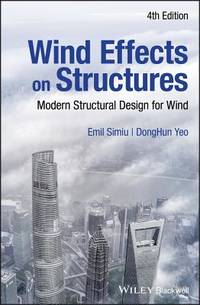
Stock photo: cover may vary
Wind Effects on Structures: Modern Structural Design for Wind Hardback - 2019
by Simiu, Emil
- Used
- Hardback
A$244.08
Free Delivery within USA
Standard delivery: 5 to 10 days
More delivery options
Standard delivery: 5 to 10 days
Dropship order
Ships from Ergodebooks (Texas, United States)
Details
- Title Wind Effects on Structures: Modern Structural Design for Wind
- Author Simiu, Emil
- Binding Hardback
- Edition 4
- Condition Used: Good
- Pages 528
- Volumes 1
- Language ENG
- Publisher Wiley-Blackwell
- Publication date 2019-03-11
- Features Bibliography, Index
- Bookseller's Inventory # SONG1119375886
- ISBN 9781119375883 / 1119375886
- Weight 2.5 lbs (1.13 kg)
- Dimensions 9.7 x 6.9 x 1.2 in (24.64 x 17.53 x 3.05 cm)
- Size 7.00x1.25x9.75
- Category Technology & Industrial Arts
- Library of Congress subjects Wind-pressure, Wind resistant design
- Library of Congress Catalogue Number 2018038948
- Dewey Decimal Code 624.175
- Quantity available 1
About Ergodebooks Texas, United States
Biblio member since 2005
Our goal is to provide best customer service and good condition books for the lowest possible price. We are always honest about condition of book. We list book only by ISBN # and hence exact book is guaranteed.
We have 30 day return policy.
Reader reviews for Wind Effects on Structures: Modern Structural Design for Wind
Write a review for this book
Important Terms and Guidelines
- Please focus on the book’s content and context. Also, add any personal comments as to how you enjoyed the book. Substantiate your likes and dislikes. You may make comparisons to other books.
- Reviews must be at least 140 characters in length.
- Please do not reveal critical plot elements.
- This is not a help line. Contact customer support if you need help.
Your review must not include:
- Obscenities, discriminatory language, or other insulting language not suitable for public domain
- Advertisements, “spam” content, or references to other products, offers or websites.
- Email addresses, URLs, phone numbers, physical addresses or other contact information.
- Overly critical comments about other reviews or reviewers
- Time-sensitive material (i.e. promotional tours, seminars, lectures, etc.)
- Availability, price, or alternative ordering/shipping information
From the publisher
From the rear cover
Provides structural engineers with the knowledge and practical tools needed to perform structural designs for wind that incorporate major technological, conceptual, analytical and computational advances achieved in the last two decades
With clear explanations and documentation of the concepts, methods, algorithms, and software available for accounting for wind loads in structural design, it also describes the wind engineer's contributions in sufficient detail that they can be effectively scrutinized by the structural engineer in charge of the design.
Wind Effects on Structures: Modern Structural Design for Wind, 4th Edition is organized in four sections. The first covers atmospheric flows, extreme wind speeds, and bluff body aerodynamics. The second examines the design of buildings, and includes chapters on aerodynamic loads; dynamic and effective wind-induced loads; wind effects with specified MRIs; low-rise buildings; tall buildings; and more. The third part is devoted to aeroelastic effects, and covers both fundamentals and applications. The last part considers other structures and special topics such as trussed frameworks; offshore structures; and tornado effects.
Offering readers the knowledge and practical tools needed to develop structural designs for wind loadings, this book:
- Points out significant limitations in the design of buildings based on techniques such as the high-frequency force balance
- Discusses powerful algorithms, tools, and software needed for the effective design for wind, and provides numerous examples of application
- Discusses techniques applicable to structures other than buildings, including stacks and suspended-span bridges
- Features several appendices on Elements of Probability and Statistics; Peaks-over-Threshold Poisson-Process Procedure for Estimating Peaks; estimates of the WTC Towers' Response to Wind and their shortcomings; and more
Wind Effects on Structures: Modern Structural Design for Wind, 4th Edition is an excellent text for structural engineers, wind engineers, and structural engineering students and faculty.

