BIBLIO is the largest independent book marketplace in the world, with over 100 million books.

Skip to content

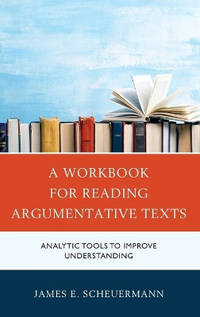
A Workbook for Reading Argumentative Texts: Analytic Tools to Improve Understanding

A Workbook for Reading Argumentative Texts: Analytic Tools to Improve Understanding

A Workbook for Reading Argumentative Texts: Analytic Tools to Improve Understanding Hardback - 2022

by James E. Scheuermann

Add to wish list
  • New
  • Hardback
New

Description

Hardback. New. his Workbook teaches the tools essential to analyzing and understanding the meaning of nonfiction texts that assert arguments.
Ask the seller a question Add to wish list
A$136.55
A$19.34 Delivery to USA
Standard delivery: 14 to 21 days
More delivery options
Ships from The Saint Bookstore (Merseyside, United Kingdom)

Details

  • Title A Workbook for Reading Argumentative Texts: Analytic Tools to Improve Understanding
  • Author James E. Scheuermann
  • Binding Hardback
  • Condition New
  • Pages 154
  • Volumes 1
  • Language ENG
  • Publisher Rowman & Littlefield Publishers
  • Publication date 2022-08-15
  • Features Bibliography, Dust Cover
  • Bookseller's Inventory # A9781475864731
  • ISBN 9781475864731 / 1475864736
  • Weight 0.88 lbs (0.40 kg)
  • Dimensions 9 x 6 x 0.5 in (22.86 x 15.24 x 1.27 cm)
  • Category Education / Teaching
  • Library of Congress subjects Persuasion (Rhetoric), English language - Rhetoric
  • Library of Congress Catalogue Number 2021050066
  • Dewey Decimal Code 160
  • Quantity available 10

About The Saint Bookstore Merseyside, United Kingdom

Biblio member since 2018

The Saint Bookstore specialises in hard to find titles & also offers delivery worldwide for reasonable rates.

Terms of Sale: Refunds or Returns: A full refund of the price paid will be given if returned within 30 days in undamaged condition. If the product is faulty, we may send a replacement.

Browse books from The Saint Bookstore

Reader reviews for A Workbook for Reading Argumentative Texts: Analytic Tools to Improve Understanding

From the publisher

This Workbook is a collection of exercises and case studies designed to serve as a companion to Reading Argumentative Texts: Analytic Tools to Improve Understanding. The exercises and case studies track each of the chapters of Reading and provide opportunities for students to hone their skills at using the analytic tools presented in Reading, and to acquire additional analytic tools and concepts. These tools are illustrated through the analysis of complete essays from the mass media, speeches, a sermon, and passages from academic works.

The approach is flexible and practical and avoids academic jargon and specific theories of argumentation. As is the case with Reading, this Workbook is grounded in two principles. First, that the meaning of an argumentative text is to be found in the statements that constitute the argument itself, in other statements that are more or less directly related to the argument, and in the structure and context of the text. Accordingly, while this book discusses the analysis of arguments, argument-types, and errors in argumentation (fallacies), it focuses equally on the other sources of meaning of a text. Second, there is no single, authoritative reading of an argumentative text.

The interplay of these two premises informs the view that analyzing and understanding an argumentative text is an art and that, within certain well-defined parameters, there are "better" and "worse" readings of a text and not "right" or "wrong" readings.

The principal sources of meaning discussed include: (1) the structure of the text (and so the book examines six types of introductions and teaches how to outline and summarize), (2) key sentences, phrases, and words in a text (so the book discusses ambiguity, the difference between factual and normative statements, irony, and rhetoric), (3) context (intellectual, social, political, cultural, and physical context), and (4) the logical connections between terms in an argument (including the four different types of arguments, fallacies, and the distinction between necessary and sufficient conditions).

The book is designed to be used in late high school or early college critical reading, critical thinking, rhetoric, or writing courses.

About the author

James E. Scheuermann received his Ph.D. (in philosophy) from the University of Chicago and his J.D. from the University of Pittsburgh School of Law. For more than 40 years, as a high school and college teacher and lawyer, he has been analyzing argumentative texts for his students and professional colleagues. He is the author of numerous articles in scholarly philosophy journals and law reviews, and in other legal publications.
tracking-