BIBLIO is the largest independent book marketplace in the world, with over 100 million books.

Skip to content

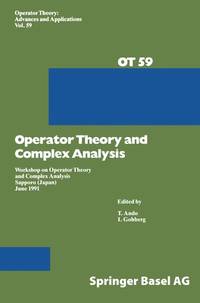
Workshop on Operator Theory and Complex Analysis: Sapporo, Japan, June 1991 (Operator Theory: Advances and Applications)

Workshop on Operator Theory and Complex Analysis: Sapporo, Japan, June 1991 (Operator Theory: Advances and Applications)

Workshop on Operator Theory and Complex Analysis: Sapporo, Japan, June 1991
Stock photo: cover may vary
Click to view full size.
Workshop on Operator Theory and Complex Analysis: Sapporo, Japan, June 1991 (Operator Theory: Advances and Applications) Hardback - 1992 - 1st Edition

by T. Ando/ I. Gohberg

Add to wish list
  • New
  • Hardback
New

Description

Birkhäuser Basel, 1992. Hardcover. New. 1st edition. 406 pages. German language. 9.88x7.01x1.14 inches.
Ask the seller a question Add to wish list
A$236.74
A$29.00 Delivery to USA
Standard delivery: 7 to 14 days
More delivery options
Ships from Revaluation Books (Devon, United Kingdom)

Details

  • Title Workshop on Operator Theory and Complex Analysis: Sapporo, Japan, June 1991 (Operator Theory: Advances and Applications)
  • Author T. Ando/ I. Gohberg
  • Binding Hardback
  • Edition number 1st
  • Edition 1
  • Condition New
  • Pages 420
  • Volumes 1
  • Language ENG
  • Publisher Birkhäuser Basel
  • Publication date 1992
  • Illustrated Yes
  • Features Bibliography, Illustrated
  • Bookseller's Inventory # x-376432824X
  • ISBN 9783764328245 / 376432824X
  • Weight 1.91 lbs (0.87 kg)
  • Dimensions 9.61 x 6.69 x 0.94 in (24.41 x 16.99 x 2.39 cm)
  • Category Mathematics
  • Library of Congress Catalogue Number 92036581
  • Dewey Decimal Code 515.724
  • Quantity available 2

About Revaluation Books Devon, United Kingdom

Biblio member since 2020

General bookseller of both fiction and non-fiction.

Terms of Sale: 30 day return guarantee, with full refund including original shipping costs for up to 30 days after delivery if an item arrives misdescribed or damaged.

Browse books from Revaluation Books

Reader reviews for Workshop on Operator Theory and Complex Analysis: Sapporo, Japan, June 1991 (Operator Theory: Advances and Applications)

From the publisher

Scattering matrices for microschemes.- 1. General expressions for the scattering matrix.- 2. Continuity condition.- References.- Holomorphic operators between Krein spaces and the number of squares of associated kernels.- 0. Introduction.- 1. Realizations of a class of Schur functions.- 2. Positive squares and injectivity.- 3. Application of the Potapov-Ginzburg transform.- References.- On reproducing kernel spaces, the Schur algorithm, and interpolation in a general class of domains.- 1. Introduction.- 2. Preliminaries.- 3. B(X) spaces.- 4. Recursive extractions and the Schur algorithm.- 5. H?(S) spaces.- 6. Linear fractional transformations.- 7. One sided interpolation.- 8. References.- The central method for positive semi-definite, contractive and strong Parrott type completion problems.- 1. Introduction.- 2. Positive semi-definite completions.- 3. Contractive completions.- 4. Linearly constrained contractive completions.- References.- Interpolation by rational matrix functions and stability of feedback systems: The 4-block case.- 1. Preliminaries.- 2. A homogeneous interpolation problem.- 3. Interpolation problem.- 4. Parametrization of solutions.- 5. Interpolation and internally stable feedback systems.- References.- Matricial coupling and equivalence after extension.- 1. Introduction.- 2. Coupling versus equivalence.- 3. Examples.- 4. Special classes of operators.- References.- Operator means and the relative operator entropy.- 1. Introduction.- 2. Origins of operator means.- 3. Operator means and operator monotone functions.- 4. Operator concave functions and Jensen's inequality.- 5. Relative operator entropy.- References.- An application of Furuta's inequality to Ando's theorem.- 1. Introduction.- 2. Operator functions.- 3. Furuta's type inequalities.- 4. An application to Ando's theorem.- References.- Applications of order preserving operator inequalities.- 0. Introduction.- 1. Application to the relative operator entropy.- 2. Application to some extended result of Ando's one.- References.- The band extension of the real line as a limit of discrete band extensions, I. The main limit theorem.- 0. Introduction.- I. Preliminaries and preparations.- II. Band extensions.- III. Continuous versus discrete.- References.- Interpolating sequences in the maximal ideal space of H? II.- 1. Introduction.- 2. Condition (A2).- 3. Condition (A3).- 4. Condition (A1).- References.- Operator matrices with chordal inverse patterns.- 1. Introduction.- 2. Entry formulae.- 3. Inertia formula.- References.- Models and unitary equivalence of cyclic selfadjoint operators in Pontrjagin spaces.- 1. The class F of linear functionals.- 2. The Pontrjagin space associated with ? ? F.- 3. Models for cyclic selfadjoint operators in Pontrjagin spaces.- 4. Unitary equivalence of cyclic selfadjoint operators in Pontrjagin spaces.- References.- The von Neumann inequality and dilation theorems for contractions.- 1. The von Neumann inequality and strong unitary dilation.- 2. Canonical representation of completely contractive maps.- 3. An effect of generation of nuclear algebras.- References.- Interpolation problems, inverse spectral problems and nonlinear equations.- References.- Extended interpolation problem in finitely connected domains.- I. Matrices and transformation formulas.- II. Disc Cases.- III. Domains of finite connectivity.- References.- Accretive extensions and problems on the Stieltjes operator-valued functions relations.- 1. Accretive and sectorial extensions of the positive operators, operators of the class C(?) and their parametric representation.- 2. Stieltjes operator-valued functions and their realization.- 3. M.S. Livsic triangular model of the M-accretive extensions (with real spectrum) of the positive operators.- 4. Canonical and generalized resolvents of QSC-extensions of Hermitian contractions.- References.- Commuting nonselfadjoint operators and algebraic curves.- 1. Commuting nonselfadjoint operators and the discriminant curve.-...
tracking-