BIBLIO is the largest independent book marketplace in the world, with over 100 million books.

Skip to content

Writing a Proposal for Your Dissertation: Guidelines and Examples

Writing a Proposal for Your Dissertation: Guidelines and Examples

Writing a Proposal for Your Dissertation: Guidelines and Examples
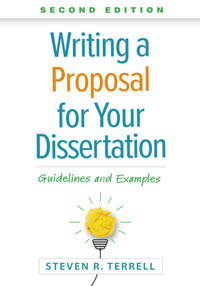
Stock photo: cover may vary

Writing a Proposal for Your Dissertation: Guidelines and Examples Hardback - 2022

by Terrell, Steven R

Add to wish list
  • New
  • Hardback
New

Description

Guilford Pubn, 2022. Hardcover. New. 2nd edition. 317 pages. 10.25x7.25x1.00 inches.
Ask the seller a question Add to wish list
A$135.86
A$29.23 Delivery to USA
Standard delivery: 7 to 14 days
More delivery options
Ships from Revaluation Books (Devon, United Kingdom)

Details

  • Title Writing a Proposal for Your Dissertation: Guidelines and Examples
  • Author Terrell, Steven R
  • Binding Hardback
  • Condition New
  • Pages 320
  • Volumes 1
  • Language ENG
  • Publisher Guilford Pubn
  • Publication date 2022
  • Illustrated Yes
  • Features Bibliography, Glossary, Illustrated, Index
  • Bookseller's Inventory # __1462550258
  • ISBN 9781462550258 / 1462550258
  • Weight 1.65 lbs (0.75 kg)
  • Dimensions 10.1 x 7.1 x 0.9 in (25.65 x 18.03 x 2.29 cm)
  • Category Sociology
  • Library of Congress subjects Dissertations, Academic, Proposal writing in research
  • Library of Congress Catalogue Number 2022026258
  • Dewey Decimal Code 378.242
  • Quantity available 1

About Revaluation Books Devon, United Kingdom

Biblio member since 2020

General bookseller of both fiction and non-fiction.

Terms of Sale: 30 day return guarantee, with full refund including original shipping costs for up to 30 days after delivery if an item arrives misdescribed or damaged.

Browse books from Revaluation Books

Reader reviews for Writing a Proposal for Your Dissertation: Guidelines and Examples

From the publisher

The encouraging book that has guided thousands of students step by step through crafting a strong dissertation proposal is now in a thoroughly revised second edition. It includes new guidance for developing methodology-specific problem statements, an expanded discussion of the literature review, coverage of the four-chapter dissertation model, and more. Terrell demonstrates how to write each chapter of the proposal, including the problem statement, purpose statement, and research questions and hypotheses; literature review; and detailed plans for data collection and analysis. "Let's Start Writing" exercises serve as building blocks for drafting a complete proposal. Other user-friendly features include case-study examples from diverse disciplines, "Do You Understand?" checklists, and end-of-chapter practice tests with answers. Appendices present an exemplary proposal written three ways to demonstrate quantitative, qualitative, and mixed methods approaches, and discuss how to structure a four-chapter dissertation.

New to This Edition

  • Introduction offering a concise overview of the entire proposal-writing process and the doctoral experience.
  • Additional help with tailoring problem and purpose statements for quantitative, qualitative, and mixed-methods studies.
  • Expanded discussion of the review of literature, including a criterion for judging the quality of primary versus secondary sources.
  • Many new examples from different disciplines, such as studies of depression treatments, approaches to reducing offender recidivism, health effects of irradiated crops, strength training in college football, and remote teaching and learning during COVID-19.
  • Focus on the five-chapter model is broadened to include specific guidance for four-chapter dissertations.
  • Broader, more detailed reference list and glossary.

About the author

Steven R. Terrell, PhD, is Professor Emeritus at Nova Southeastern University. He has taught quantitative and qualitative research methods since the 1980s and is the author of over 150 journal articles, book chapters, conference papers, and presentations. Dr. Terrell is a member of the American Counseling Association and the American Psychological Association, and served as Chair of the American Educational Research Association's Online Teaching and Learning Special Interest Group. He is on the editorial boards of several national and international journals and was recently named a Fellow and Distinguished Scholar of the International Institute for Applied Knowledge Management. He is currently serving as part-time faculty in the School of Computing at Middle Georgia State University.
tracking-