BIBLIO is the largest independent book marketplace in the world, with over 100 million books.

Skip to content

You Can Do Math: Scientific Notation, Engineering Notation and Standard Form

You Can Do Math: Scientific Notation, Engineering Notation and Standard Form

You Can Do Math: Scientific Notation, Engineering Notation and Standard Form
Stock photo: cover may vary

You Can Do Math: Scientific Notation, Engineering Notation and Standard Form Paperback - 2019

by Tanna, Sunil

Add to wish list
  • Used
  • Paperback
Used: Good

Description

Independently Published, 2019-04-08. paperback. Used: Good. 8.50x0.28x11.00. Buy with confidence. Excellent Customer Service & Return policy.
Ask the seller a question Add to wish list
A$38.99
Free Delivery within USA
Standard delivery: 5 to 10 days
More delivery options
Dropship order
Ships from Ergodebooks (Texas, United States)

Details

  • Title You Can Do Math: Scientific Notation, Engineering Notation and Standard Form
  • Author Tanna, Sunil
  • Binding Paperback
  • Condition Used: Good
  • Pages 124
  • Volumes 1
  • Language ENG
  • Publisher Independently Published
  • Publication date 2019-04-08
  • Bookseller's Inventory # SONG1093288760
  • ISBN 9781093288766 / 1093288760
  • Weight 0.67 lbs (0.30 kg)
  • Dimensions 11 x 8.5 x 0.26 in (27.94 x 21.59 x 0.66 cm)
  • Size 8.50x0.28x11.00
  • Category Mathematics
  • Quantity available 1

About Ergodebooks Texas, United States

Biblio member since 2005

Our goal is to provide best customer service and good condition books for the lowest possible price. We are always honest about condition of book. We list book only by ISBN # and hence exact book is guaranteed.

Terms of Sale:

We have 30 day return policy.

Browse books from Ergodebooks

Reader reviews for You Can Do Math: Scientific Notation, Engineering Notation and Standard Form

From the publisher

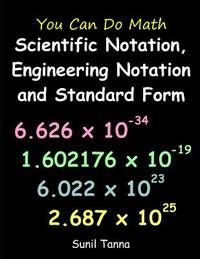
This book provides a complete guide to scientific notation (known in the UK as standard form) and engineering notation. It explains how the notation works, the advantages of using it, how to convert to and from it, how to compare numbers and orders of magnitude, and even how to perform approximate arithmetic operations (without using a calculator) such as addition, subtraction, multiplication, division, exponentiation, square roots, cube roots, and logarithms on numbers in scientific notation. There are over 200 questions and answers (answers explain how to get the answer) to help you master this important math topic.

Table of contents is:

Chapter 1: What are Scientific Notation and Engineering Notation?
Whole Number Powers of 10
What is Scientific Notation?
- Converting Decimal Numbers to Normalized Scientific Notation
- Converting Scientific Notation to Decimal
What is Normalized Scientific Notation (Standard Form)?
- Significant Figures
- Estimated Final Digits
- E-notation and Other Notational Standards
- Converting Decimal Numbers to Normalized Scientific Notation
- Converting Scientific Notation to Decimal
What is Engineering Notation?
- Significant Figures
- Engineering Notation and SI Unit Prefixes
- Converting Decimal Numbers to Engineering Notation
- Converting Engineering Notation to Decimal
Normalizing and Denormalizing Numbers in Scientific and Engineering Notation
- Increasing the Value of the Exponent and Decreasing the Absolute Value of the Coefficient
- Decreasing the Value of the Exponent and Increasing the Absolute Value of the Coefficient
- Converting a Number in Normalized Scientific Notation to Engineering Notation
- Converting a Number in Engineering Notation to Normalized Scientific Notation
Questions
Answers to Chapter 1 Questions

Chapter 2: Comparing Numbers in Scientific Notation
Comparing Numbers in Normalized Scientific Notation
Comparing Numbers in Engineering Notation
Comparing Numbers in Denormalized Scientific Notation
Questions
Answers to Chapter 2 Questions

Chapter 3: Orders of Magnitude
Definitions of Order of Magnitude
Order of Magnitude Estimates
Order of Magnitude Differences
- Approximate Order of Magnitude Differences
Questions
Answers to Chapter 3 Questions

Chapter 4: Adding & Subtraction
How to Add Numbers in Scientific and Engineering Notation
- Approximate Addition in Scientific and Engineering Notation
How to Subtract Numbers in Scientific and Engineering Notation
- Approximate Subtraction in Scientific and Engineering Notation
Questions
Answers to Chapter 4 Questions

Chapter 5: Multiplication and Division
How to Multiply Numbers in Scientific and Engineering Notation
- Approximate Multiplication in Scientific and Engineering Notation
How to Divide Numbers in Scientific and Engineering Notation
- Approximate Division in Scientific and Engineering Notation
Questions
Answers to Chapter 5 Questions

Chapter 6: Exponentiation
How to Exponentiate Numbers in Scientific and Engineering Notation
- Approximate Exponentation in Scientific and Engineering Notation
How to Find Approximate Square Roots in Scientific and Engineering Notation
How to Find Approximate Cube Roots in Scientific and Engineering Notation
Questions
Answers to Chapter 6 Questions

Chapter 7: Logarithms
How to Calculate Approximate Logarithms in Base 10
How to Calculate Approximate Logarithms in Base 2
How to Calculate Approximate Natural Logarithms
Questions
Answers to Chapter 7 Questions

Conclusion

tracking-