BIBLIO is the largest independent book marketplace in the world, with over 100 million books.

Skip to content

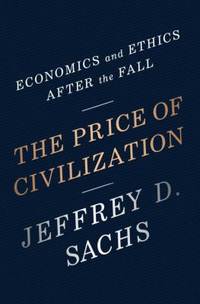
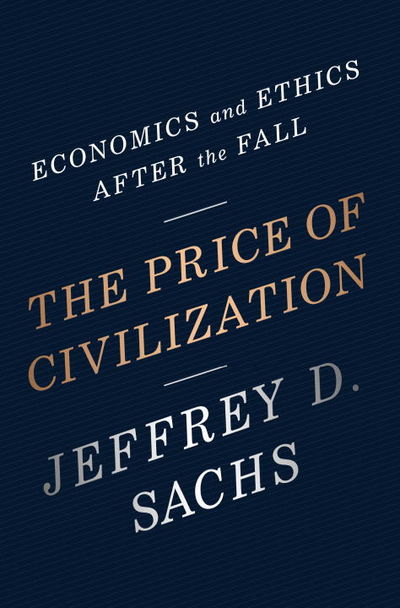
The Price of Civilization: Economics and Ethics After the Fall
Stock photo: cover may vary

The Price of Civilization: Economics and Ethics After the Fall Hardback - 2011

by Jeffrey Sachs

Add to wish list

Reader reviews for The Price of Civilization: Economics and Ethics After the Fall

From the publisher

JEFFREY D. SACHS is the Director of The Earth Institute and professor of health policy and management at Columbia University. He is also special advisor to UN Secretary-General Ban Ki-moon. From 2002-2006, he was Director of the UN Millennium Project, which set global goals to reduce extreme poverty, disease and hunger by 2015. He was among TIME's 100 most influential leaders in 2004 and 2005. He is the author of many books and articles, including Common Wealth and The End of Poverty, both of which were international bestsellers. He is one of the leading voices calling for economic development that is in line with environmental sustainabilty.

Details

  • Title The Price of Civilization: Economics and Ethics After the Fall
  • Author Jeffrey Sachs
  • Binding Hardback
  • Edition 1st Printing
  • Pages 324
  • Volumes 1
  • Language ENG
  • Publisher Random House Canada, Mississauga, ON, Canada
  • Publication date 2011-10-04
  • ISBN 9780307357571 / 0307357570
  • Category Business / Economics / Finance
  • Dewey Decimal Code 330.973

Excerpt

A Crisis of Values
 
At the root of America’s economic crisis lies a moral crisis: the decline of civic virtue among America’s political and economic elite. A society of markets, laws, and elections is not enough if the rich and powerful fail to behave with respect, honesty, and compassion toward the rest of society and toward the world. America has developed the world’s most competitive market society but has squandered its civic virtue along the way. Without restoring an ethos of social responsibility, there can be no meaningful and sustained economic recovery.
 
I fi nd myself deeply surprised and unnerved to have to write this book. During most of my forty years in economics I have assumed that America, with its great wealth, depth of learning, advanced technologies, and democratic institutions, would reliably fi nd its way to social betterment. I decided early on in my career to devote my energies to the economic challenges abroad, where I felt the economic problems were more acute and in need of attention. Now I am worried about my own country. The economic crisis of recent years refl ects a deep, threatening, and ongoing deterioration of our national politics and culture of power.
 
The crisis, I will argue, developed gradually over the course of several decades. We are not facing a short- term business cycle downturn, but the working out of long- term social, political, and economic trends. The crisis, in many ways, is the culmination of an era— the baby boomer era— rather than of particular policies or presidents. It is also a bipartisan affair: both Democrats and Republicans have played their part in deepening the crisis. On many days it seems that the only difference between the Republicans and Democrats is that Big Oil owns the Republicans while Wall Street owns the Democrats. By understanding the deep roots of the crisis, we can move beyond illusory solutions such as the “stimulus” spending of 2009–2010, the budget cuts of 2011, and the unaffordable tax cuts that are implemented year after year. These are gimmicks that distract us from the deeper reforms needed in our society.
 
The fi rst two years of the Obama presidency show that our economic and political failings are deeper than that of a particular president. Like many Americans, I looked to Barack Obama as the hope for a breakthrough. Change was on the way, or so we hoped; yet there has been far more continuity than change. Obama has continued down the well- trodden path of open- ended war in Afghanistan, massive military budgets, kowtowing to lobbyists, stingy foreign aid, unaffordable tax cuts, unprecedented budget defi cits, and a disquieting unwillingness to address the deeper causes of America’s problems. The administration is packed with individuals passing through the revolving door that connects Wall Street and the White House. In order to fi nd deep solutions to America’s economic crisis, we’ll need to understand why the American political system has proven to be so resistant to change.
 
The American economy increasingly serves only a narrow part of society, and America’s national politics has failed to put the country back on track through honest, open, and transparent problem solving. Too many of America’s elites— among the super-rich, the CEOs, and many of my colleagues in academia— have abandoned a commitment to social responsibility. They chase wealth and power, the rest of society be damned.
 
We need to reconceive the idea of a good society in the early twenty- fi rst century and to fi nd a creative path toward it. Most important, we need to be ready to pay the price of civilization through multiple acts of good citizenship: bearing our fair share of taxes, educating ourselves deeply about society’s needs, acting as vigilant stewards for future generations, and remembering that compassion is the glue that holds society together. I would suggest that a majority of the public understands this challenge and accepts it. During my research for this book, I became reacquainted with my fellow Americans, not only through countless discussions but also through hundreds of opinion surveys on, and studies of, American values. I was delighted with what I found. Americans are very different from the ways the elites and the media pundits want us to see ourselves.
 
The American people are generally broad- minded, moderate, and generous. These are not the images of Americans we see on television or the adjectives that come to mind when we think of America’s rich and powerful elite. But America’s political institutions have broken down, so that the broad public no longer holds these elites to account. And alas, the breakdown of politics also implicates the broad public. American society is too deeply distracted by our media- drenched consumerism to maintain the habits of effective citizenship.
 
Clinical Economics
 
I am a macroeconomist, meaning that I study the overall functioning of a national economy rather than the workings of one particular sector. My operating principle is that the economy is intimately interconnected with a much broader drama that includes politics, social psychology, and the natural environment. Economic issues can rarely be understood in isolation, though most economists fall into that trap. An effective macroeconomist must look at the big canvas, in which culture, domestic politics, geopolitics, public opinion, and environmental and natural resource constraints all play important roles in economic life.
 
My job as a macroeconomic adviser during the past quarter century has been to help national economies function properly by diagnosing economic crises and then correcting breakdowns in key sectors of the economy. To do that job well, I must strive to understand in detail how the different parts of the economy and society both fi t together and interact with the world economy through trade, fi nance, and geopolitics. Beyond that, I must also strive to understand the public’s beliefs, the country’s social history, and the society’s underlying values. All of this requires a broad and eclectic set of tools. Like other economists, I pore over charts and data. In addition, I read stacks of opinion surveys as well as cultural and political histories. I compare notes with political and business leaders and visit factories, fi nancial fi rms, high- tech service centers, and local community organizations. Sound ideas about economic reform must pass a “truth test” at many levels, making sense at the community level as well as the national political level.
 
A macroeconomist faces the challenge of a clinical doctor who must help a patient with serious symptoms and an unknown underlying disease. An effective response involves making a correct diagnosis about the underlying problem and then designing a treatment regimen to correct it. In my book The End of Poverty I called this process “clinical economics.” My inspiration has been my wife, Sonia, a gifted medical doctor who showed me the wonders of science- based clinical medicine.
 
I didn’t train to be a clinical economist, though fortunately my theoretical training, combined with my wife’s inspiration and some very good professional luck, enabled me to forge an unusual personal path to clinical economics. I was blessed with a fi rst- rate edu- cation as an undergraduate and graduate student at Harvard, where I later joined the faculty in 1980. With life- changing good fortune, I became involved in practical economic problem solving in Bolivia in 1985, and from then on I have built a career at the intersection of theory and practice. I spent much of the 1980s working in debt- ridden Latin America to help support that region’s return to democracy and macroeconomic stability after two decades of incompetent and violent military rule. In the late 1980s and early 1990s I was invited to help Eastern Europe and the former Soviet Union in their transitions from communism and dictatorship to democracy and market economy. That work, in turn, brought me invitations to the world’s two great behemoths, China and India, where I could watch, debate, and share ideas about the world- changing market reforms of those two great societies. Since the mid- 1990s, I have turned much of my attention to the poorest regions of the world, and especially to sub- Saharan Africa, to try to assist them in their ongoing fi ght against poverty, hunger, disease, and climate change. Having worked in and diagnosed dozens of economies over my career, I’ve come to have a good feel for the interplay of politics, economics, and a society’s values. Lasting economic solutions are found when all of these components of social life are brought into a proper balance.
 
In this book I will bring clinical economics to bear on America’s economic crisis. By taking a holistic view of America’s economic problems, I hope to diagnose some of the deeper maladies affl icting our society today and to correct the basic misdiagnosis that was made thirty years ago and that still sticks today. When the U.S. economy hit the skids in the 1970s, the political Right, represented by Ronald Reagan, claimed that government was to blame for its growing ills. This diagnosis, although incorrect, had a plausible ring to it to enough Americans to enable the Reagan coalition to begin a process of dismantling effective government programs and undermining the government’s capacity to help steer the economy. We are still living with the disastrous consequences of that failed diagnosis, and we continue to ignore the real challenges, involving globalization, technological change, and environmental threats.

Media reviews

New York Times Bestseller
 
“The ideas in the book have a hook you won’t forget.... In Jeff’s hands, the millstone of opportunity around our necks becomes an adventure, something doable and achievable.”
—Bono
 
“A useful contribution to the conversation we must have in order to make informed political choices in the years ahead.”
The Wall Street Journal
 
“An important assessment of what ails America, and a must-read for policymakers.”
Kirkus Reviews
 
This is the latest in a spate of books provoked by the world economic crisis and one of the best.... He is a fine economist and statistician, and if you want to stockpile facts and arguments for radical advocacy, this is the book for you.”
The Guardian
 
“An important book.... The sheer sweep of his analysis...flouts the boundaries of economics to encompass politics, psychology and moral philosophy.”
Financial Times

“The author’s straightforward exposition, buttressed by a wealth of revealing tables and charts, sharply rebuts reigning free market orthodoxies and makes a compelling case for an activist state that redistributes wealth and makes life fairer and more productive for everyone. . . . His stimulating, staunchly progressive take on America’s dysfunctions is a must-read for every concerned citizen.”
Publishers Weekly (starred review)

Praise for Jeffrey Sachs:
"Jeffrey Sachs is that rare phenomenon: an academic economist famous for his theories about why some countries are poor and others rich, and also famous for his successful practical work in helping poor countries become richer."
— Jared Diamond, Pulitzer Prize-winning author of Guns, Germs and Steel and Collapse

About the author

JEFFREY D. SACHS is the Director of The Earth Institute and professor of health policy and management at Columbia University. He is also special advisor to UN Secretary-General Ban Ki-moon. From 2002-2006, he was Director of the UN Millennium Project, which set global goals to reduce extreme poverty, disease and hunger by 2015. He was among "TIME's "100 most influential leaders in 2004 and 2005. He is the author of many books and articles, including Common Wealth and The End of Poverty, both of which were international bestsellers. He is one of the leading voices calling for economic development that is in line with environmental sustainabilty.

More Copies for Sale

The Price of Civilization: Economics and Ethics After the Fall

The Price of Civilization: Economics and Ethics After the Fall

by Sachs, Jeffrey D.

  • Used
  • Good
  • Hardback
Condition
Good
Binding
Hardcover
ISBN 10 / ISBN 13
9780307357571 / 0307357570
Quantity available
3
Seller
Item price
A$17.37
Free Delivery to USA
Show details

Description:
Random House Canada, 2011. Hardcover. Good. Disclaimer:A copy that has been read, but remains in clean condition. All pages are intact, and the cover is intact. The spine may show signs of wear. Pages can include limited notes and highlighting, and the copy can include previous owner inscriptions. At ThriftBooks, our motto is: Read More, Spend Less.Dust jacket quality is not guaranteed.
Add to wish list
Item price
A$17.37
Free Delivery to USA
The Price of Civilization: Economics and Ethics After the Fall

The Price of Civilization: Economics and Ethics After the Fall

by Sachs, Jeffrey D.

  • Used
  • Very good
  • Hardback
Condition
Very good
Binding
Hardcover
ISBN 10 / ISBN 13
9780307357571 / 0307357570
Quantity available
2
Seller
Item price
A$17.37
Free Delivery to USA

Show details

Description:
Random House Canada, 2011. Hardcover. Very Good. May have limited writing in cover pages. Pages are unmarked. ~ ThriftBooks: Read More, Spend Less.Dust jacket quality is not guaranteed.
Add to wish list
Item price
A$17.37
Free Delivery to USA
Price of Civilization : Economics and Ethics after the Fall
Stock photo: cover may vary

Price of Civilization : Economics and Ethics after the Fall

by Sachs, Jeffrey D

  • Used
Condition
Used
ISBN 10 / ISBN 13
9780307357571 / 0307357570
Quantity available
1
Seller
Item price
A$20.71
Free Delivery to USA

Show details

Description:
Used - Very Good. Pages intact with possible writing/highlighting. Binding strong with minor wear. Dust jackets/supplements may not be included. Stock photo provided. Product includes identifying sticker. Better World Books: Buy Books. Do Good.
Add to wish list
Item price
A$20.71
Free Delivery to USA
Price of Civilization: Economics and Ethics After the Fall
Stock photo: cover may vary

Price of Civilization: Economics and Ethics After the Fall

by Jeffrey Sachs

  • Used
  • Hardback
Condition
Very Good+
Binding
Hardcover
ISBN 10 / ISBN 13
9780307357571 / 0307357570
Quantity available
1
Seller
Item price
A$23.20
A$26.10 Delivery to USA

Show details

Description:
Random House Canada, October 2011. Hardcover . Very Good+/Good+. Binding is square, tight, and solid. Pages are clean, unmarked, and not bent. Dust jacket is edgeworn.
Add to wish list
Item price
A$23.20
A$26.10 Delivery to USA
The Price of Civilization: Economics and Ethics After the Fall
Stock photo: cover may vary

The Price of Civilization: Economics and Ethics After the Fall

by Jeffrey D. Sachs

  • Used
  • Very good
  • Hardback
  • first
Condition
Very good
Edition
First edition
Binding
Hardcover
ISBN 10 / ISBN 13
9780307357571 / 0307357570
Quantity available
1
Seller
Item price
A$24.65
A$72.51 Delivery to USA

Show details

Description:
Toronto: Random House Canada, 2011. First edition. Hardcover. Very good/Very good. 8vo. pp.324
Add to wish list
Item price
A$24.65
A$72.51 Delivery to USA
The Price of Civilization: Economics and Ethics After the Fall
Stock photo: cover may vary

The Price of Civilization: Economics and Ethics After the Fall

by Sachs, Jeffrey D.

  • Used
  • Good
  • Hardback
Condition
Good
Binding
Hardcover
ISBN 10 / ISBN 13
9780307357571 / 0307357570
Quantity available
1
Seller
Item price
A$56.99
Free Delivery to USA

Show details

Description:
hardcover. Good. Access codes and supplements are not guaranteed with used items. May be an ex-library book.
Add to wish list
Item price
A$56.99
Free Delivery to USA
The Price of Civilization : American Values and the Return to Prosperity
Stock photo: cover may vary

The Price of Civilization : American Values and the Return to Prosperity

by Sachs, Jeffrey D

  • Used
  • Fine
  • Hardback
  • first
Condition
Excellent
Binding
Hardcover
ISBN 10 / ISBN 13
9780307357571 / 0307357570
Quantity available
1
Seller
Item price
A$66.40
A$13.04 Delivery to USA

Show details

Description:
Mississauga, ON, Canada: Random House of Canada, Limited, 2011. Hardcover. Fine/Fine. 9x6x1. First Edition. Clean No Remarks Or Highlights Inside. 324 Pages With The Index. Hardcover With A Dust Jacket.- Specializing in academic, collectible and historically significant, providing the utmost quality and customer service satisfaction. For any questions feel free to email us.
Add to wish list
Item price
A$66.40
A$13.04 Delivery to USA