BIBLIO is the largest independent book marketplace in the world, with over 100 million books.

Skip to content

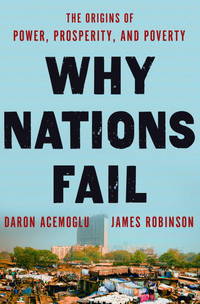
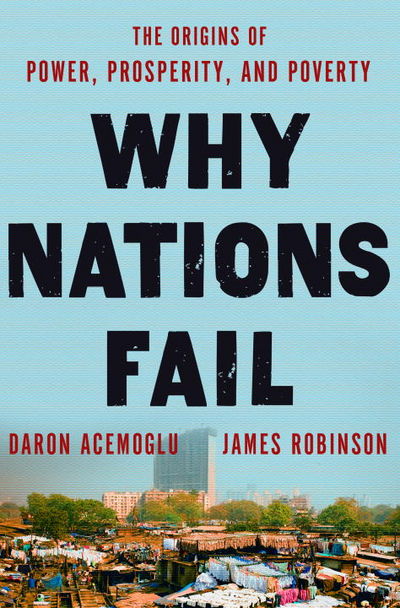
Why Nations Fail: The Origins of Power, Prosperity, and Poverty
Stock photo: cover may vary

Why Nations Fail: The Origins of Power, Prosperity, and Poverty Hardback - 2012

by Daron Acemoglu; James A. Robinson

Add to wish list

Two of the world's best and most erudite economists turn to the hardest issue of all: why are some nations poor and others rich? Written with a deep knowledge of economics and political history, this is perhaps the most powerful statement made to date that institutions matter.' A provocative, instructive, yet thoroughly enthralling book.--Joel Mokyr, Northwestern University.

Reader reviews for Why Nations Fail: The Origins of Power, Prosperity, and Poverty

From the publisher

NEW YORK TIMES AND WALL STREET JOURNAL BESTSELLER - From two winners of the 2024 Nobel Prize in Economic Sciences, "who have demonstrated the importance of societal institutions for a country's prosperity"

"A wildly ambitious work that hopscotches through history and around the world to answer the very big question of why some countries get rich and others don't."--The New York Times

FINALIST: Financial Times and Goldman Sachs Business Book of the Year Award - ONE OF THE BEST BOOKS OF THE YEAR: The Washington Post, Financial Times, The Economist, BusinessWeek, Bloomberg, The Christian Science Monitor, The Plain Dealer

Why are some nations rich and others poor, divided by wealth and poverty, health and sickness, food and famine? Is it culture, the weather, or geography that determines prosperity or poverty? As Why Nations Fail shows, none of these factors is either definitive or destiny.

Drawing on fifteen years of original research, Daron Acemoglu and James Robinson conclusively show that it is our man-made political and economic institutions that underlie economic success (or the lack of it). Korea, to take just one example, is a remarkably homogenous nation, yet the people of North Korea are among the poorest on earth while their brothers and sisters in South Korea are among the richest. The differences between the Koreas is due to the politics that created those two different institutional trajectories. Acemoglu and Robinson marshal extraordinary historical evidence from the Roman Empire, the Mayan city-states, the Soviet Union, the United States, and Africa to build a new theory of political economy with great relevance for the big questions of today, among them:

- Will China's economy continue to grow at such a high speed and ultimately overwhelm the West?

- Are America's best days behind it? Are we creating a vicious cycle that enriches and empowers a small minority?

"This book will change the way people think about the wealth and poverty of nations . . . as ambitious as Jared Diamond's Guns, Germs, and Steel."--BusinessWeek

Details

  • Title Why Nations Fail: The Origins of Power, Prosperity, and Poverty
  • Author Daron Acemoglu; James A. Robinson
  • Binding Hardback
  • Edition [ Edition: First
  • Pages 544
  • Volumes 1
  • Language ENG
  • Publisher Crown Currency, New York
  • Publication date 2012-03-20
  • Illustrated Yes
  • Features Bibliography, Deckle Edges, Dust Cover, Illustrated, Index, Maps, Price on Product - Canadian, Table of Contents
  • ISBN 9780307719218 / 0307719219
  • Weight 2 lbs (0.91 kg)
  • Dimensions 9.38 x 6.64 x 1.89 in (23.83 x 16.87 x 4.80 cm)
  • Reading level 1300
  • Category Politics / Current Events
  • Library of Congress subjects Economics - Political aspects, Developing countries - Economic policy
  • Library of Congress Catalogue Number 2011023538
  • Dewey Decimal Code 330

Media reviews

"Should be required reading for politicians and anyone concerned with economic development." —Jared Diamond, New York Review of Books

"...bracing, garrulous, wildly ambitious and ultimately hopeful. It may, in fact, be a bit of a masterpiece."Washington Post

“For economics and political-science students, surely, but also for the general reader who will appreciate how gracefully the authors wear their erudition.”Kirkus Reviews
 
“Provocative stuff; backed by lots of brain power.”Library Journal

“This is an intellectually rich book that develops an important thesis with verve. It should be widely read.”Financial Times

“A probing . . . look at the roots of political and economic success . . . large and ambitious new book.” The Daily

Why Nations Fail is a splendid piece of scholarship and a showcase of economic rigor.” —The Wall Street Journal

"Ranging from imperial Rome to modern Botswana, this book will change the way people think about the wealth and poverty of nations...as ambitious as Jared Diamond's Guns, Germs, and Steel."
Bloomberg BusinessWeek

“The main strength of this book is beyond the power of summary: it is packed, from beginning to end, with historical vignettes that are both erudite and fascinating. As Jared Diamond says on the cover: 'It will make you a spellbinder at parties.' But it will also make you think.” —The  Observer (UK)

"A brilliant book.” Bloomberg (Jonathan Alter)

Why Nations Fail is a wildly ambitious work that hopscotches through history and around the world to answer the very big question of why some countries get rich and others don’t.” The New York Times (Chrystia Freeland)

"Why Nations Failis a truly awesome book. Acemoglu and Robinson tackle one of the most important problems in the social sciences—a question that has bedeviled leading thinkers for centuries—and offer an answer that is brilliant in its simplicity and power. A wonderfully readable mix of history, political science, and economics, this book will change the way we think about economic development. Why Nations Fail is a must-read book." —Steven Levitt, coauthor of Freakonomics

"You will have three reasons to love this book. It’s about national income differences within the modern world, perhaps the biggest problem facing the world today. It’s peppered with fascinating stories that will make you a spellbinder at cocktail parties—such as why Botswana is prospering and Sierra Leone isn’t. And it’s a great read. Like me, you may succumb to reading it in one go, and then you may come back to it again and again." —Jared Diamond, Pulitzer Prize–winning author of the bestsellers Guns, Germs, and Steel and Collapse

"A compelling and highly readable book. And [the] conclusion is a cheering one: the authoritarian ‘extractive’ institutions like the ones that drive growth in China today are bound to run out of steam. Without the inclusive institutions that first evolved in the West, sustainable growth is impossible, because only a truly free society can foster genuine innovation and the creative destruction that is its corollary." —Niall Ferguson, author of The Ascent of Money

"Some time ago a little-known Scottish philosopher wrote a book on what makes nations succeed and what makes them fail. The Wealth of Nations is still being read today. With the same perspicacity and with the same broad historical perspective, Daron Acemoglu and James Robinson have retackled this same question for our own times. Two centuries from now our great-great- . . . -great grandchildren will be, similarly, reading Why Nations Fail." —George Akerlof, Nobel laureate in economics, 2001

"Why Nations Fail is so good in so many ways that I despair of listing them all. It explains huge swathes of human history. It is equally at home in Asia, Africa and the Americas. It is fair to left and right and every flavor in between. It doesn’t pull punches but doesn’t insult just to gain attention. It illuminates the past as it gives us a new way to think about the present. It is that rare book in economics that convinces the reader that the authors want the best for ordinary people. It will provide scholars with years of argument and ordinary readers with years of did-you-know-that dinner conversation. It has some jokes, which are always welcome. It is an excellent book and should be purchased forthwith, so to encourage the authors to keep working." —Charles C. Mann, author of 1491 and 1493

“Imagine sitting around a table listening to Jared Diamond, Joseph Schumpeter, and James Madison reflect on over two thousand years of political and economic history.  Imagine that they weave their ideas into a coherent theoretical framework based on limiting extraction, promoting creative destruction, and creating strong political institutions that share power and you begin to see the contribution of this brilliant and engagingly written book.” —Scott E. Page, University of Michigan and Santa Fre Institute

“This fascinating and readable book centers on the complex joint evolution of political and economic institutions, in good directions and bad. It strikes a delicate balance between the logic of political and economic behavior and the shifts in direction created by contingent historical events, large and small at ‘critical junctures.' Acemoglu and Robinson provide an enormous range of historical examples to show how such shifts can tilt toward favorable institutions, progressive innovation and economic success or toward repressive institutions and eventual decay or stagnation. Somehow they can generate both excitement and reflection.” —Robert Solow, Nobel Laureate in Economics, 1987

“It’s the politics, stupid! That is Acemoglu and Robinson’s simple yet compelling explanation for why so many countries fail to develop. From the absolutism of the Stuarts to the antebellum South, from Sierra Leone to Colombia, this magisterial work shows how powerful elites rig the rules to benefit themselves at the expense of the many.  Charting a careful course between the pessimists and optimists, the authors demonstrate history and geography need not be destiny. But they also document how sensible economic ideas and policies often achieve little in the absence of fundamental political change.”—Dani Rodrik, Kennedy School of Government, Harvard University

“Two of the world’s best and most erudite economists turn to the hardest  issue of all: why are some nations poor and others rich? Written with a deep knowledge of economics and political history, this is perhaps the most powerful statement made to date that ‘institutions matter.’  A provocative, instructive, yet thoroughly enthralling book.” —Joel Mokyr, Robert H. Strotz Professor of Arts and Sciences and Professor of Economics and History, Northwestern University

“A brilliant and uplifting book—yet also a deeply disturbing wake-up call. Acemoglu and Robinson lay out a convincing theory of almost everything to do with economic development. Countries rise when they put in place the right pro-growth political institutions and they fail—often spectacularly—when those institutions ossify or fail to adapt.  Powerful people always and everywhere seek to grab complete control over government, undermining broader social progress for their own greed. Keep those people in check with effective democracy or watch your nation fail.” —Simon Johnson, co-author of 13 Bankers and professor at MIT Sloan

“This important and insightful book, packed with historical examples, makes the case that inclusive political institutions in support of inclusive economic institutions is key to sustained prosperity. The book reviews how some good regimes got launched and then had a virtuous spiral, while bad regimes remain in a vicious spiral.  This is important analysis not to be missed.” —Peter Diamond, Nobel Laureate in Economics
 
“Acemoglu and Robinson have made an important contribution to the debate as to why similar-looking nations differ so greatly in their economic and political development. Through a broad multiplicity of historical examples, they show how institutional developments, sometimes based on very accidental circumstances, have had enormous consequences. The openness of a society, its willingness to permit creative destruction, and the rule of  appear to be decisive for economic development.” —Kenneth Arrow, Professor Emeritus, Stanford University, Nobel Laureate in Economics, 1972
 
“Acemoglu and Robinson—two of the world's leading experts on development—reveal why it is not geography, disease, or culture which explains why some nations are rich and some poor, but rather a matter of institutions and politics. This highly accessible book provides welcome insight to specialists and general readers alike.” —Francis Fukuyama, author of The End of History and the Last Man and The Origins of Political Order

“Some time ago a little known Scottish philosopher wrote a book on what makes nations succeed and what makes them fail.  The Wealth of Nations is still being read today.  With the same perspicacity and with the same broad historical perspective, Daron Acemoglu and James Robinson have re-tackled this same question for our own times.  Two centuries from now our great-great-…-great grandchildren will be, similarly, reading Why Nations Fail.” —George Akerlof, Nobel Laureate in Economics, 2001
 
“In this stunningly wide ranging book Acemoglu and Robinson ask a simple but vital question, why do some nations become rich and others remain poor?  Their answer is also simplebecause some polities develop more inclusive political institutions.  What is remarkable about the book is the crispness and clarity of the writing, the elegance of the argument, and the remarkable richness of historical detail.  This book is a must read at a moment where governments right across the western world must come up with the political will to deal with a debt crisis of unusual proportions.” —Steve Pincus, Bradford Durfee Professor of History and International and Area Studies, Yale University
 
“The authors convincingly show that countries escape poverty only when they have appropriate economic institutions, especially private property and competition. More originally, they argue countries are more likely to develop the right institutions when they have an open pluralistic political system with competition for political office, a widespread electorate, and openness to new political leaders. This intimate connection between political and economic institutions is the heart of their major contribution, and has resulted in a study of great vitality on one of the crucial questions in economics and political economy.” — Gary S. Becker, Nobel Laureate in Economics, 1992
 
“This not only a fascinating and interesting book: it is a really important one.  The highly original research that Professors Acemoglu and Robinson have done, and continue to do,  on how economic forces, politics and policy choices evolve together and constrain each other, and how institutions affect that evolution, is essential to understanding the successes and failures of societies and nations.  And here, in this book, these insights come in a highly accessible, indeed riveting form.  Those who pick this book up and start reading will have trouble putting it down.” ¯Michael Spence, Nobel Laureate in Economics, 2001

"In this delightfully readable romp through 400 years of  history, two of the giants of contemporary social science bring us an inspiring and important message: it is freedom that makes the world rich. Let tyrants everywhere tremble!" —Ian Morris, Stanford University, author of Why the West Rules – For Now

“Acemoglu and Robinson pose the fundamental question concerning the development of the bottom billion. Their answers are profound, lucid, and convincing.” ―Paul Collier, Professor of Economics, Oxford University, and author of The Bottom Billion

Citations

  • Booklist, 03/01/2012, Page 34
  • Choice, 09/01/2012, Page 0
  • Kirkus Reviews, 02/01/2012, Page 0
  • Library Journal, 11/15/2011, Page 52
  • New York Review of Books, 06/07/2012, Page 70

About the author

Daron Acemoglu is the Killian Professor of Economics at MIT. In 2005 he received the John Bates Clark Medal awarded to economists under forty judged to have made the most significant contribution to economic thought and knowledge. He is also the co-author of The Narrow Corridor: States, Societies, and the Fate of Liberty.

James A. Robinson, a political scientist and an economist, is the David Florence Professor of Government at Harvard University. A world-renowned expert on Latin America and Africa, he has worked in Botswana, Mauritius, Sierra Leone, and South Africa. He is also the co-author of The Narrow Corridor: States, Societies, and the Fate of Liberty.

More Copies for Sale

WHY NATIONS FAIL
Stock photo: cover may vary

WHY NATIONS FAIL

by ACEMOGLU,DARON

  • Used
  • Hardback
Condition
Good+
Binding
Hardcover
ISBN 10 / ISBN 13
9780307719218 / 0307719219
Quantity available
1
Seller
Item price
A$18.08
A$8.08 Delivery to USA

Show details

Description:
hc. Good+. All pages and cover are intact. Possible minor highlighting and marginalia. Ships from an indie bookstore in NYC.
Add to wish list
Item price
A$18.08
A$8.08 Delivery to USA
Why Nations Fail: The Origins of Power, Prosperity, and Poverty
Stock photo: cover may vary

Why Nations Fail: The Origins of Power, Prosperity, and Poverty

by Acemoglu, Daron; Robinson, James A.

  • Used
  • Very good
  • first
Condition
Very good
Edition
1
ISBN 10 / ISBN 13
9780307719218 / 0307719219
Quantity available
1
Seller
Item price
A$18.57
Free Delivery to USA

Show details

Description:
Crown Currency. 1. Very Good. With dust jacket. It's a well-cared-for item that has seen limited use. The item may show minor signs of wear. All the text is legible, with all pages included. It may have slight markings and/or highlighting.
Add to wish list
Item price
A$18.57
Free Delivery to USA
Why Nations Fail: The Origins of Power, Prosperity, and Poverty
Stock photo: cover may vary

Why Nations Fail: The Origins of Power, Prosperity, and Poverty

by Acemoglu, Daron; Robinson, James A.

  • Used
  • Acceptable
  • first
Condition
Acceptable
Edition
1
ISBN 10 / ISBN 13
9780307719218 / 0307719219
Quantity available
1
Seller
Item price
A$20.09
Free Delivery to USA
Show details

Description:
Crown Currency. 1. Acceptable. With dust jacket. The item might be beaten up but readable. May contain markings or highlighting, as well as stains, bent corners, or any other major defect, but the text is not obscured in any way.
Add to wish list
Item price
A$20.09
Free Delivery to USA
Why Nations Fail : The Origins of Power, Prosperity, and Poverty

Why Nations Fail : The Origins of Power, Prosperity, and Poverty

by Daron Acemoglu; James A. Robinson

  • Used
  • Good
  • Hardback
Condition
Good
Binding
Hardcover
ISBN 10 / ISBN 13
9780307719218 / 0307719219
Quantity available
1
Seller
Item price
A$20.16
Free Delivery to USA

Show details

Description:
Crown/Archetype, 2012. Hardcover. Good. Disclaimer:A copy that has been read, but remains in clean condition. All pages are intact, and the cover is intact. The spine may show signs of wear. Pages can include limited notes and highlighting, and the copy can include previous owner inscriptions. The dust jacket is missing. At ThriftBooks, our motto is: Read More, Spend Less.
Add to wish list
Item price
A$20.16
Free Delivery to USA
Why Nations Fail: The Origins of Power, Prosperity, and Poverty
Stock photo: cover may vary

Why Nations Fail: The Origins of Power, Prosperity, and Poverty

by Acemoglu, Daron

  • Used
  • Hardback
  • first
Condition
Used
Edition
1
Binding
Hardcover
ISBN 10 / ISBN 13
9780307719218 / 0307719219
Quantity available
1
Seller
Item price
A$27.21
Free Delivery to USA

Show details

Description:
Currency, 2012-03-20. 1. hardcover. Used: Good. 6.60x1.65x9.54. Buy with confidence. Excellent Customer Service & Return policy.
Add to wish list
Item price
A$27.21
Free Delivery to USA
Why Nations Fail: The Origins of Power, Prosperity, and Poverty
Stock photo: cover may vary

Why Nations Fail: The Origins of Power, Prosperity, and Poverty

by Acemoglu, Daron

  • Used
  • Good
  • Hardback
Condition
Good
Binding
Hardcover
ISBN 10 / ISBN 13
9780307719218 / 0307719219
Quantity available
1
Seller
Item price
A$27.42
Free Delivery to USA
Show details

Description:
Crown Currency. hardcover. Good. 9.5X6.5X1.5. Buy with confidence. Excellent Customer Service & Return policy.
Add to wish list
Item price
A$27.42
Free Delivery to USA
Why Nations Fail: The Origins of Power, Prosperity, and Poverty
More photos

Why Nations Fail: The Origins of Power, Prosperity, and Poverty

by Daron Acemoglu, James A. Robinson

  • Used
  • Hardback
  • first
Condition
New
Edition
FIRST EDITION
Binding
Hardcover
ISBN 10 / ISBN 13
9780307719218 / 0307719219
Quantity available
1
Seller
Item price
A$28.36
A$5.66 Delivery to USA

Show details

Description:
Crown Business, 2012. FIRST EDITION. Hardcover. Like New/Like New. First Edition, Third Printing. Not price-clipped. Published by Crown Business, 2012. Octavo. Hardcover. Book is like new. Dust jacket is like new with shelf wear. 100% positive feedback. 30 day money back guarantee. NEXT DAY SHIPPING! Excellent customer service. Please email with any questions. All books packed carefully and ship with free delivery confirmation/tracking. All books come with free bookmarks. Ships from Sag Harbor, New York.
Add to wish list
Item price
A$28.36
A$5.66 Delivery to USA
Why Nations Fail
Stock photo: cover may vary

Why Nations Fail

by Robinson, Daron Acemoglu; James,

  • Used
Condition
New
ISBN 10 / ISBN 13
9780307719218 / 0307719219
Quantity available
5
Seller
Item price
A$32.10
A$5.66 Delivery to USA

Show details

Description:
like new.
Add to wish list
Item price
A$32.10
A$5.66 Delivery to USA
Why Nations Fail: The Origins of Power, Prosperity, and Poverty
Stock photo: cover may vary

Why Nations Fail: The Origins of Power, Prosperity, and Poverty

by Acemoglu, Daron; Robinson, James A.

  • New
Condition
New
ISBN 10 / ISBN 13
9780307719218 / 0307719219
Quantity available
6
Seller
Item price
A$32.47
A$5.66 Delivery to USA

Show details

Description:
Currency. New. BRAND NEW, GIFT QUALITY! NOT OVERSTOCKS OR MARKED UP REMAINDERS! DIRECT FROM THE PUBLISHER!
Add to wish list
Item price
A$32.47
A$5.66 Delivery to USA
Why Nations Fail: The Origins of Power, Prosperity, and Poverty
Stock photo: cover may vary

Why Nations Fail: The Origins of Power, Prosperity, and Poverty

by Acemoglu, Daron

  • New
  • Hardback
  • first
Condition
New
Edition
1
Binding
Hardcover
ISBN 10 / ISBN 13
9780307719218 / 0307719219
Quantity available
6
Seller
Item price
A$33.70
Free Delivery to USA

Show details

Description:
Currency, 2012-03-20. 1. hardcover. New. 6.60x1.65x9.54. Buy with confidence. Excellent Customer Service & Return policy.
Add to wish list
Item price
A$33.70
Free Delivery to USA