BIBLIO is the largest independent book marketplace in the world, with over 100 million books.

Skip to content

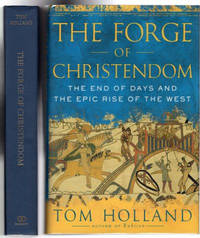
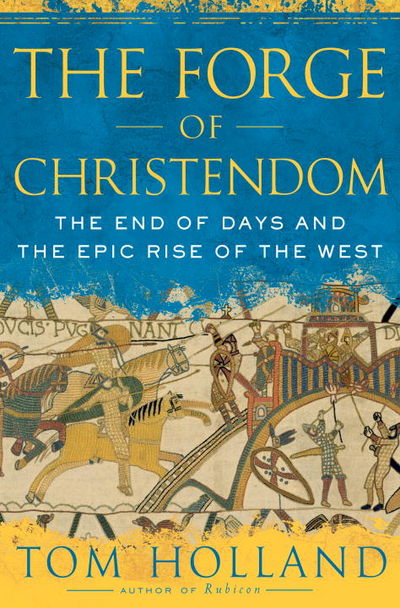
The Forge of Christendom: The End of Days and the Epic Rise of the West
Stock photo: cover may vary

The Forge of Christendom: The End of Days and the Epic Rise of the West Hardback - 2009

by Tom Holland

Add to wish list

Summary

In AD 900, few would have guessed that the splintering kingdoms of Christendom were candidates for future greatness. Hemmed in by implacable enemies on three sides, and by ocean on the fourth, it seemed that the Christian people had nowhere to turn. Indeed, there were many who feared--cast in the Millennium's shadow--that they were nearing the time when the Antichrist would appear, drowning the world in blood and heralding its end. But the Antichrist did not appear, and Christendom did not collapse. Instead, forged from the convulsions of those terrible times, there emerged a new civilization as the Christian people set to the heroic task of building a Jerusalem on earth themselves. With an epic sweep that transports us from the crucifixion to the First Crusade, and from the glitter of Constantinople to the bleak shores of Canada, Tom Holland's The Forge of Christendom is a brilliant study of a truly fateful revolution: the emergence of Western Europe for the first time as a distinctive and expansionist power.It was the age of Otto the Great and William the Conqueror, of Caliphs and Viking sea-kings, of hermits, monks, and serfs. It witnessed the spread of castles, the invention of knighthood, and the founding of a papal monarchy. Above all, it brought people to fear that the end days might be at hand, and yet also--with an effort so prodigious that it has the power to move us still--to invent themselves anew.A momentous achievement: for this was nothing less than the founding of the modern West. It is an epic story that Tom Holland renders with the narrative skill and wide-angled scope of a novelist and the careful scholarship a historian. It will transform its readers' conception of the origins of the Modern West.

Reader reviews for The Forge of Christendom: The End of Days and the Epic Rise of the West

From the publisher

In AD 900, few would have guessed that the splintering kingdoms of Christendom were candidates for future greatness. Hemmed in by implacable enemies on three sides, and by ocean on the fourth, it seemed that the Christian people had nowhere to turn. Indeed, there were many who feared--cast in the Millennium's shadow--that they were nearing the time when the Antichrist would appear, drowning the world in blood and heralding its end.
But the Antichrist did not appear, and Christendom did not collapse. Instead, forged from the convulsions of those terrible times, there emerged a new civilization as the Christian people set to the heroic task of building a Jerusalem on earth themselves. With an epic sweep that transports us from the crucifixion to the First Crusade, and from the glitter of Constantinople to the bleak shores of Canada, Tom Holland's "The Forge of Christendom" is a brilliant study of a truly fateful revolution: the emergence of Western Europe for the first time as a distinctive and expansionist power.
It was the age of Otto the Great and William the Conqueror, of Caliphs and Viking sea-kings, of hermits, monks, and serfs. It witnessed the spread of castles, the invention of knighthood, and the founding of a papal monarchy. Above all, it brought people to fear that the end days might be at hand, and yet also--with an effort so prodigious that it has the power to move us still--to invent themselves anew.
A momentous achievement: for this was nothing less than the founding of the modern West. It is an epic story that Tom Holland renders with the narrative skill and wide-angled scope of a novelist and the careful scholarship a historian. It will transform its readers' conception of the origins of the Modern West.

Details

  • Title The Forge of Christendom: The End of Days and the Epic Rise of the West
  • Author Tom Holland
  • Binding Hardback
  • Edition First American E
  • Pages 476
  • Volumes 1
  • Language ENG
  • Publisher Doubleday Books, New York
  • Publication date 2009-05-05
  • Illustrated Yes
  • ISBN 9780385520584 / 0385520581
  • Weight 1.9 lbs (0.86 kg)
  • Dimensions 9.46 x 6.36 x 1.33 in (24.03 x 16.15 x 3.38 cm)
  • Category History - General History
  • Library of Congress subjects Church history
  • Library of Congress Catalogue Number 2009000868
  • Dewey Decimal Code 270.2

Excerpt

1
The Return of the King
The Whore of Babylon
"All these will I give you," said Satan, showing Jesus the kingdoms of the world, "if you will fall down and worship me."1 But Jesus, scorning empire, refused the temptation. And Satan, confounded, retired in great confusion; and angels came and ministered to the Son of Man. Or so, at any rate, his followers reported.
The kingdoms shown to Jesus already had a single master: Caesar. Monarch of a city which had devoured the whole earth, and trampled it down, and broken it to pieces, "exceedingly terrible,"2 he swayed the fate of millions from his palace upon the hill of the Palatine in Rome. Jesus had been born, and lived, as merely one of his myriad subjects. The rule proclaimed by the "Anointed One," the "Christ," however, was not of this world. Emperors and their legions had no power to seize it. The Kingdom of Heaven was promised instead to the merciful, the meek, the poor. "Blessed are the peacemakers, for they shall be called sons of God."3 And Jesus -- even facing death -- practised what he had preached. When guards were sent to arrest him, his chief disciple, Peter, "the rock" upon whom it had been prophesied that the Church itself would be built, sought to defend his master; but Jesus, healing the man wounded in the ensuing scuffle, ordered Peter to put up his weapon. "For all who take the sword," he warned, "will perish by the sword."4 Dragged before a Roman governor, Jesus raised no voice of complaint as he was condemned to death as an enemy of Caesar. Roman soldiers guarded him as he hauled his cross through the streets of Jerusalem and out on to the execution ground, Golgotha, the Place of the Skull. Roman nails were hammered through his hands and feet. The point of a Roman spear was jabbed into his side.
In the years and decades that followed, Christ's disciples, insisting to the world that their master had risen from His tomb in defiance of Satan and all the bonds of death, not surprisingly regarded the empire of the Caesars as a monstrosity. Peter, who chose to preach the gospel in the very maw of the beast, named Rome "Babylon";5 and it was there that he, like his master, ultimately suffered death by crucifixion. Other Christians arrested in the capital were dressed in animal skins and torn to pieces by dogs, or else set on fire to serve the imperial gardens as torches. Some sixty years after Christ had departed from the sight of His disciples, a revelation of His return was granted to a disciple named John, a vision of the end of days, in which Rome appeared as a whore "drunk with the blood of the saints and the blood of the martyrs," mounted upon a scarlet beast, and adorned with purple and gold -- "and on her forehead was written a name of mystery: 'Babylon the great, mother of harlots and of earth's abominations.'"6 Great though she was, however, the doom of the whore was certain. Rome would fall, and deadly portents afflict mankind, and Satan, "the dragon, that ancient serpent,"7 escape his prison, until at last, in the final hour of reckoning, Christ would come again, and all the world be judged, and Satan and his followers be condemned to a pit of fire. And an angel, the same one who had shown John the revelation, warned him not to seal up the words of the prophecy vouchsafed to him, "For the hour is near."
But the years slipped by, and Christ did not return. Time closed the eyes of the last man to have seen Him alive. His followers, denied a Second Coming, were obliged to adapt to a present still ruled by Caesar. Whore or not, Rome gave to them, as to all her subjects, the fruits of her world-spanning order. Across the empire, communities of Christians spread and flourished. Gradually, step by tentative step, a hierarchy was established capable of administering these infant churches. Just as Jesus had given to Peter the charge to be shepherd of His sheep, so congregations entrusted themselves to "overseers": "bishops." "Pappas," such men were called: affectionate Greek for "father." Immersed as they were in the day-to-day running of their bishoprics, such men could hardly afford to stake all their trust in extravagant visions of apocalypse. Though they remained passionate in their hope of beholding Christ's return in glory, they also had a responsibility to care for their flocks in the present. Quite as much as any pagan, many came to realise, they had good cause to appreciate the pax Romana.
Nor was justification for this perspective entirely lacking in Holy Scripture. St. Paul -- although martyred, as St. Peter had been, in Rome -- had advised the Church there, before his execution, that the structures of governance, even those of the very pagan empire itself, had been "instituted by God."8 Indeed, it struck many students of the apostle that the Caesars had a more than incidental role to play in his vision of the end of days. Whereas St. John had portrayed Rome as complicit with the Beast, that demon in human form who was destined, just before Christ's return, to establish a tyranny of universal evil, seducing men and women everywhere by means of spectacular miracles, chilling their souls and dimming the Church beneath a tide of blood, Paul, it seemed, had cast the empire as precisely the opposite: the one bulwark capable of "restraining" Antichrist.9 Yet such an interpretation did not entirely clear up the ambivalence with which most Christians still regarded Rome, and the prospect of her fall: for if the reign of Antichrist was self-evidently to be dreaded, then so also might it be welcomed, as heralding Christ's return. "But of that or that hour," as Jesus Himself had admonished His disciples, "no one knows, not even the angels in heaven, nor the Son, but only the Father."10 That being so, many Church fathers concluded, it could hardly be reckoned a sin to hold Rome's empire in their prayers.
For redeemed though they hoped to be, even the devoutest Christians were sinners still, fallen and fashioned out of dust. Until a new heaven and a new earth had been established upon the ruins of the old, and a new Jerusalem descended "out of heaven from God,"11 the Church had no choice but to accommodate itself to the rule of a worldly power. Laws still had to be administered, cities governed, order preserved. Enemies of that order, lurking in dank and distant forests, or amid the sands of pitiless deserts, still had to be kept at bay. As the fourth century of the Christian era dawned, followers of the Prince of Peace were to be found even among the ranks of Caesar's soldiers.12 Later ages would preserve the memory of Maurice, an Egyptian general stationed at the small town of Agaunum, in the Alps, who had commanded a legion entirely comprising of the faithful. Ordered to put to the sword a village of innocent fellow Christians, he had refused. And yet, as Maurice himself had made perfectly clear to the infuriated emperor, he would have found in an order to attack pagan enemies no cause for mutiny. "We are your soldiers, yes," he was said to have explained, "but we are also the soldiers of God. To you, we owe the dues of military service -- but to Him the purity of our souls."13
The emperor, however, had remained toweringly unimpressed. He had ordered the mutineers' execution. And so it was that Maurice and the entire legion under his command had won their martyrs' crowns.
Ultimately, it seemed, obedience to both Christ and Caesar could not be reconciled.


A New Rome
But what if Caesar himself were a servant of Christ? Barely a decade after Maurice's martyrdom, and even as persecution of the Church rose to fresh heights of ferocity, the hand of God was preparing to manifest itself in a wholly unexpected way. In ad 312 a pretender to the imperial title by the name of Constantine marched from Gaul -- what is now France -- across the Alps, and on towards Rome. The odds seemed stacked against him. Not only was he heavily outnumbered, but his enemies had already taken possession of the capital. One noon, however, looking to the heavens for inspiration, Constantine saw there the blazing of a cross, visible to his whole army, and inscribed with the words, "By this sign, conquer." That night, in his tent, he was visited by Christ Himself. Again came the instruction: "By this sign, conquer." Constantine, waking at dawn, obeyed. He gave orders for the "heavenly sign of God" to be inscribed upon his soldiers' shields.14 When battle was finally joined outside Rome, Constantine was victorious. Entering the capital, he did not forget to whom he had owed his triumph. Turning his back on a whole millennium of tradition, he offered up no sacrifices to those demons whom the Caesars, in their folly and their blindness, had always worshipped as gods. Instead, the dominion of the Roman people was set upon a radically new path, one which God had clearly long been planning for it, to serve Him as the tool and agent of His grace, as an imperium christianum -- a Christian empire.
"And because Constantine made no supplications to evil spirits, but worshipped only the one true God, he enjoyed a life more favoured by marks of worldly prosperity than anyone would have dared imagine was possible."15 Certainly, it was hard for anyone to dispute that his reign had indeed been divinely blessed. In all, Constantine ruled for thirty-one years: only a decade less than the man who had first established his fiat over Rome and her empire, Caesar Augustus. It was during the reign of Augustus that Jesus had been born into the world; and now, under Constantine, so it seemed to his Christian subjects, the times were renewing themselves again. In Jerusalem, earth and rubbish were cleared from the tomb in which Christ had been laid. A Church of the Holy Sepulchre, "surpassing all the churches of the world in beauty," was raised above it, and over Golgotha, the hill of the crucifixion.16 Simultaneously, on the shores of the Bosphorus, what had formerly been the pagan city of Byzantium was redeveloped to serve the empire as a Christian capital. Constantine himself, it was said, marking out the street plan of his foundation with a spear, had been guided by the figure of Christ walking before him. Never again would pagan temples be built on Byzantine soil. No palls of smoke greasy with sacrifice would ever drift above the spreading streets. Graced with the splendid title of "the New Rome," the capital would provide the first Christian emperor with the most enduring of all his memorials. Ever after, the Romans would know it as "the City of Constantine" -- Constantinople.
A seat of empire, to be sure -- but hardly a monument to Christian humility. The leaders of the Church were unperturbed. Scarcely able as they were to credit the miracle that had transformed them so unexpectedly from a persecuted minority into an imperial elite, they raised few eyebrows at the spectacle of their emperor's magnificence. Since, as St. John had seen in his vision, the New Jerusalem would not be descending to earth until the very end of days, it struck most of them as a waste of time to preach revolution. Far more meritorious, the world's fallen state being what it was, to labour at the task of redeeming it from chaos. It was order, not egalitarianism, that the mirror of heaven showed back to earth.
What were the saints, the angels and the archangels if not the very model of a court, ranked in an exquisite hierarchy amid the pomp of the World Beyond, with Christ Himself, victorious in His great battle over death and darkness, presiding over them, and over the monarchy of the universe, in a blaze of celestial light? A Christian emperor, ruling as the sponsor and protector of the Church, could serve not merely as Christ's ally in the great war against evil, but as His representative on earth, "directing, in imitation of God Himself, the administration of this world's affairs."17 In the bejewelled and perfumed splendours of Constantinople might be glimpsed a reflection of the beauties of paradise; in the armies that marched to war against the foes of the Christian order an image of the angelic hosts. What had once been the very proofs of the empire's depravity -- its wealth, its splendour, its terrifying military might -- now seemed to mark it out as a replica of heaven.
Naturally, the Christ to whom Constantine and his successors compared themselves bore little resemblance to the Jesus who had died in excruciating and blood-streaked agony upon a rough-hewn cross. Indeed, whether in the meditations of theologians or in the mosaics of artisans, He began to resemble nothing so much as a Roman emperor. Whereas the faithful had once looked to their Messiah to sit in awful judgement over Rome, now bishops publicly implored Him to turn His "heavenly weapons" against the enemies of the empire, "so that the peace of the Church might be untroubled by storms of war."18 By the fifth Christian century, prayers such as these were turning shrill and desperate -- for increasingly, the storms of war appeared to be darkening all the world. Savages from the barbarous wilds beyond the Christian order, no longer content to respect the frontiers that had for so long been circumscribed by Roman might, were starting to sweep across the empire, threatening to despoil it of its fairest territories, and to dismember a dominion only lately consecrated to the service of God. Was this the end of days come at last? Christians might have been forgiven for thinking so. In ad 410, Rome herself was sacked, and men cried out, just as St. John had foreseen that they would, "'Alas, alas for the great city!'"19 Still waves of migrants continued to flood through the breached frontiers, into Gaul and Britain, Spain and Africa, the Balkans and Italy; and this too, it struck many, St. John had prophesied. For the end time, he had written, would see Satan gather to himself nations from the far ends of the world; and their numbers would be like "the sand of the sea."20 And their names, St. John had written, would be Gog and Magog.
Notes
1 Matthew 4.9.
2 Daniel 7.19.
3 Matthew 5.9.
4 Matthew 26.52.
5 1 Peter 5.13. The first independent allusion to Peter's presence in Rome does not date until ad 96.
6 Revelation 17.4-6.
7 Ibid., 20.2.
8 Romans 13.1.
9 2 Thessalonians 2.6.
10 Mark 13.32.
11 Revelation 21.2.
12 Christians were expelled from the army some time around 300, just before the great persecution launched by the Emperor Diocletian in 303. This has raised considerable doubts about the veracity of the story of St. Maurice, since he and his legion are supposed to have been martyred for refusing to take part in this self-same persecution. For a convincing explanation of the legend's origin, see Woods.
13 Eucherius of Lyon, 9.
14 Lactantius, 44.5.
15 Augustine, City of God, 5.25.
16 Eusebius, Life of Constantine, 3.31.
17 Ibid., In Praise of the Emperor Constantine, 1.
18 "Examples of prayers for the Empire and the Emperor" (c), Folz (1969), p. 176.
19 Revelation 18.19.
20 Ibid., 20.8.

Media reviews

“[The Forge of Christendom] is a marvelous, enthralling read, and gives a lively sense of these turbulent centuries that were so crucial in the making of Western civilization. Read it, and be thrilled, amazed, and enlightened.” —Allan Massie, Daily Telegraph

About the author

TOM HOLLAND gained the top degree at Cambridge before earning his Ph.D. at Oxford. He is the author of the critically acclaimed works of history "Rubicon: The Last Years of the Roman Empire "and "Persian Fire: The First World Empire and the Battle for the West"

More Copies for Sale

The Forge of Christendom: The End of Days and the Epic Rise of the West
Stock photo: cover may vary

The Forge of Christendom: The End of Days and the Epic Rise of the West

by Holland, Tom

  • Used
  • Hardback
  • first
Condition
Used
Edition
First Edition
Binding
Hardcover
ISBN 10 / ISBN 13
9780385520584 / 0385520581
Quantity available
1
Seller
Item price
A$28.03
Free Delivery to USA

Show details

Description:
Doubleday, 2009-05-05. First Edition. hardcover. Used: Good. 6.40x1.37x9.51. Buy with confidence. Excellent Customer Service & Return policy.
Add to wish list
Item price
A$28.03
Free Delivery to USA
The Forge of Christendom : The End of Days and the Epic Rise of the West
Stock photo: cover may vary

The Forge of Christendom : The End of Days and the Epic Rise of the West

by Holland, Tom

  • Used
Condition
Used
ISBN 10 / ISBN 13
9780385520584 / 0385520581
Quantity available
1
Seller
Item price
A$28.73
Free Delivery to USA

Show details

Description:
Knopf Doubleday Publishing Group. Used - Good. Former library copy. Pages intact with minimal writing/highlighting. The binding may be loose and creased. Dust jackets/supplements are not included. Includes library markings. Stock photo provided. Product includes identifying sticker. Better World Books: Buy Books. Do Good.
Add to wish list
Item price
A$28.73
Free Delivery to USA
The Forge of Christendom: The End of Days and the Epic Rise of the West
Stock photo: cover may vary

The Forge of Christendom: The End of Days and the Epic Rise of the West

by Holland, Tom

  • Used
  • Good
  • Hardback
Condition
Good
Binding
Hardcover
ISBN 10 / ISBN 13
9780385520584 / 0385520581
Quantity available
1
Seller
Item price
A$30.21
Free Delivery to USA

Show details

Description:
Doubleday. hardcover. Good. 9.5X6.5X1.5. Buy with confidence. Excellent Customer Service & Return policy.
Add to wish list
Item price
A$30.21
Free Delivery to USA
The Forge of Christendom: The End of Days and the Epic Rise of the West
Stock photo: cover may vary

The Forge of Christendom: The End of Days and the Epic Rise of the West

by Holland, Tom

  • Used
  • Good
  • Hardback
Condition
Good
Binding
Hardcover
ISBN 10 / ISBN 13
9780385520584 / 0385520581
Quantity available
1
Seller
Item price
A$59.56
Free Delivery to USA

Show details

Description:
hardcover. Good. Access codes and supplements are not guaranteed with used items. May be an ex-library book.
Add to wish list
Item price
A$59.56
Free Delivery to USA
The Forge of Christendom: The End of Days and the Epic Rise of the West
Stock photo: cover may vary

The Forge of Christendom: The End of Days and the Epic Rise of the West

by Holland, Tom

  • New
  • Hardback
  • first
Condition
New
Edition
First Edition
Binding
Hardcover
ISBN 10 / ISBN 13
9780385520584 / 0385520581
Quantity available
1
Seller
Item price
A$78.36
Free Delivery to USA

Show details

Description:
Doubleday, 2009-05-05. First Edition. hardcover. New. 6.40x1.37x9.51. Buy with confidence. Excellent Customer Service & Return policy.
Add to wish list
Item price
A$78.36
Free Delivery to USA
The Forge of Christendom: The End of Days and the Epic Rise of the West
Stock photo: cover may vary

The Forge of Christendom: The End of Days and the Epic Rise of the West

by Holland, Tom

  • New
  • Hardback
Condition
New
Binding
Hardcover
ISBN 10 / ISBN 13
9780385520584 / 0385520581
Quantity available
1
Seller
Item price
A$105.07
A$48.07 Delivery to USA

Show details

Description:
Doubleday, 2009. Hardcover. New. 512 pages. 9.50x6.25x1.50 inches.
Add to wish list
Item price
A$105.07
A$48.07 Delivery to USA
THE FORGE OF CHRISTENDOM
More photos

THE FORGE OF CHRISTENDOM: THE END OF DAYS AND THE EPIC RISE OF THE WEST

by Holland, Tom

  • Used
  • Fine
  • Hardback
  • first
Condition
Excellent
Edition
First Edition
Binding
Hardcover
ISBN 10 / ISBN 13
9780385520584 / 0385520581
Quantity available
1
Seller
Item price
A$86.06
A$10.76 Delivery to USA

Show details

Description:
First US edition, first prnt. Originally published in the U.K. as Millenium. Maps. Preface. Notes. Bibliography. Index. Color illustrations. Few pages with bottom corner wrinkles; otherwise, in Fine condition in a Fine dustjacket with an archival cover. Holland's third book of ancient and medieval history.
Add to wish list
Item price
A$86.06
A$10.76 Delivery to USA
The Forge of Christendom: The End of Days and the Epic Rise of the West
Stock photo: cover may vary

The Forge of Christendom: The End of Days and the Epic Rise of the West

by Holland, Tom

  • New
  • Hardback
Condition
New
Binding
Hardcover
ISBN 10 / ISBN 13
9780385520584 / 0385520581
Quantity available
1
Seller
Item price
A$146.35
A$8.53 Delivery to USA

Show details

Description:
Doubleday, 2009-05-05. Hardcover. New. In shrink wrap. Looks like an interesting title!
Add to wish list
Item price
A$146.35
A$8.53 Delivery to USA