Summary
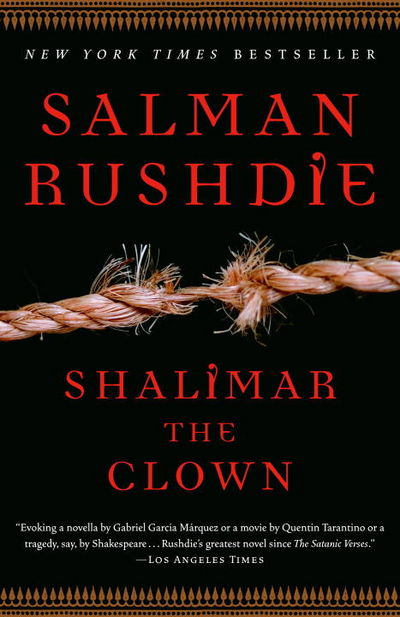
Shalimar the Clown is a masterpiece from one of our greatest writers, a dazzling novel that brings together the fiercest passions of the heart and the gravest conflicts of our time into an astonishingly powerful, all-encompassing story.Max Ophuls' memorablelife ends violently in Los Angeles in 1993 when he is murdered by his Muslim driver Noman Sher Noman, also known as Shalimar the Clown. At first the crime seems to be politically motivated -- Ophuls was previously ambassador to India, and later US counterterrorism chief -- but it is much more.Ophuls is a giant, an architect of the modern world: a Resistance hero and best-selling author, brilliant economist and clandestine US intelligence official. But it is as Ambassador to India that the seeds of his demise are planted, thanks to another of his great roles -- irresistible lover. Visiting the Kashmiri village of Pachigam, Ophuls lures an impossibly beautiful dancer, the ambitious (and willing) Boonyi Kaul, away from her husband, and installs her as his mistress in Delhi. But their affair cannot be kept secret, and when Boonyi returns home, disgraced and obese, it seems that all she has waiting for her is the inevitable revenge of her husband: Noman Sher Noman, Shalimar the Clown. He was an acrobat and tightrope walker in their village's traditional theatrical troupe; but soon Shalimar is trained as a militant in Kashmir's increasingly brutal insurrection, and eventually becomes a terrorist with a global remit and a deeply personal mission of vengeance.With sweeping brilliance, Salman Rushdie portrays fanatical mullahs as fully as documentary filmmakers, rural headmen as completely as British spies; he describes villages that compete to make the most splendid feasts, the mentality behind martial law, and the celebrity of Los Angeles policemen, all with the same genius.But the main story is only part of the story. In this stunningly rich book everything is connected, and everyone is a part of everyone else. Shalimar the Clown is a true work of the era of globalization, intricately mingling lives and countries, and finding unexpected and sometimes tragic connections between the seemingly disparate. The violent fate of Kashmir recalls Strasbourg's experience in World War Two; Resistance heroism against the Nazis counterpoints Al-Qaeda's terror in Pakistan, North Africa and the Philippines. 1960s Pachigam is not so far from post-war London, or the Hollywood-driven present-day Los Angeles where Max's daughter by Boonyi, India Ophuls, beautiful, strong-willed, modern, waits, as vengeance plays itself out.A powerful love story, intensely political and historically informed, Shalimar the Clown is also profoundly human, an involving story of people's lives, desires and crises -- India Ophuls' desperate search for her real mother, for example; Max's wife's attempts to deal with his philandering -- as well as, in typical Rushdie fashion, a magical tale where the dead speak and the future can be foreseen.Shalimar the Clown is steeped in both the Hindu epic Ramayana and the great European novelists, melding the storytelling traditions of east and west into a magnificently fruitful blend -- and serves, itself, as a corrective to the destructive clashes of values it scorchingly depicts. Enthralling, comic and amazingly abundant, it will no doubt come to be seen as one of the key books of our time.The second portent came on the morning of the murder, when Shalimar the driver approached Max Ophuls at breakfast, handed him his schedule card for the day, and gave in his notice. The ambassador's drivers tended to be short-term...
Excerpt
Chapter 1
At twenty-four the ambassador’s daughter slept badly through the warm, unsurprising nights. She woke up frequently and even when sleep did come her body was rarely at rest, thrashing and flailing as if trying to break free of dreadful invisible manacles. At times she cried out in a language she did not speak. Men had told her this, nervously. Not many men had ever been permitted to be present while she slept. The evidence was therefore limited, lacking consensus; however, a pattern emerged. According to one report she sounded guttural, glottal-stoppy, as if she were speaking Arabic. Night-Arabian, she thought, the dreamtongue of Scheherazade. Another version described her words as science-fictional, like Klingon, like a throat being cleared in a galaxy far, far away. Like Sigourney Weaver channeling a demon in Ghostbusters. One night in a spirit of research the ambassador’s daughter left a tape recorder running by her bedside but when she heard the voice on the tape its death’s-head ugliness, which was somehow both familiar and alien, scared her badly and she pushed the erase button, which erased nothing important. The truth was still the truth.
These agitated periods of sleep-speech were mercifully brief, and when they ended she would subside for a time, sweating and panting, into a state of dreamless exhaustion. Then abruptly she would awake again, convinced, in her disoriented state, that there was an intruder in her bedroom. There was no intruder. The intruder was an absence, a negative space in the darkness. She had no mother. Her mother had died giving her birth: the ambassador’s wife had told her this much, and the ambassador, her father, had confirmed it. Her mother had been Kashmiri, and was lost to her, like paradise, like Kashmir, in a time before memory. (That the terms Kashmir and paradise were synonymous was one of her axioms, which everyone who knew her had to accept.) She trembled before her mother’s absence, a void sentinel shape in the dark, and waited for the second calamity, waited without knowing she was waiting. After her father died—her brilliant, cosmopolitan father, Franco-American, “like Liberty,” he said, her beloved, resented, wayward, promiscuous, often absent, irresistible father—she began to sleep soundly, as if she had been shriven. Forgiven her sins, or, perhaps, his. The burden of sin had been passed on. She did not believe in sin.
So until her father’s death she was not an easy woman to sleep with, though she was a woman with whom men wanted to sleep. The pressure of men’s desires was tiresome to her. The pressure of her own desires was for the most part unrelieved. The few lovers she took were variously unsatisfactory and so (as if to declare the subject closed) she soon enough settled on one pretty average fellow, and even gave serious consideration to his proposal of marriage. Then the ambassador was slaughtered on her doorstep like a halal chicken dinner, bleeding to death from a deep neck wound caused by a single slash of the assassin’s blade. In broad daylight! How the weapon must have glistened in the golden morning sun; which was the city’s quotidian blessing, or its curse. The daughter of the murdered man was a woman who hated good weather, but most of the year the city offered little else. Accordingly, she had to put up with long monotonous months of shadowless sunshine and dry, skin-cracking heat. On those rare mornings when she awoke to cloud cover and a hint of moisture in the air she stretched sleepily in bed, arching her back, and was briefly, even hopefully, glad; but the clouds invariably burned off by noon and then there it was again, the dishonest nursery blue of the sky that made the world look childlike and pure, the loud impolite orb blaring at her like a man laughing too loudly in a restaurant.
In such a city there could be no grey areas, or so it seemed. Things were what they were and nothing else, unambiguous, lacking the subtleties of drizzle, shade and chill. Under the scrutiny of such a sun there was no place to hide. People were everywhere on display, their bodies shining in the sunlight, scantily clothed, reminding her of advertisements. No mysteries here or depths; only surfaces and revelations. Yet to learn the city was to discover that this banal clarity was an illusion. The city was all treachery, all deception, a quick-change, quicksand metropolis, hiding its nature, guarded and secret in spite of all its apparent nakedness. In such a place even the forces of destruction no longer needed the shelter of the dark. They burned out of the morning’s brightness, dazzling the eye, and stabbed at you with sharp and fatal light.
Her name was India. She did not like this name. People were never called Australia, were they, or Uganda or Ingushetia or Peru. In the mid-1960s her father, Max Ophuls (Maximilian Ophuls, raised in Strasbourg, France, in an earlier age of the world), had been America’s best-loved, and then most scandalous, ambassador to India, but so what, children were not saddled with names like Herzegovina or Turkey or Burundi just because their parents had visited those lands and possibly misbehaved in them. She had been conceived in the East—conceived out of wedlock and born in the midst of the firestorm of outrage that twisted and ruined her father’s marriage and ended his diplomatic career—but if that were sufficient excuse, if it was okay to hang people’s birthplaces round their necks like albatrosses, then the world would be full of men and women called Euphrates or Pisgah or Iztaccíhuatl or Woolloomooloo. In America, damn it, this form of naming was not unknown, which spoiled her argument slightly and annoyed her more than somewhat. Nevada Smith, Indiana Jones, Tennessee Williams, Tennessee Ernie Ford: she directed mental curses and a raised middle finger at them all.
“India” still felt wrong to her, it felt exoticist, colonial, suggesting the appropriation of a reality that was not hers to own, and she insisted to herself that it didn’t fit her anyway, she didn’t feel like an India, even if her color was rich and high and her long hair lustrous and black. She didn’t want to be vast or subcontinental or excessive or vulgar or explosive or crowded or ancient or noisy or mystical or in any way Third World. Quite the reverse. She presented herself as disciplined, groomed, nuanced, inward, irreligious, understated, calm. She spoke with an English accent. In her behavior she was not heated, but cool. This was the persona she wanted, that she had constructed with great determination. It was the only version of her that anyone in America, apart from her father and the lovers who had been scared off by her nocturnal proclivities, had ever seen. As to her interior life, her violent English history, the buried record of disturbed behavior, the years of delinquency, the hidden episodes of her short but eventful past, these things were not subjects for discussion, were not (or were no longer) of concern to the general public. These days she had herself firmly in hand. The problem child within her was sublimated into her spare-time pursuits, the weekly boxing sessions at Jimmy Fish’s boxing club on Santa Monica and Vine where Tyson and Christy Martin were known to work out and where the cold fury of her hitting made the male boxers pause to watch, the biweekly training sessions with a Clouseau-attacking Burt Kwouk look-alike who was a master of the close-combat martial art of Wing Chun, the sun-bleached blackwalled solitude of Saltzman’s Moving Target shooting gallery out in the desert at 29 Palms, and, best of all, the archery sessions in downtown Los Angeles near the city’s birthplace in Elysian Park, where her new gifts of rigid self-control, which she had learned in order to survive, to defend herself, could be used to go on the attack. As she drew back her golden Olympic-standard bow, feeling the pressure of the bowstring against her lips, sometimes touching the bottom of the arrow shaft with the tip of her tongue, she felt the arousal in herself, allowed herself to feel the heat rising in her while the seconds allotted to her for the shot ticked down toward zero, until at last she let fly, unleashing the silent venom of the arrow, reveling in the distant thud of her weapon hitting its target. The arrow was her weapon of choice.
She also kept the strangeness of her seeing under control, the sudden otherness of vision that came and went. When her pale eyes changed the things she saw, her tough mind changed them back. She did not care to dwell on her turbulence, never spoke about her childhood, and told people she did not remember her dreams.
On her twenty-fourth birthday the ambassador came to her door. She looked down from her fourth-floor balcony when he buzzed and saw him waiting in the heat of the day wearing his absurd silk suit like a French sugar daddy. Holding flowers, yet. “People will think you’re my lover,” India shouted down to Max, “my cradle-snatching Valentine.” She loved the ambassador when he was embarrassed, the pained furrow of his brow, the right shoulder hunching up against his ear, the hand raised as if to ward off a blow. She saw him fracture into rainbow colors through the prism of her love. She watched him recede into the past as he stood below her on the sidewalk, each successive moment of him passing before her eyes and being lost forever, surviving only in outer space in the form of escaping light-rays. This is what loss was, what death was: an escape into the luminous wave-forms, into the ineffable speed of the light-years and the parsecs, the eternally receding distances of the cosmos. At the rim of the known universe an unimaginable creature would someday put its eye to a telescope and see Max Ophuls approaching, wearing a silk suit and carrying birthday roses, forever borne forward on tidal waves of light. Moment by moment he was leaving her, becoming an ambassador to such unthinkably distant elsewheres. She closed her eyes and opened them again. No, he was not billions of miles away amid the wheeling galaxies. He was here, correct and present, on the street where she lived.
He had recovered his poise. A woman in running clothes rounded the corner from Oakwood and cantered toward him, appraising him, making the easy judgments of the times, judgments about sex and money. He was one of the architects of the postwar world, of its international structures, its agreed economic and diplomatic conventions. His tennis game was strong even now, at his advanced age. The inside-out forehand, his surprise weapon. That wiry frame in long white trousers, carrying not much more than five percent body fat, could still cover the court. He reminded people of the old champion Jean Borotra: those few old-timers who remembered Borotra. He stared with undisguised European pleasure at the jogger’s American breasts in their sports bra. As she passed him he offered her a single rose from the enormous birthday bouquet. She took the flower; and then, appalled by his charm, by the erotic proximity of his snappy crackle of power, and by herself, accelerated anxiously away. Fifteen–love.
From the balconies of the apartment building the old Central and East European ladies were also staring at Max, admiringly, with the open lust of toothless age. His arrival was the high point of their month. They were out en masse today. Usually they gathered together in small street-corner clumps or sat in twos and threes by the courtyard swimming pool chewing the fat, sporting inadvisable beachwear without shame. Usually they slept a lot and when not sleeping complained. They had buried the husbands with whom they had spent forty or even fifty years of unregarded life. Stooped, leaning, expressionless, the old women lamented the mysterious destinies that had stranded them here, halfway across the world from their points of origin. They spoke in strange tongues that might have been Georgian, Croatian, Uzbek. Their husbands had failed them by dying. They were pillars that had fallen, they had asked to be relied upon and had brought their wives away from everything that was familiar into this shadowless lotus-land full of the obscenely young, this California whose body was its temple and whose ignorance was its bliss, and then proved themselves unreliable by keeling over on the golf course or face down in a bowl of noodle soup, thus revealing to their widows at this late stage in their lives the untrustworthiness of existence in general and of husbands in particular. In the evenings the widows sang childhood songs from the Baltic, from the Balkans, from the vast Mongolian plains.
The neighborhood’s old men were single, too, some inhabiting sagging sacks of bodies over which gravity had exerted far too much power, others grizzle-chopped and letting themselves go in dirty T-shirts and pants with unbuttoned flies, while a third, jauntier contingent dressed sharply, affecting berets and bow ties. These natty gents periodically tried to engage the widows in conversation. Their efforts, with yellow glints of false teeth and melancholy sightings of slicked-down vestiges of hair beneath the doffed berets, were invariably and contemptuously ignored. To these elderly beaux, Max Ophuls was an affront, the ladies’ interest in him a humiliation. They would have killed him if they could, if they had not been too busy staving off their own deaths.
India saw it all, the exhibitionist, desirous old women pirouetting and flirting on the verandahs, the lurking, spiteful old men. The antique Russian super, Olga Simeonovna, a bulbous denim-clad samovar of a woman, was greeting the ambassador as if he were a visiting head of state. If there had been a red carpet on the premises she would have rolled it out for him.
“She keeps you waiting, Mr. Ambassador, what you gonna do, the young. I say nothing against. Just, a daughter these days is more difficult, I was a daughter myself who for me my father was like a god, to keep him waiting unthinkable. Alas, daughters today are hard to raise and then they leave you flat. I sir am formerly mother, but now they are dead to me, my girls. I spit on their forgotten names. This is how it is.”
From the Hardcover edition.