
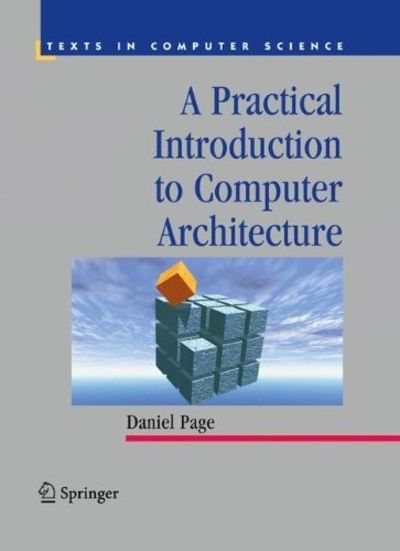
A Practical Introduction to Computer Architecture Paperback - 2011
by Daniel Page
Reader reviews for A Practical Introduction to Computer Architecture
Write a review for this book
Important Terms and Guidelines
- Please focus on the book’s content and context. Also, add any personal comments as to how you enjoyed the book. Substantiate your likes and dislikes. You may make comparisons to other books.
- Reviews must be at least 140 characters in length.
- Please do not reveal critical plot elements.
- This is not a help line. Contact customer support if you need help.
Your review must not include:
- Obscenities, discriminatory language, or other insulting language not suitable for public domain
- Advertisements, “spam” content, or references to other products, offers or websites.
- Email addresses, URLs, phone numbers, physical addresses or other contact information.
- Overly critical comments about other reviews or reviewers
- Time-sensitive material (i.e. promotional tours, seminars, lectures, etc.)
- Availability, price, or alternative ordering/shipping information
From the publisher
From the rear cover
Computer architecture, which underpins computer science, is a topic in which "getting things done" is paramount: The ability to understand trade-offs before selecting between and implementing well-considered design options is often as important as the study of those options at a more theoretical level.
This easy-to-follow A Practical Introduction to Computer Architecture blends traditional teaching approaches with the use of mathematics, together with the use of a hardware description language (Verilog) and a concrete processor (MIPS32) as vehicles for "hands-on" modelling and experimenting with digital logic and processor design. This unique approach encourages readers to derive their own conclusions via experimentation, enabling them to discover for themselves the fundamental and exciting topics of computer architecture.
The book is divided into three parts, covering each of the three levels of abstraction: the digital logic layer, the instruction set and micro-architecture layer, and the hardware/software interface. The first part deals with the basic tools and techniques which underpin the rest of the book, whereas the second part deals with the broad topic of processor design and implementation. The final part bridges the gap between hardware and software by examining the programming tools and operating-system concepts that support the development and execution of programs.
Topics and features:
- Includes a wide-ranging introductory chapter, familiarising the reader with both the subject and the book's contents
- Outlines basic methods for evaluating processors, with a focus on performance
- Investigates advanced topics in processor design, such as superscalar and vector processors
- Presents a detailed description of a development tool-chain
- Provides a stand-alone tutorial on using SPIM, a MIPS32 simulator
- Focuses onaspects of compilers which are closely tied to the processor, covering register allocation, instruction selection and scheduling
- Explores real implementations of concepts such as scheduling and interrupt handling
- Examines the concept of efficient programming
- Concludes every chapter with a set of example problems, and contains an appendix that discusses solutions
- Supplies additional supportive material, such as example source code and electronic lecture slides, at http: //www.cs.bris.ac.uk/home/page/teaching/pica.html
This practical, reader-friendly textbook has been written with undergraduates in mind, and is suitable for self-study. The book can also be used by postgraduate students as a supportive reference for use in combination with more specialised textbooks.
Dr. Dan Page is a lecturer at the University of Bristol, affiliated with both the Languages and Architecture Group and the Cryptography and Information Security Group. He was one of the founders of Identum (now part of Trend Micro), which is involved in delivering cryptographic expertise and products to industrial customers.
Details
- Title A Practical Introduction to Computer Architecture
- Author Daniel Page
- Binding Paperback
- Edition 1st edition
- Pages 642
- Volumes 1
- Language ENG
- Publisher Springer
- Publication date 2011-02-04
- Illustrated Yes
- Features Bibliography, Illustrated
- ISBN 9781849968317 / 1849968314
- Weight 2.4 lbs (1.09 kg)
- Dimensions 9.1 x 6.9 x 1.4 in (23.11 x 17.53 x 3.56 cm)
- Category Computers - General Information
- Dewey Decimal Code 004.22
More Copies for Sale
A Practical Introduction to Computer Architecture
by Daniel Page
- New
- Paperback
- Condition
- New
- Binding
- Paperback
- ISBN 10 / ISBN 13
- 9781849968317 / 1849968314
- Quantity available
- 367
- Seller
- Item price
-
A$104.99A$15.54 Delivery to USA
Show details
A Practical Introduction to Computer Architecture
by Page, Daniel
- New
- Paperback
- Condition
- New
- Binding
- Paperback
- ISBN 10 / ISBN 13
- 9781849968317 / 1849968314
- Quantity available
- 2
- Seller
- Item price
-
A$140.74A$29.18 Delivery to USA
Show details
A Practical Introduction to Computer Architecture (Texts in Computer Science)
by Page, Daniel
- New
- Paperback
- first
- Condition
- New
- Edition
- Softcover reprint of hardcover 1st ed. 2009
- Binding
- Paperback
- ISBN 10 / ISBN 13
- 9781849968317 / 1849968314
- Quantity available
- 1
- Seller
- Item price
-
A$113.82A$21.68 Delivery to USA
Show details
A Practical Introduction to Computer Architecture
by Daniel Page
- New
- Paperback
- Condition
- New
- Binding
- Paperback
- ISBN 10 / ISBN 13
- 9781849968317 / 1849968314
- Quantity available
- 10
- Seller
- Item price
-
A$155.78A$19.36 Delivery to USA
Show details
A Practical Introduction to Computer Architecture (Texts in Computer Science)
by Page, Daniel
- Used
- Good
- Paperback
- Condition
- Good
- Binding
- Paperback
- ISBN 10 / ISBN 13
- 9781849968317 / 1849968314
- Quantity available
- 1
- Seller
- Item price
-
A$127.74Free Delivery to USA
