
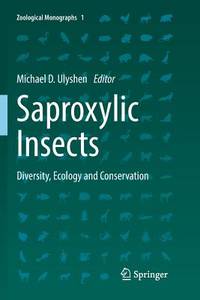
Stock photo: cover may vary
Saproxylic Insects: Diversity, Ecology and Conservation Paperback - 2019
by Michael D. Ulyshen (Editor)
Add to wish list
Reader reviews for Saproxylic Insects: Diversity, Ecology and Conservation
Write a review for this book
Important Terms and Guidelines
- Please focus on the book’s content and context. Also, add any personal comments as to how you enjoyed the book. Substantiate your likes and dislikes. You may make comparisons to other books.
- Reviews must be at least 140 characters in length.
- Please do not reveal critical plot elements.
- This is not a help line. Contact customer support if you need help.
Your review must not include:
- Obscenities, discriminatory language, or other insulting language not suitable for public domain
- Advertisements, “spam” content, or references to other products, offers or websites.
- Email addresses, URLs, phone numbers, physical addresses or other contact information.
- Overly critical comments about other reviews or reviewers
- Time-sensitive material (i.e. promotional tours, seminars, lectures, etc.)
- Availability, price, or alternative ordering/shipping information
From the publisher
From the rear cover
This volume offers extensive information on insect life in dying and dead wood. Written and reviewed by leading experts from around the world, the twenty-five chapters included here provide the most global coverage possible and specifically address less-studied taxa and topics. An overarching goal of this work is to unite literature that has become fragmented along taxonomic and geographic lines. A particular effort was made to recognize the dominant roles that social insects (e.g., termites, ants and passalid beetles) play in saproxylic assemblages in many parts of the world without overlooking the non-social members of these communities.
The book is divided into four parts:
- Part I "Diversity" includes chapters addressing the major orders of saproxylic insects (Coleoptera, Diptera, Hymenoptera, Hemiptera, Lepidoptera and Blattodea), broadly organized in decreasing order of estimated global saproxylic diversity. In addition to order-level treatments, some chapters in thispart discuss groups of particular interest, including pollinators, hymenopteran parasitoids, ants, stag and passalid beetles, and wood-feeding termites.
- Part II "Ecology" discusses insect-fungal and insect-insect interactions, nutritional ecology, dispersal, seasonality, and vertical stratification.
- Part III "Conservation" focuses on the importance of primary forests for saproxylic insects, offers recommendations for conserving these organisms in managed forests, discusses the relationships between saproxylic insects and fire, and addresses the value of tree hollows and highly-decomposed wood for saproxylic insects. Utilization of non-native wood by saproxylic insects and the suitability of urban environments for these organisms are also covered.
- Lastly, Part IV "Methodological Advancements" highlights molecular tools for assessing saproxylic diversity.
The book offers an accessible and insightful resource for natural historians of all kinds and will especially appeal to entomologists, ecologists, conservationists and foresters.
Details
- Title Saproxylic Insects: Diversity, Ecology and Conservation
- Author Michael D. Ulyshen (Editor)
- Binding Paperback
- Pages 904
- Volumes 1
- Language ENG
- Publisher Springer
- Publication date 2019-01-30
- Illustrated Yes
- Features Illustrated
- ISBN 9783030093587 / 3030093581
- Weight 2.77 lbs (1.26 kg)
- Dimensions 9.21 x 6.14 x 1.81 in (23.39 x 15.60 x 4.60 cm)
-
Themes
- Topical: Ecology
- Category Science
- Dewey Decimal Code 577
About the author
More Copies for Sale
Saproxylic Insects : Diversity, Ecology and Conservation
- New
- Paperback
- Condition
- New
- Binding
- Paperback
- ISBN 10 / ISBN 13
- 9783030093587 / 3030093581
- Quantity available
- 634
- Seller
- Item price
-
A$535.60A$15.45 Delivery to USA
Show details
Add to wish list
Item price
A$535.60
A$15.45
Delivery to USA
