
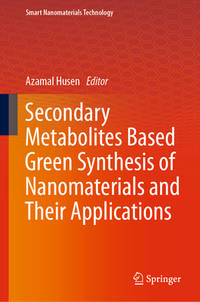
Secondary Metabolites Based Green Synthesis of Nanomaterials and Their Applications Hardback - 2023
by Azamal Husen (Editor)
Reader reviews for Secondary Metabolites Based Green Synthesis of Nanomaterials and Their Applications
Write a review for this book
Important Terms and Guidelines
- Please focus on the book’s content and context. Also, add any personal comments as to how you enjoyed the book. Substantiate your likes and dislikes. You may make comparisons to other books.
- Reviews must be at least 140 characters in length.
- Please do not reveal critical plot elements.
- This is not a help line. Contact customer support if you need help.
Your review must not include:
- Obscenities, discriminatory language, or other insulting language not suitable for public domain
- Advertisements, “spam” content, or references to other products, offers or websites.
- Email addresses, URLs, phone numbers, physical addresses or other contact information.
- Overly critical comments about other reviews or reviewers
- Time-sensitive material (i.e. promotional tours, seminars, lectures, etc.)
- Availability, price, or alternative ordering/shipping information
From the publisher
From the rear cover
Nanotechnology is gaining importance in every field of science and technology. Green synthesis of nanomaterials involves the use of microorganisms such as bacteria, fungi, viruses; and different lower and higher plants. Green synthesis of nanomaterials from plant extracts becoming popular in comparison to synthesis using microorganisms. Plant based-nanomaterials synthesis is easy, have no need to bring back from the culture medium, and is safe. Additionally, plant-based nanomaterials are eco-friendly, in comparison to physical and chemical modes of synthesis. Several lower and higher plants are rich in terms of secondary metabolites. These metabolites have been used as medicine in crude extract form or with some other formulations. They have been also used to isolate the bioactive compounds in modern medicine as well as in herbal medicine systems. Thus, phytochemicals present in the plant and their parts play an important role in nanomaterials synthesis, mainly due to the presence of a significant number of secondary metabolites, for instance, alkaloids, flavonoids, saponins, steroids, tannins, etc. Further, essential and aromatic oils have been also explored for nanomaterials synthesis, and they are also equally useful in terms of their various biological applications. These organic ingredients come from a wide range of plant components, such as leaves, stems, roots, shoots, flowers, bark, and seeds. Globally, the presence of different plants has shown a capability to produce huge and diverse groups of secondary metabolites. The functional groups present in the plant extract acts as capping and stabilizing agent. Most of the time, pure isolated bioactive compounds are more biologically active; hence scholars are focusing their research on the synthesis of nanomaterials using some particular class of secondary metabolites. Investigations have shown that the green synthesized nanomaterials were found to be more biologically active in comparison to chemicallysynthesized nanomaterials. These nanomaterials and or nanocomposites found different applications especially in drug delivery, detection and cure of cancer cells, diagnosis of a genetic disorder, photoimaging, and angiogenesis detection. They have also shown several applications in agricultural, horticultural as well as forestry sectors. The book in hand covers a wide range of topics as mentioned above. It incorporates chapters that the authors have skilfully crafted with clarity and precision, reviewing up-to-date literature with lucid illustrations. The book would cater to the need of graduate students as a textbook and simultaneously be useful for both novices and experienced scientists and or researchers working in the discipline of nanotechnology, nanomedicine, medicinal plants, plant science, economic botany, chemistry, biotechnology, pharmacognosy, pharmaceuticals, industrial chemistry, and many other interdisciplinary subjects. It should also inspire industrialists and policy makers associated with plant-based nano products.
Details
- Title Secondary Metabolites Based Green Synthesis of Nanomaterials and Their Applications
- Author Azamal Husen (Editor)
- Binding Hardback
- Pages 357
- Volumes 1
- Language ENG
- Publisher Springer
- Publication date 2023-05-03
- Illustrated Yes
- Features Illustrated
- ISBN 9789819909261 / 9819909260
- Weight 1.53 lbs (0.69 kg)
- Dimensions 9.21 x 6.14 x 0.88 in (23.39 x 15.60 x 2.24 cm)
- Category Science
About the author
More Copies for Sale
Secondary Metabolites Based Green Synthesis of Nanomaterials and Their Applications
- New
- Hardback
- Condition
- New
- Binding
- Hardcover
- ISBN 10 / ISBN 13
- 9789819909261 / 9819909260
- Quantity available
- 313
- Seller
- Item price
-
A$303.77A$15.43 Delivery to USA
Show details
Secondary Metabolites Based Green Synthesis of Nanomaterials and Their Applications
by Husen, Azamal (Edited by)
- New
- Hardback
- Condition
- New
- Binding
- Hardcover
- ISBN 10 / ISBN 13
- 9789819909261 / 9819909260
- Quantity available
- 2
- Seller
- Item price
-
A$451.56A$28.96 Delivery to USA
Show details
Secondary Metabolites Based Green Synthesis of Nanomaterials and Their Applications (Smart Nanomaterials Technology)
- New
- Hardback
- Condition
- New
- Binding
- Hardcover
- ISBN 10 / ISBN 13
- 9789819909261 / 9819909260
- Quantity available
- 4
- Seller
- Item price
-
A$410.67A$5.78 Delivery to USA
