
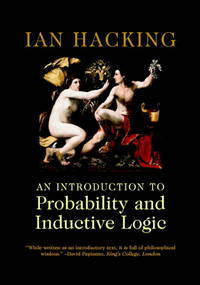
Stock photo: cover may vary
An Introduction to Probability and Inductive Logic Paperback - 2001
by Ian Hacking
Add to wish list
This is an introductory textbook on probability and induction written by one of the world's foremost philosophers of science. The book has been designed to offer maximal accessibility to the widest range of students (not only those majoring in philosophy) and assumes no formal training in elementary symbolic logic. It offers a comprehensive course covering all basic definitions of induction and probability.
Reader reviews for An Introduction to Probability and Inductive Logic
Write a review for this book
Important Terms and Guidelines
- Please focus on the book’s content and context. Also, add any personal comments as to how you enjoyed the book. Substantiate your likes and dislikes. You may make comparisons to other books.
- Reviews must be at least 140 characters in length.
- Please do not reveal critical plot elements.
- This is not a help line. Contact customer support if you need help.
Your review must not include:
- Obscenities, discriminatory language, or other insulting language not suitable for public domain
- Advertisements, “spam” content, or references to other products, offers or websites.
- Email addresses, URLs, phone numbers, physical addresses or other contact information.
- Overly critical comments about other reviews or reviewers
- Time-sensitive material (i.e. promotional tours, seminars, lectures, etc.)
- Availability, price, or alternative ordering/shipping information
From the publisher
First line
Most of the main ideas about probability come up right at the beginning.
Details
- Title An Introduction to Probability and Inductive Logic
- Author Ian Hacking
- Binding Paperback
- Edition First Edition
- Pages 322
- Volumes 1
- Language ENG
- Publisher Cambridge University Press, Cambridge, UK
- Publication date 2001-07-02
- Illustrated Yes
- Features Bibliography, Illustrated, Index
- ISBN 9780521775014 / 0521775019
- Weight 1.25 lbs (0.57 kg)
- Dimensions 9.9 x 6.9 x 0.8 in (25.15 x 17.53 x 2.03 cm)
- Category Philosophy
- Library of Congress subjects Induction (Logic), Probabilities
- Library of Congress Catalogue Number 00045503
- Dewey Decimal Code 160
More Copies for Sale
Stock photo: cover may vary
An Introduction to Probability and Inductive Logic
by Hacking, Ian
- Used
- Condition
- Used
- ISBN 10 / ISBN 13
- 9780521775014 / 0521775019
- Quantity available
- 1
- Seller
- Item price
-
A$30.03A$4.37 Delivery to USA
Show details
Add to wish list
Item price
A$30.03
A$4.37
Delivery to USA
An Introduction to Probability and Inductive Logic
by Ian Hacking
- Used
- Very good
- Paperback
- Condition
- Very good
- Binding
- Paperback
- ISBN 10 / ISBN 13
- 9780521775014 / 0521775019
- Quantity available
- 1
- Seller
- Item price
-
A$35.79Free Delivery to USA
Show details
Add to wish list
Item price
A$35.79
Free Delivery to USA
Stock photo: cover may vary
An Introduction to Probability and Inductive Logic
by Hacking, Ian
- Used
- Good
- Paperback
- Condition
- Good
- Binding
- Paperback
- ISBN 10 / ISBN 13
- 9780521775014 / 0521775019
- Quantity available
- 1
- Seller
- Item price
-
A$37.16A$8.73 Delivery to USA
Show details
Add to wish list
Item price
A$37.16
A$8.73
Delivery to USA
An Introduction to Probability and Inductive Logic
Ian Hacking
We're sorry, this copy is no longer available.
Stock photo: cover may vary
Introduction to Probability and Inductive Logic
by Ian Hacking,Hacking Ian
- Used
- Very good
- Condition
- Very good
- ISBN 10 / ISBN 13
- 9780521775014 / 0521775019
- Quantity available
- 1
- Seller
- Item price
-
A$51.00A$8.73 Delivery to USA
Show details
Add to wish list
Item price
A$51.00
A$8.73
Delivery to USA
Stock photo: cover may vary
An Introduction to Probability and Inductive Logic
by Hacking, Ian
- Used
- Paperback
- Condition
- Used
- Binding
- Paperback
- ISBN 10 / ISBN 13
- 9780521775014 / 0521775019
- Quantity available
- 1
- Seller
- Item price
-
A$54.48A$21.86 Delivery to USA
Show details
Add to wish list
Item price
A$54.48
A$21.86
Delivery to USA
Stock photo: cover may vary
An Introduction to Probability and Inductive Logic
by Hacking, Ian
- Used
- Paperback
- Condition
- New
- Binding
- Paperback
- ISBN 10 / ISBN 13
- 9780521775014 / 0521775019
- Quantity available
- 1
- Seller
- Item price
-
A$56.96A$7.27 Delivery to USA
Show details
Add to wish list
Item price
A$56.96
A$7.27
Delivery to USA
Stock photo: cover may vary
An Introduction to Probability and Inductive Logic
by Hacking, Ian
- Used
- Very good
- Paperback
- Condition
- Very good
- Binding
- Paperback
- ISBN 10 / ISBN 13
- 9780521775014 / 0521775019
- Quantity available
- 1
- Seller
- Item price
-
A$56.96A$7.27 Delivery to USA
Show details
Add to wish list
Item price
A$56.96
A$7.27
Delivery to USA
Stock photo: cover may vary
An Introduction to Probability and Inductive Logic
by Hacking, Ian
- Used
- Very good
- Paperback
- Condition
- Very good
- Binding
- Paperback
- ISBN 10 / ISBN 13
- 9780521775014 / 0521775019
- Quantity available
- 1
- Seller
- Item price
-
A$56.96A$7.27 Delivery to USA
Show details
Add to wish list
Item price
A$56.96
A$7.27
Delivery to USA
Stock photo: cover may vary
An Introduction to Probability and Inductive Logic
by Hacking, Ian
- New
- Paperback
- Condition
- New
- Binding
- Paperback
- ISBN 10 / ISBN 13
- 9780521775014 / 0521775019
- Quantity available
- 10
- Seller
- Item price
-
A$62.22A$21.86 Delivery to USA
Show details
Add to wish list
Item price
A$62.22
A$21.86
Delivery to USA
